
Speaking With Nimble’s William Adams
From the Original Pages
Click a page to enlarge · Alt-click to open the full issue
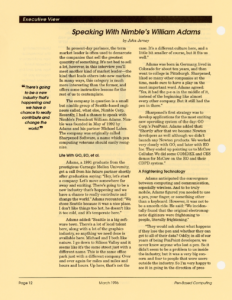
In present-day parlance, the term market leader is often used to demarcate the companies that sell the greatest quantity of something. It’s not bad to sell a lot, however, in this interview you’ll meet another kind of market leader—the kind that leads others into new markets. In many ways, this category is much more interesting than the former, and offers some instructive lessons for the rest of us to contemplate.
The company in question is a small but nimble group of Seattle-based engineers called, what else, Nimble Corp. Recently, I had a chance to speak with Nimble’s President William Adams. Nimble was founded in May of 1992 by Adams and his partner Michael Labes. The company was originally called Sharpened Software, a name which pen computing veterans should easily recognize.
Life With GO, EO, et al.
Adams, a 1991 graduate from the prestigious Carnegie Mellon University, got a call from his future partner shortly after graduation saying: “Hey, let’s start a company. Let’s move somewhere far away and exciting. There’s going to be a new industry that’s happening and we have a chance to really contribute and change the world.” Adams recounted: “We chose Seattle because it was a nice place. I don’t like things too hot, he doesn’t like it too cold, and it’s temperate here.”
“There’s going to be a new industry that’s happening and we have a chance to really contribute and change the world.”
Adams added: “Seattle is a big software town. There’s a lot of local talent here, along with a lot of the graphics industry, so anything we need done is available here. Michael and I both like nature. I go down to Silicon Valley and it seems like it’s the same street just with a different name. This is the same office park just with a different company. Over and over again for miles and miles and hours and hours. Up here, that’s not the case. It’s a different culture here, and a little bit smaller of course, but it fits us well.”
Adams was born in Germany, lived in Colorado for about ten years, and then went to college in Pittsburgh. Sharpened, liked so many other companies at the time, made sure to have a play on the most important word. Adams agreed: “Yes, it had the p-e-n in the middle of it, instead of the beginning like almost every other company. But it still had the pen in there.”
Sharpened’s first strategy was to develop applications for the most exciting new operating system of the day: GO Corp.’s PenPoint. Adams added that: “Shortly after that we became Newton developers as well although we didn’t launch any Newton products. We worked very closely with GO, and later with EO Inc. They ended up pointing us to McCaw Cellular. We did some COMDEX and CES demos for McCaw on the EO and their CDPD system.”
A Frightening Technology
Adams anticipated the convergence between computing and communication, especially wireless. And to be truly mobile, Adams figured you needed to use a pen, your finger, or something other than a keyboard. However, it was not to be a smooth ride. He said: “We incidentally found that the original electromagnetic digitizers were frightening to people, literally frightening.”
“They would ask about what happens if they lose the pen and whether they can get to all of their data? Oddly, in all of our years of being PenPoint developers, we never knew anyone who lost a pen. So it didn’t seem to be a problem to us inside the industry, but it was a very big concern and fear to people that were users outside the industry. So I’m very happy to see it in going in the direction of pressure-sensitive stylus input devices instead of electromagnetic.”
Still, notwithstanding the issue of lost pens, Adams was a fan of the early IBM ThinkPad 700T and 710T. He nostalgically remembered: “They had the best screens in my opinion, with the laser etched, teflon-coated displays. That was a real pleasure to use. I think that’s still my favorite screen.” Adams is right.
Like many early entrepreneurs, Adams’ understanding of the market was derived from his own personal experiences using technology and evaluating its shortcomings. One particular experience defined his goals concerning the utility of mobile computing devices. He recalled: “I once dropped my IBM 700T in a puddle while I was standing outside of a 7-11 store at a pay phone. It was almost completely submerged when I pulled it out, shook it off, and checked to see that it was still working. And I thought, yes, this is what we need. This is what everyone needs. They need something that’s indestructible, that they can take with them, and has everything they want on it.”
He continued: “But of course, I was standing at a pay phone, not using my machine as I should have because it didn’t have the ability to let me speak with someone directly. I had to use another mechanism to do that which was not as satisfying. You need to have the wireless connection.”
Pedestrian Market Research
Like many developers looking for something that was new and substantially different from either Windows or the Macintosh, Adams was impressed by PenPoint. He observed: “It was far ahead of its time. It was powerful and when people saw the machine and saw what it could do, they were impressed. But when they saw the price, they said, ‘ouch, that’s very expensive.'”
Adams identified that a large part of the problem with pen systems is that they tend to be up to two generations behind the current generation on the desktop. He commented: That’s definitely hurting things even today.”
Sharpened’s first product was called InOrder, which Adams described as a mix between a personal information organizer, an intelligent assistant, and a personal secretary. Describing the application, Adams noted: “Basically, the idea was for a replacement of sticky notes, the 3M Post-it note. We noticed that everybody, regardless of how meticulous, careless, or organized they were, had these stickies in the back of their DayTimer or on their desk, especially around the monitor.”
Of course people do this because memory tends to be very spatially-oriented, helping people remember important facts and events by where they are stored or where they occurred. Adams concurred. But more interesting than the product itself is how Sharpened determined the need. In some ways, this is perhaps the most interesting aspect of the technology industry—identifying the genesis of important ideas.
In the case of InOrder, Adams revealed the most unlikely of sources: “This was for the needs of an uncle of Michael’s. He had been teaching for some 30 years, was busy writing a book, and had this room full of crates. And each crate was a box full of little scraps of paper and, for half of them, he had no idea what they referenced. But here was this wealth of knowledge that he wanted to impart to other people and he couldn’t do it. So we wrote this product for people like him who spend a lifetime acquiring information and then can’t find their own information to share with other people.”
“Every afternoon in the summer, I would walk down the street with my ThinkPad and, often at night since it had a brilliant backlit screen, stop joggers and show them the software and what it could do. From this, I’d get an idea of what these completely random people wanted.”
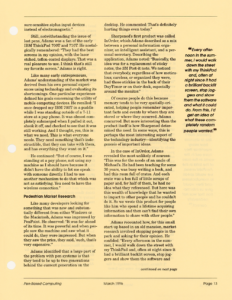
Adams recounted how, for this small start-up based in an old mansion, market research involved stopping people in the park and asking for their opinion. He confided: “Every afternoon in the summer, I would walk down the street with my ThinkPad and, often at night since it had a brilliant backlit screen, stop joggers and show them the software and what it could do. From this, I’d get an idea of what these completely random people wanted.”
From this, Adams was able to determine that people want to be connected, to get at their information quickly, and to do it without being burdened by a complicated system. Having built the better mousetrap, Adams himself felt a bit trapped in trying to sell it. He explained: “It was received very well by our customers, but we sold what we considered to be not very many of them. I stayed up late nights looking at the stars, trying to figure out what we were doing wrong; how we weren’t selling these pieces of software.”
Sleepless in Seattle
As it turns out, Adams spent some unwarranted sleepless nights since the market was not exactly what he had be told by various hardware manufacturers. He revealed: “We sold in the hundreds of units. However, we discovered a year or two later that the market was only a tenth the size of what we had been told. And for that size of the market, our efforts were in line with what they should have been.”
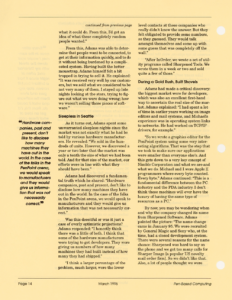
“Hardware companies, past and present, don’t like to disclose how many machines they have out in the world. In the case of the folks in the PenPoint arena, we would speak to manufacturers and they would give us information that was not necessarily correct.”
Adams had discovered a fundamental truth which he shared: “Hardware companies, past and present, don’t like to disclose how many machines they have out in the world. In the case of the folks in the PenPoint arena, we would speak to manufacturers and they would give us information that was not necessarily correct.”
Was this deceitful or was it just a case of overly optimistic projections? Adams responded: “I honestly think there was a little of both. I think that some of the hardware manufacturers were trying to get developers. They were giving us numbers of how many machines they had built instead of how many they had shipped.”
“I think a larger percentage of the problem, much larger, were the lower level contacts at these companies who really didn’t know the answer. But they felt obligated to provide some numbers, so they guessed. They would talk amongst themselves and come up with some guess that was completely off the wall.”
“After InOrder, we wrote a set of utility programs called Sharpened Tools. We wrote them in a week or two and sold quite a few of those.”
During a Gold Rush, Built Shovels
Adams had made a critical discovery: the biggest market were for developers, which was also an excellent first-hand way to ascertain the real size of the market. Adams explained: “I had spent a lot of time in earlier years working on image editors and mail systems, and Michael’s experience was in operating system links to networks. He had worked on TCP/IP drivers, for example.”
“So we wrote a graphics editor for the PenPoint system using some very interesting algorithms. That was the step that we took to make sure our applications were smaller than everyone else’s. And this gets down to a very key concept of Nimble Corporation and what we are and what we do. Michael and I were Apple ][ programmers where every byte counted. Every byte.” Adams continued: “This is a fundamental difference between the PC industry and the PDA industry. I don’t think these machines will ever have the luxury of having the same type of resources as a PC.”
By now, you may be wondering when and why the company changed its name from Sharpened Software. Adams painted the picture: “The name change came in January 95. We were recruited by General Magic and Sony who, at the time, had a closed development system. There were several reasons for the name chance: Sharpened was hard to say on the phone and we got too many calls for Sharper Image [a popular US novelty mail order firm]. So we didn’t like that. Also, a lot of people thought we were associated with Sharp or they would say sharp-en or sharp-ed but not Sharpened.”
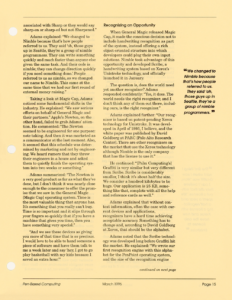
“We changed to Nimble because that’s how people referred to us. They said ‘oh, those guys up in Seattle, they’re a group of nimble programmers.”
Adams explained: “We changed to Nimble because that’s how people referred to us. They said ‘oh, those guys up in Seattle, they’re a group of nimble programmers. They can write something quickly and much faster than anyone else given the same task. And their code is nimble; they can change direction quickly if you need something done.’ People referred to us as nimble, so we changed our name to Nimble. This came at the same time that we had our first round of external money raising.”
Taking a look at Magic Cap, Adams noticed some fundamental shifts in the industry. He explained: “We saw serious efforts on behalf of General Magic and their partners.” Apple’s Newton, on the other hand, failed to grab Adams’ attention. He commented: “The Newton seemed to be engineered for one purpose: note taking. And then it was marketed as a communicator at the last moment. Also, it seemed that this schedule was determined by marketing and not by engineering. We heard rumors that they threw their engineers in a house and asked them to quietly finish the operating system into two weeks or something.”
Adams summarized: “The Newton is a very good product as far as what they’ve done, but I don’t think it was nearly close enough to the consumer to offer the promise that we saw in the General Magic [Magic Cap] operating system. Time is the most valuable thing that anyone has. It’s something that you really can’t buy. Time is so important and it slips through your fingers so quickly that if you have a machine that gives you time, then you have something very special.”
“And we see these devices as giving you more of that time that is so precious. I would love to be able to hand someone a piece of software and have them talk to me a week later and say ‘hey, I got to go play basketball with my kids because I saved an extra hour.'”
Recognizing an Opportunity
When General Magic released Magic Cap, it made the conscious decision not to include handwriting recognition as part of the system, instead offering a rich object-oriented structure into which developers could plug their own input solutions. Nimble took advantage of this opportunity and developed Scribe, a handwriting system based on Xerox’s Unistroke technology, and officially launched it in January.
The question is, does the world need yet another recognizer? Adams responded confidently: “Yes, it does. The world needs the right recognizer, and I don’t think any of them out there, including ours, is the right recognizer.”
Adams explained further: “Our recognizer is based on patent-pending Xerox technology for Unistroke. It was developed in April of 1993, I believe, and the white paper was published by David Goldberg at PARC [Palo Alto Research Center]. There are other recognizers on the market that use the Xerox technology although Nimble is the only company that has the license to use it.”
He continued: “[Palm Computing’s] Graffiti is very similar but very different from Scribe. Scribe is considerably smaller, I think it’s about half the size. We consider a hundred kilobytes to be huge. Our application is 25 KB, something like that, complete with all the help and reference cards as well.”
Adams explained that without context information, often the case with current devices and applications, recognizers have a hard time achieving acceptable accuracy. Something has to change and, according to David Goldberg at Xerox, that should be the alphabet.
Adams noted that the Scribe technology was developed long before Graffiti hit the market. He explained: “We wrote our first recognition engine with this alphabet for the PenPoint operating system, and the size of the recognition engine with the lookup table was 1132 bytes. With the interface and everything, it was just about 3 KB. So we had a completely functioning, hundred percent accurate character recognition system in less than 3 KB.”
“The first thing I said when I saw Graffiti was ‘Wow, I can’t believe they did that without a license.’ We spent a year and a half negotiating a license with Xerox and now have the only license to Unistroke.”
Adams continued to puzzle about the patent issue as it relates to Xerox and Unistroke. He recalled: “The first thing I said when I saw Graffiti was ‘Wow, I can’t believe they did that without a license.’ This means that if the patent is issued, you need a license to use the technology. We spent a year and a half negotiating a license with Xerox and now have the only license to Unistroke. That’s one difference, as far as the license goes, but we believe we have a fundamentally stronger product regardless of the license.”
Creating a New Channel
One of the challenges in this early market is establishing one or more channels to potential customers. Nimble faces the same problem but, unlike many, has decided to do something about it. Adams explained: “So many people in the industry say that in a number of years we’ll get there. There will be machines, and there will be software, and the industry will become big. But there’s one thing missing from all of those statement and that is, who is going to get us there? Who is going to make the industry big?”
“Well, I’m convinced that you can’t sit around and wait for this to happen. We can’t afford to wait for it to happen, so we must make it happen ourselves. We realized that a person probably wouldn’t buy a piece of hardware if he or she knew that for the next year, you couldn’t have any software for it other than what came with it, because it was too expensive for software vendors to distribute their software to you. The single most evident piece that was missing was the channel for distribution.”
Adams continued: “So about a year and a half ago, we said we’re sick and tired of this. We’re going to do it if no one else is because sooner or later someone will, so why not do it sooner than later. We think we know how, so we’ll give it a shot. Among our core competencies is our experience in communications-centric applications, so we had our perfect group for this type of development.”
The result of this is one of Nimble’s most exciting products: Outfitters Direct. Adams described it: “It’s a catalog shopping system that, unlike any other software distribution system that we know of, runs offline instead of online. You connect the system and your machine downloads the catalog. It’s all automated. You can get the software by floppy, but the catalog has to come over the modem.”
“After this, you unplug your phone line and you browse the catalog on your own time offline, including reading the product descriptions. Catalog updates are free and, if you want, can get one every five minutes, everyday, all year. It’s an 800 number, so you don’t pay there either. Outside the United States, however, you have to pay for the international call. There are no monthly fees, there are no download fees, there are really no fees at all.”
Adams stressed that Outfitters Direct is completely transparent to the consumer and offers very little barrier. He commented: “People aren’t going to use this if there are fees and hidden costs. The software itself for Outfitters Direct is free. You can spend half an hour on your way to San Jose flipping through the catalog, finding products that you want, and when you get to the other end, plug the phone back in and go take a shower. By the time you come back, all your software is loaded onto your machine and the transaction is finished. It’s all paid for and you’re done. You’re ready to go.”
Adams is confident about Outfitters Direct, but stated that the jury is still out concerning user’s reaction to it and whether they will continue to demand a more tangible interaction with their software retailer. However, he is convinced that developers will appreciate the business model which includes a retail margin but not as large.
Adams expanded: “We have a retail margin just like a normal store, but much smaller. And we have a delivery fee for any piece of software that is directly related to the size, so as your application grows, the delivery fee for it grows. That covers the modem time that it takes us to get it to the client.”
The Fine Print
Getting into the details, Adams observed that Outfitters Direct has a 35% retail margin while, for a store: “it’s usually 50% plus a 5 or 10% marketing coop. Plus you pay shipping to get your product there and you pay to get it back if they want to give it back to you. You have to take returns. In addition, the Outfitters Direct system includes the ability to do physical distribution. So if you have a product that has a manual that needs to be shipped, or a PC card, or whatever the case may be, we can download the software portion to the machine. Then we can send you in the mail, or have the vendor send you in the mail, the rest of the goods.”
“This is really great because it changes your communicator or your PDA from a box to a tool. You now have access to software that makes your machine do what you want to do. It’s no longer the same as your friend’s PDA and his friend’s PDA.”
Adams enthusiastically concluded: “This is really great because it changes your communicator or your PDA from a box to a tool. You now have access to software that makes your machine do what you want to do. It’s no longer the same as your friend’s PDA and his friend’s PDA.”
Nimble is happy to use established technology where available, but in this case, opted for a homegrown solution. Adams noted: “Our communication is intelligent and we have our own proprietary system. Telescript was too heavy for what we were doing. We needed a very light system, very light-weight, and what we have is a very light-weight client.”
Currently, Outfitters Direct is only available for Magic Cap-based devices, such as the Sony Magic Link and Motorola Envoy. However, Adams sees his system as being both suitable and desirable for the range of personal digital assistants available including Apple’s Newton.
Adams stressed: “This is a distribution channel for PDAs. At this particular moment in time, there is a Magic Cap client but this will grow as time goes by. We need to make sure that distribution is available for all PDAs. This brings up a very important point about vertical systems. Verticals are a very different world than the horizontal, but it’s still a piece of software like any other piece of software. We’re finding a lot of interest in the vertical community from companies that want to put all their updates and bug fixes on Outfitters Direct to make sure that they have access for their customers.”
Outfitters Direct also offers the intriguing option of targeted promotions and sales. Adams explained that: “It can be done through a custom catalog. We can tell each machine apart, we can tell what kind of machine they have, and we know how much free memory they have because we have to make sure that the applications they order will fit. So we can provide custom catalogs. We know who they are when they connect.”
Adams noted that Outfitters Direct is already customized based on the platform, so that Sony PIC-2000 users today have a different catalog than PIC-1000 users. Likewise, these users have a different catalog than Motorola Envoy users.
Already labelled as one of the most exciting Magic Cap developers, Nimble doesn’t plan to sit still. Adams predicted: “We have an idea of where we want to be one, two, and five years from now. We want to help make sure that these machines are as easy to use as they can be. We’ve seen people pick up their machines, be really happy, and really get a lot from it.”
“It’s very satisfying both for them and for us. And I really want to see that happen. We’re working very hard to make that happen. You’ll see a lot in the future from Nimble.”
William Adams
Nimble Corporation
President
Suite 203
Seattle, WA 98109
(206) 340-4400
(206) 340-8755 (fax)
[email protected]
Transcribed from Pen-Based Computing, Volume 6, Number 3 — March 1996. Pages 12, 13, 14, 15, 16, 17.