Palm Graffiti (for Newton) Package
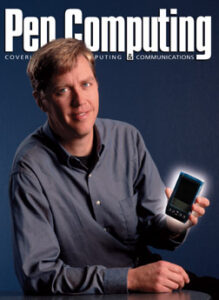
Graffiti was a single-stroke shorthand handwriting recognition system developed by Jeff Hawkins (Palm Computing).
By using a simpler alphabet, computers could easily recognize handwriting. Hawkins believed that people would take the time to learn Graffiti just as people learn to touch-type. Hawkins recalled his insight: “And then it came to me in a flash. Touch-typing is a skill you learn.”
(Source: Wikipedia)
Were you involved with this artifact? If so, we would like to include your story on this page. Let us know how you contributed.
Artifact Details
Graffiti for Newton
Palm Computing, Inc.
United States
English
1994
Original package with incomplete contents.
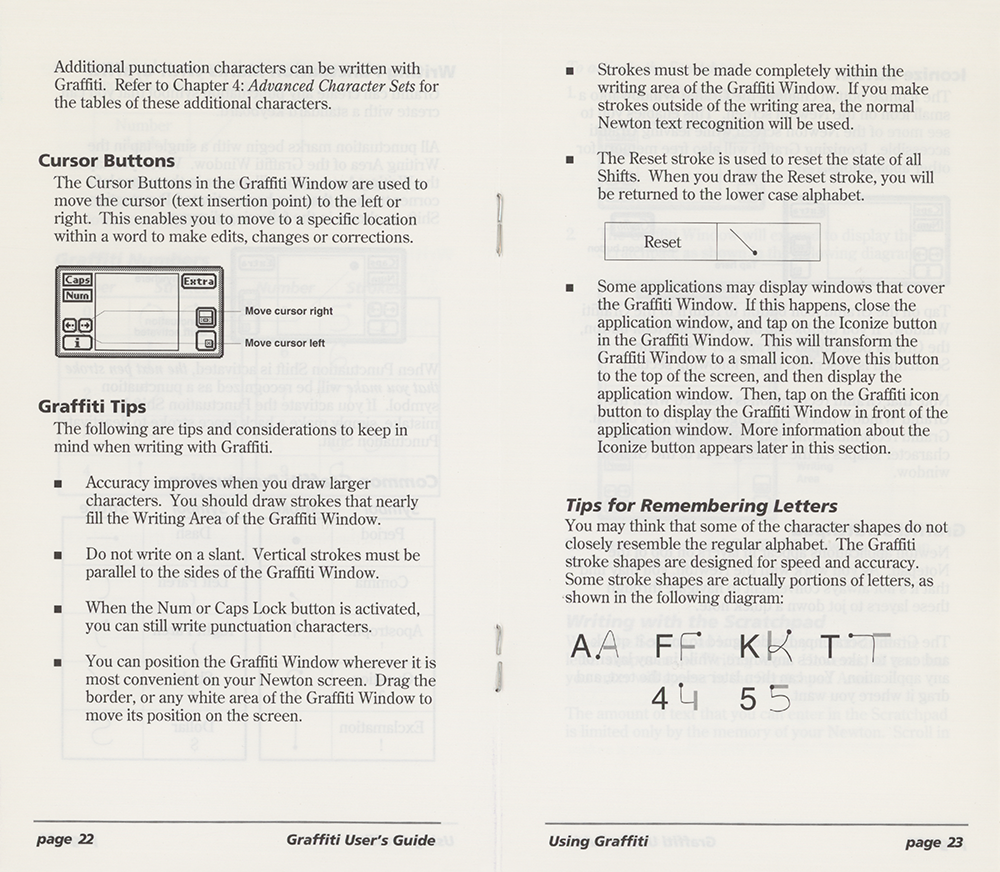
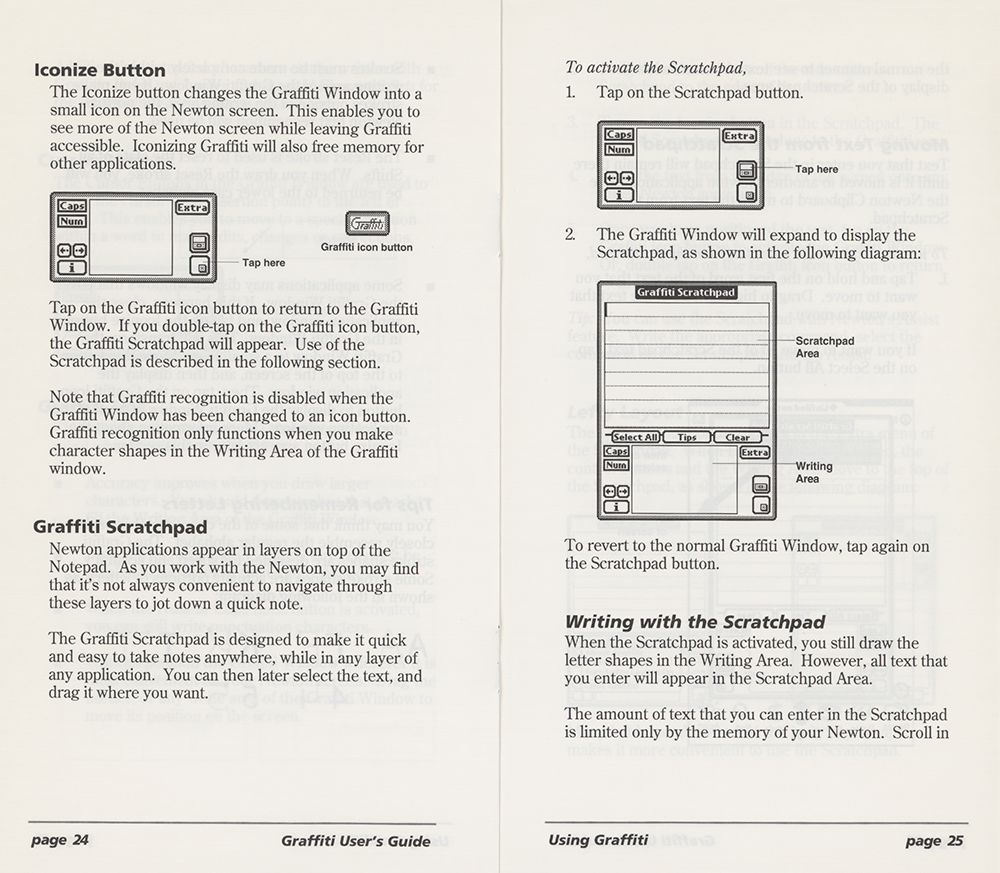
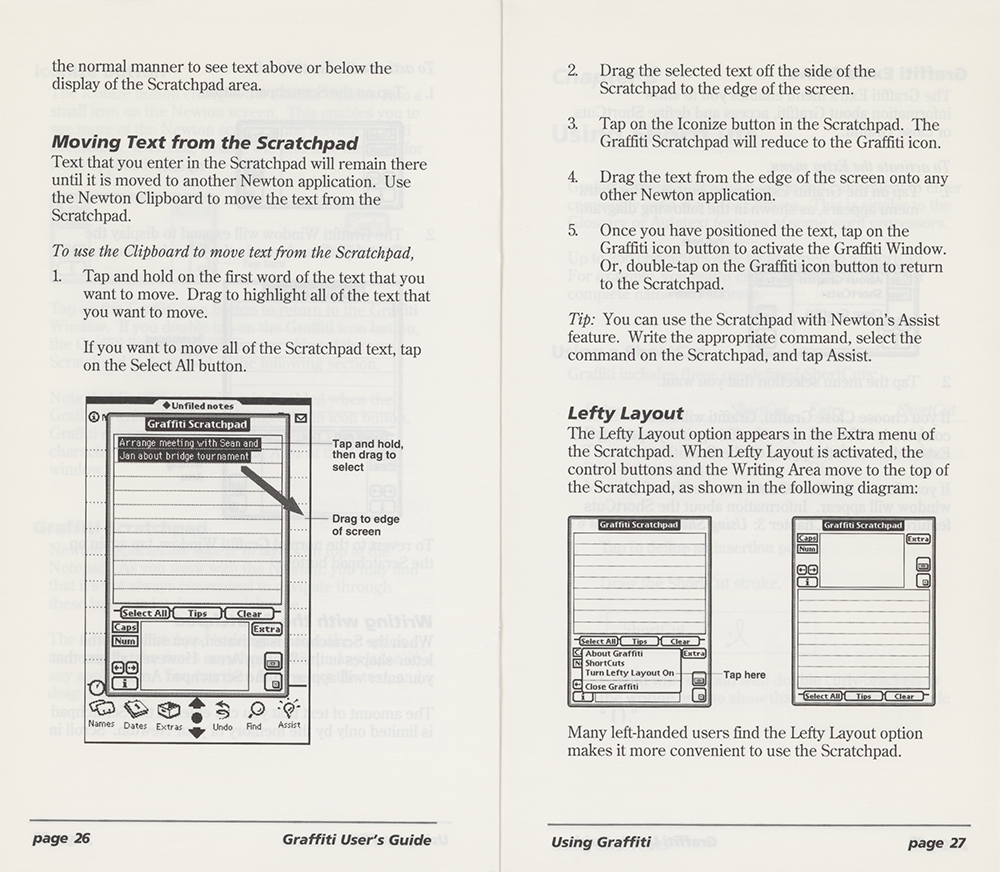
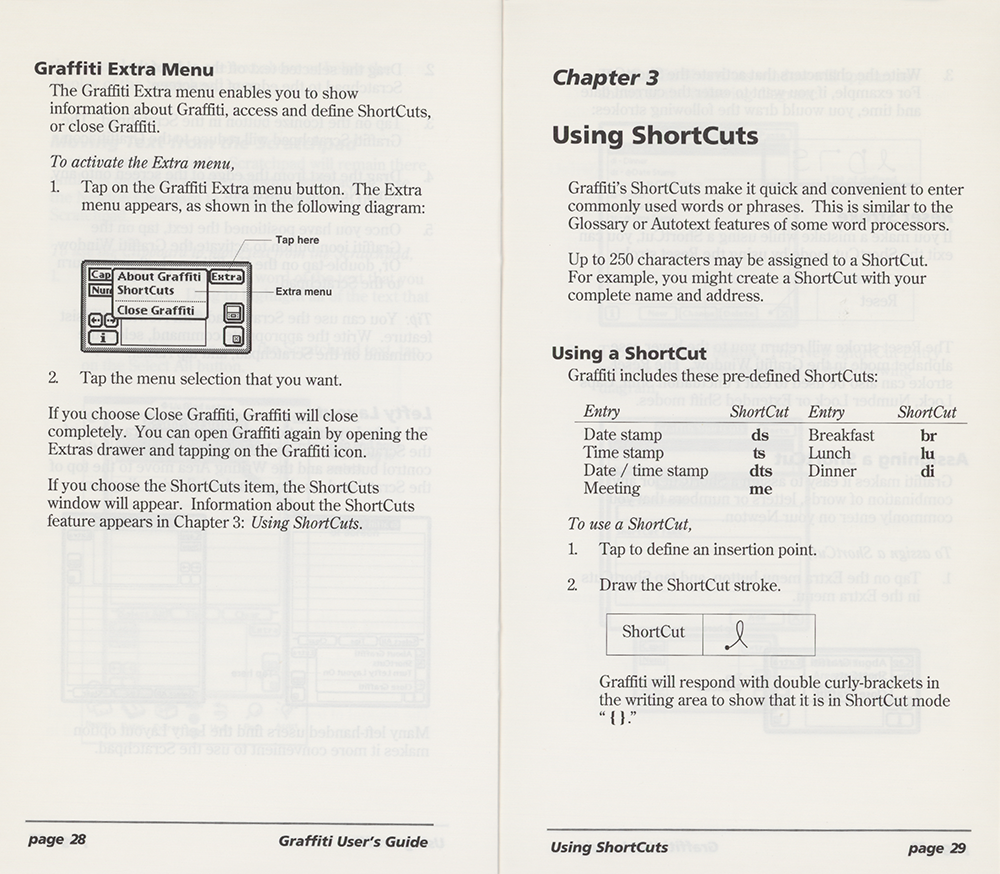
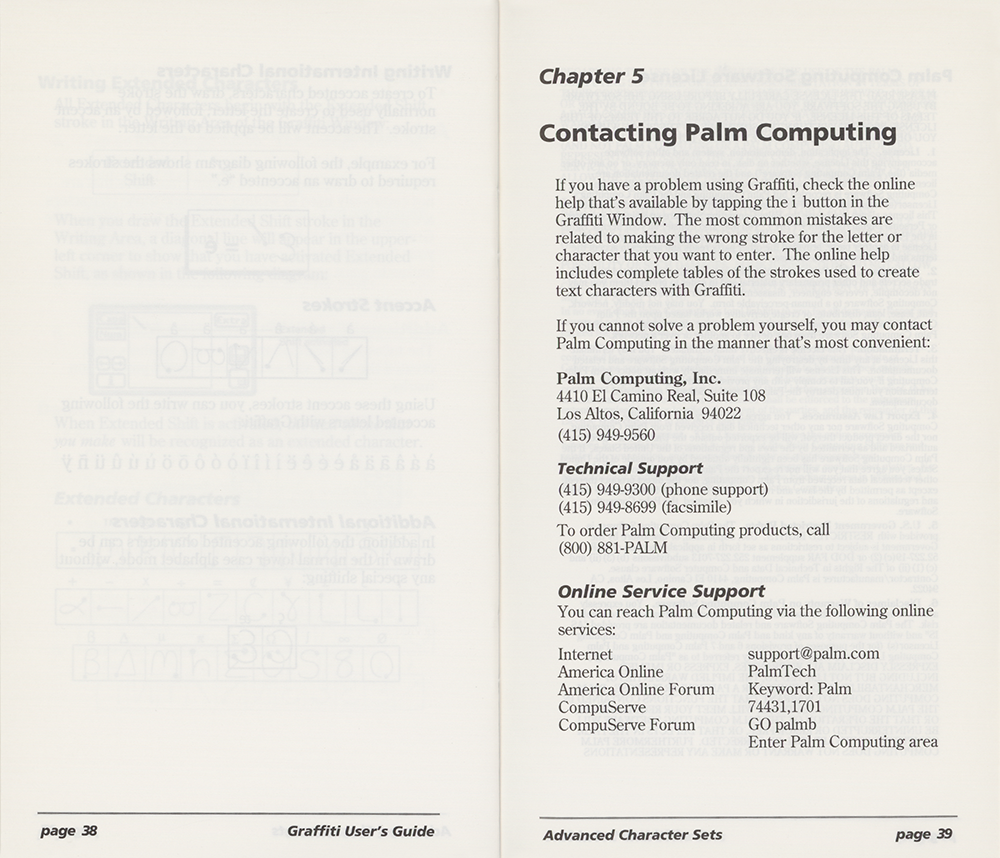
Graffiti User's Guide, Graffiti reference card, card holder, reference card installation, 5.25" disk request form, CompuServe invitation, and registration card. 3.5" DOS diskette missing.
5.75" x 7" x 1"
P2000
d356e51ab109a146
1994
Acquired from developer
2018-05-17
2
Organizations
People
Associated Products
Original Press Release
Palm Computing delivers major advance in handwriting recognition technology
Sept. 19, 1994 -- Palm Computing Monday announced Graffiti power writing technology, a new method of entering text into handheld computers with a pen.
Graffiti will support all major pen-based computing platforms including Apple's Newton, General Magic's Magic Cap, GEOS from Geoworks, Microsoft Windows for Pen Computing, Microsoft Winpad and PenRight! Current shipping Personal Digital Assistants (PDAs) which will take advantage of Graffiti add-on software include the Apple Newton MessagePad, AST Gridpad 2390, Casio Z-7000, Sharp Expert Pad PI-7000 and Tandy Z-PDA Zoomer.
Graffiti represents a major advance in handwriting recognition technology by delivering instant and accurate recognition.
Graffiti works with a simplified version of the existing alphabet. The user enters pre-defined strokes for each letter, Graffiti then translates that stroke into the corresponding text character on the computer screen. Testing has revealed that most users can learn to enter these strokes fast enough to achieve more than 30 words per minute with 100% accuracy.
Because Graffiti works with a basic modification of the existing alphabet, most users become competent with Graffiti in less than 20 minutes.
Graffiti is being supported as an optional text entry method by a wide range of handheld computing developers including: Apple Computer, Casio Corp., Hewlett Packard, Motorola, Sharp Electronics and Tandy Corp.
"Palm Computing's introduction of Graffiti marks an important milestone in the development of the mobile communications market," said Rhonda Dirvin, director PDA marketing, Motorola Personal Portable Systems. "Motorola is excited about the reliability and flexibility of this new handwriting recognition and believes Graffiti will be a key enabling technology for a variety of handheld communications devices."
High Speed and Accuracy Reduces User Frustration
By increasing the uniqueness of each character, Palm has developed a system which is highly accurate, therefore addressing the major frustration of current handheld computer users: predictability. If the correct strokes representing a letter in the alphabet are entered, users will achieve 100% recognition accuracy.
Graffiti's efficient pattern recognition algorithm combined with the simplified alphabet provide almost instant character recognition on all supported systems. This results in an immediate response for the user.
Each time the user writes a stroke, the electronic ink is instantly translated into a text character. The user gains control by immediately verifying the information, which provides the opportunity to instantly correct mistakes. The sensation of using Graffiti is very similar to typing on a keyboard. When the user hits a key (strokes a character) a letter appears on the screen.
Graffiti Allows Users to Write Almost Any Character
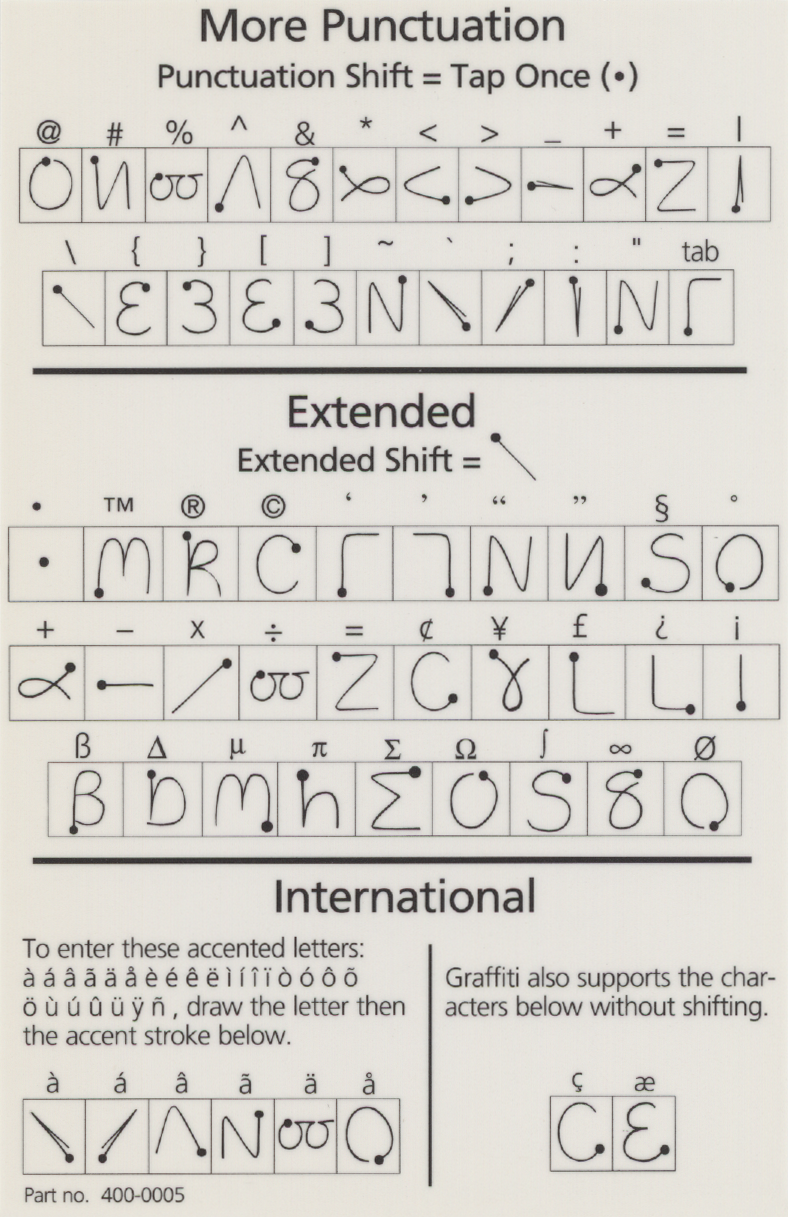
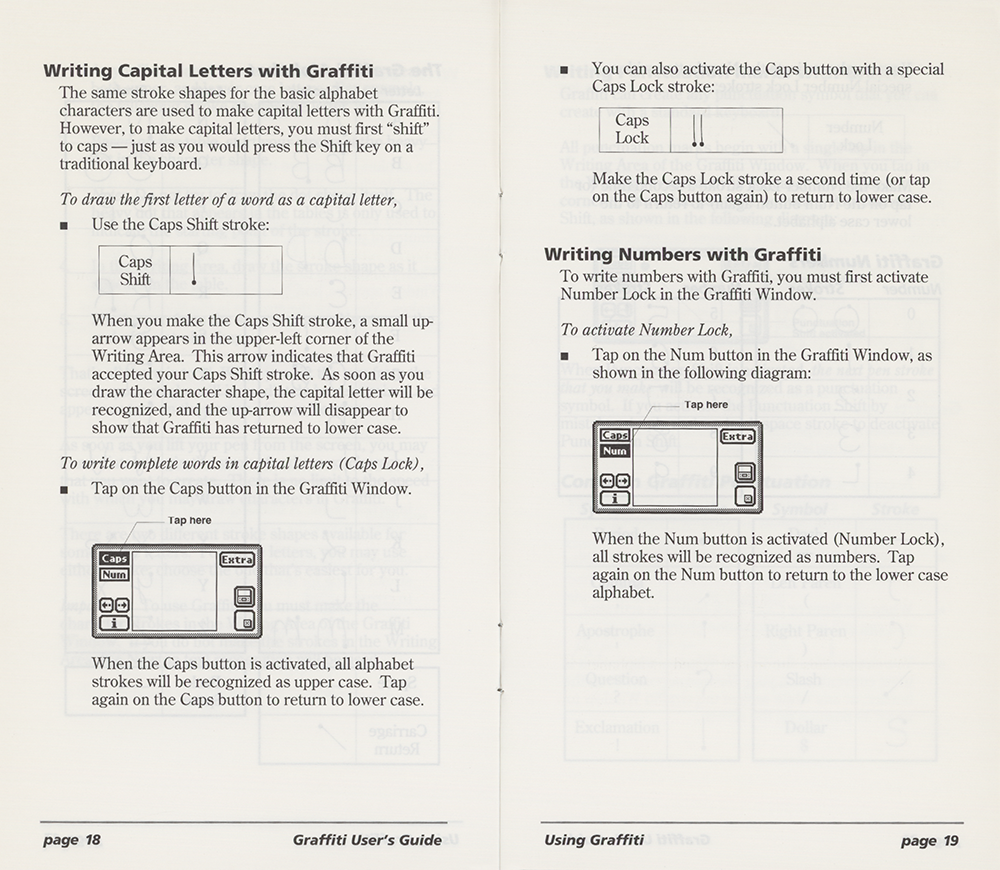
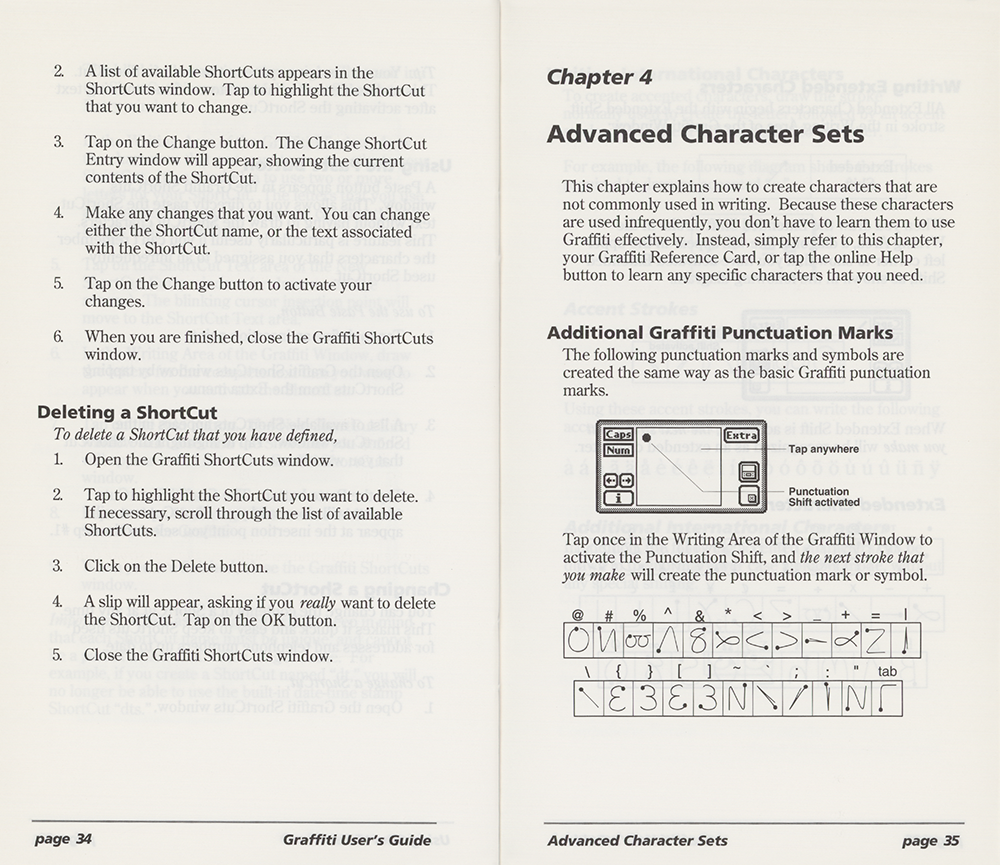
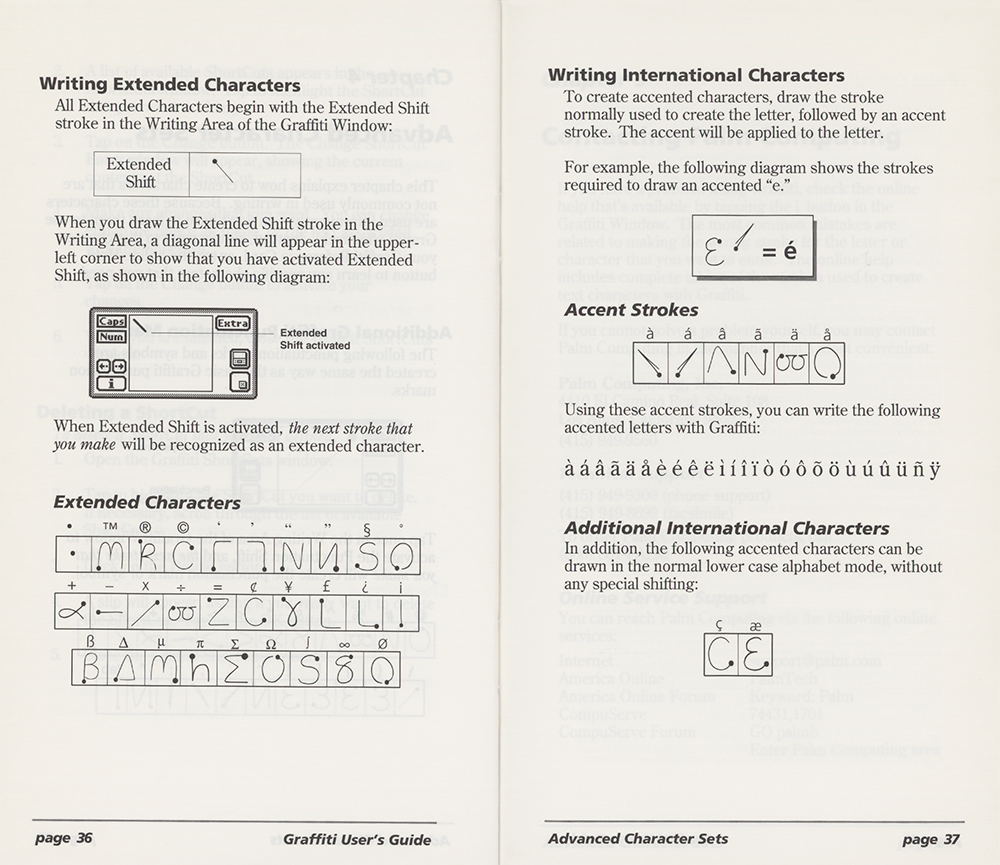
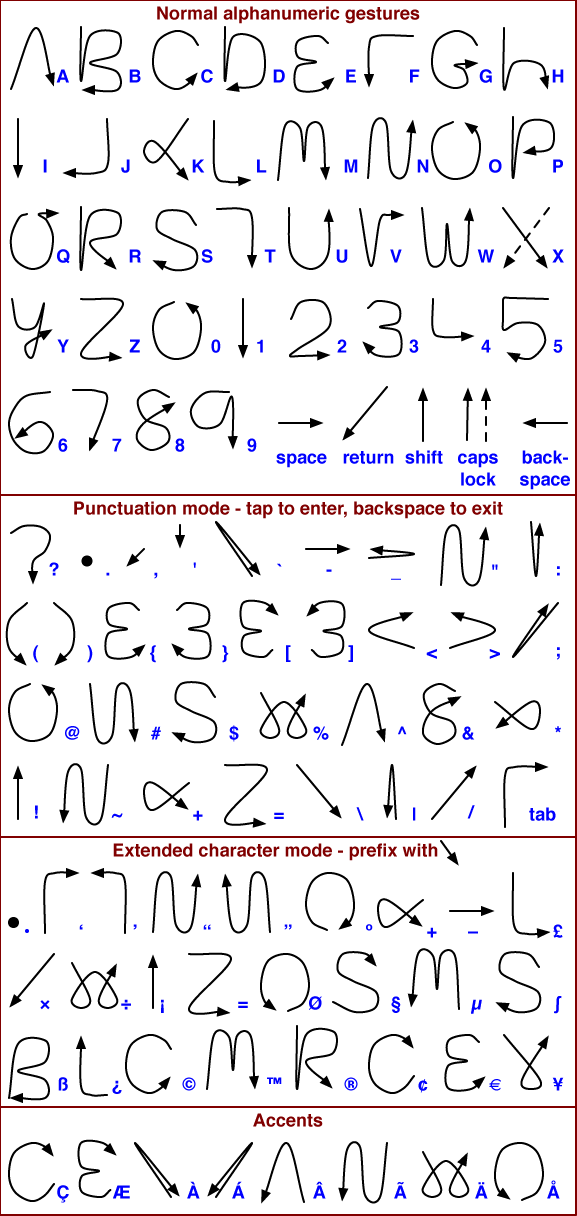
Graffiti covers many characters which are impossible to achieve with current recognition technology including accented characters, punctuation and symbols. Capitalization, punctuation, numbers and symbols are handled similarly to a keyboard. When the user wants to input a capital letter in Graffiti, they "shift" Graffiti into uppercase through a simple upstroke.
The letter following the upstroke is then capitalized. Graffiti has shifts for caps lock and numbers, enabling users to enter strokes similar to the actual characters of the Roman alphabet without confusing a "1" and an "I", or a "5" and an "S". These strokes are never confused by the Graffiti system.
"We've been very impressed with the completeness of the Graffiti system," said Richard C. Watts, vice president and general manager of Hewlett Packard's Personal Information Products Group. "Graffiti provides easy access to accented characters, symbols and punctuation which are difficult to achieve with standard recognition systems."
Graffiti Enables Future Generation of Pocket Sized Devices
Because Graffiti provides an immediate response to each stroke of the pen, user do not need to write out words or sentences, but rather can write one character on top of another. By not looking at the screen, the Graffiti user can concentrate on the speaker or the document they are transcribing. Further, since the user can write in a small area on the screen, wide acceptance of Graffiti may result in the development of smaller devices with smaller screens for entering data.
"Graffiti is a significant technology breakthrough which enables development of pocket-sized devices with robust data input capabilities," said Doug Brackbill, vice president, Mtel Advanced Applications Group. "We think Graffiti will spur the growth of new markets for wireless messaging."
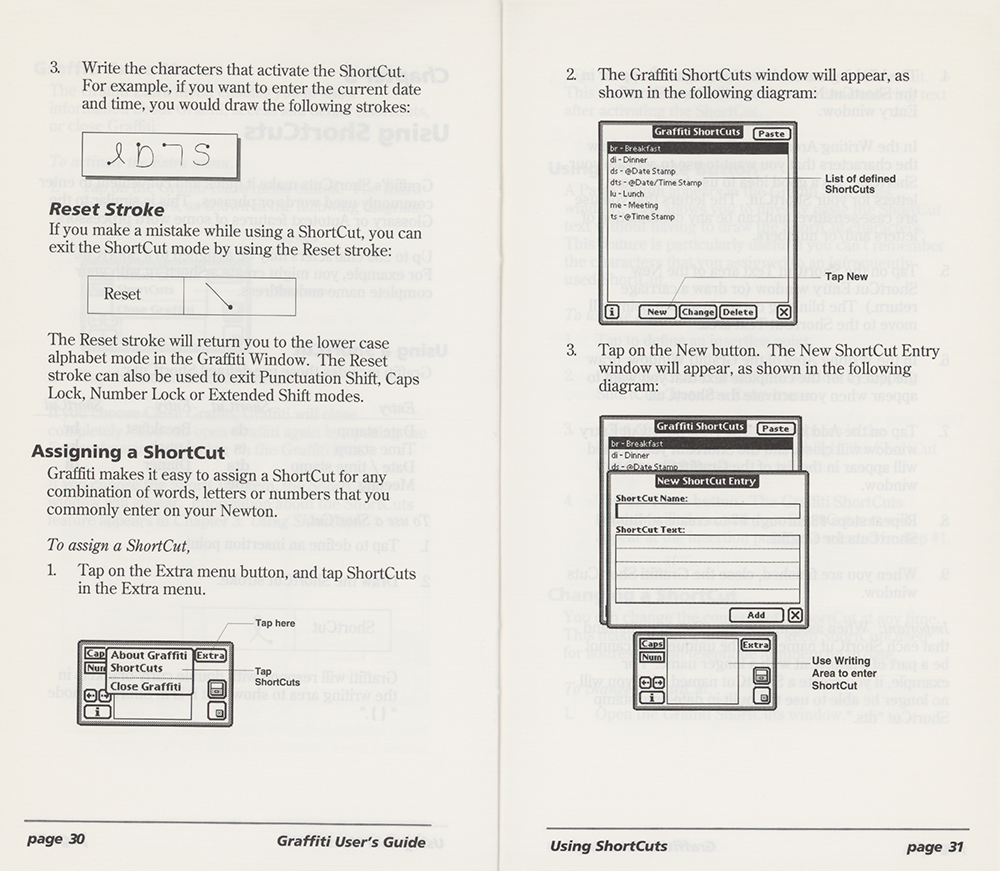
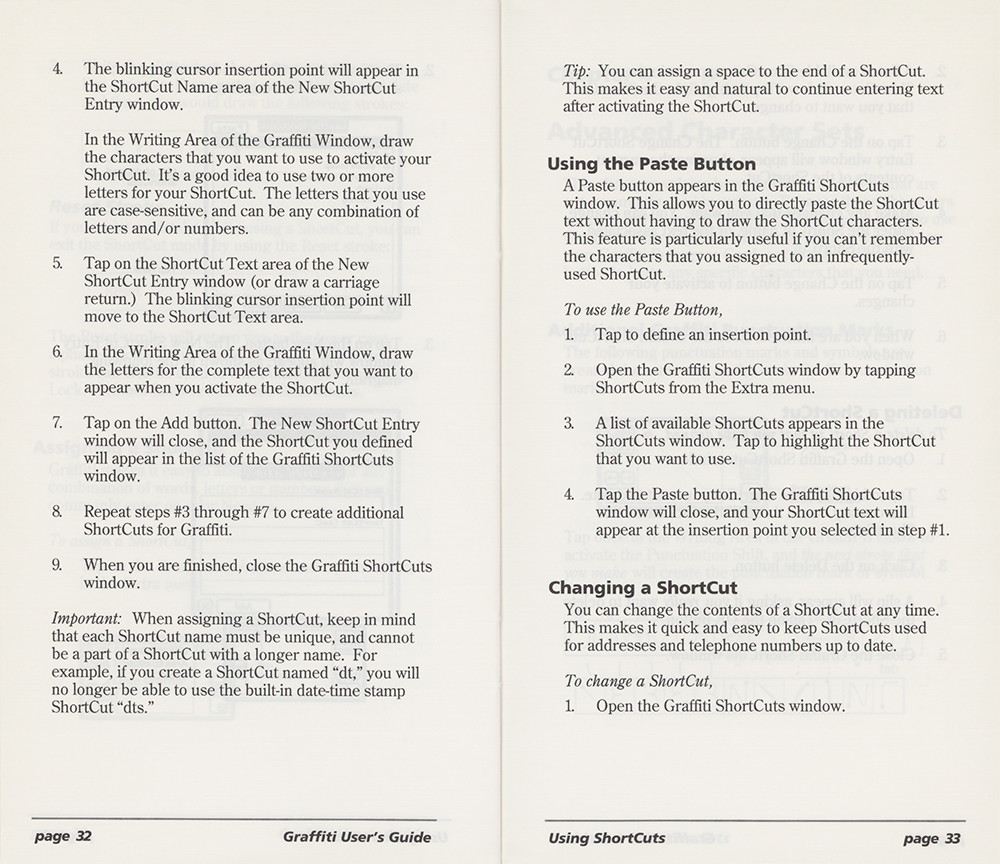
Through the use of Graffiti's ShortCuts, large blocks of text can be entered into the system with a few pen strokes. With ShortCuts a user can build a library of frequently used phrases, and easily recall any of them with a few strokes of the pen. For instance, the user may create a thank you note which they often fax to customers. By inputting the ShortCuts "shift" stroke and, for example, "th" for thank you, Graffiti will recall the entire predefined block of text.
Graffiti User Testing Shows High Level of Satisfaction
Palm Computing conducted extensive user testing with Newton and Zoomer owners, as well as non-PDA users. Ninety five percent of test subjects who owned a Newton or Zoomer wanted Graffiti after testing. Ninety seven percent of the Graffiti alphabetical characters were recalled by users after a week of non-use. Several device manufacturers have conducted their own user testing and found similar results.
"Our Graffiti user testing has been overwhelmingly positive," said Ed Colligan, vice president marketing for Palm Computing. "Nearly all users tested learned the system in under 20 minutes and became proficient in less than 2 hours. Most users showed an extremely high level of satisfaction. These results lead us to believe that Graffiti will become a major method of data entry for pocket-sized computers."
Graffiti is based on Palm's patented recognition algorithms. Palm has other patents pending on broad elements of Graffiti's unique functionality.
Product, Pricing and Availability
Graffiti includes the core recognition software which users download to their handheld device, and an online tutorial and help system. A trial copy of Graffiti is available directly from Palm Computing by calling 800/881-PALM or through America Online, Compuserve or the Internet. Graffiti is priced at $79 and is immediately available for the GEOS and Magic Cap platforms by calling 800/881-PALM.
Graffiti for Newton will be available Q4 1994 direct from Palm Computing and wherever Newtons are sold. Graffiti for PenRight! is available to potential vertical customers for evaluation. Graffiti for Windows for Pen Computing and Winpad are under development and slated for release next year.
Palm Computing is the leading independent provider of application software for consumer focused handheld computers. Headquartered in Los Altos, its products include personal information management applications, desktop to handheld computer connectivity software, PalmPrint handwriting recognizer and Graffiti power writing technology.
CONTACT:
Palm Computing Inc., Los Altos
Ed Colligan, 415/949-9742
Cathy Cain, 415/949-9874
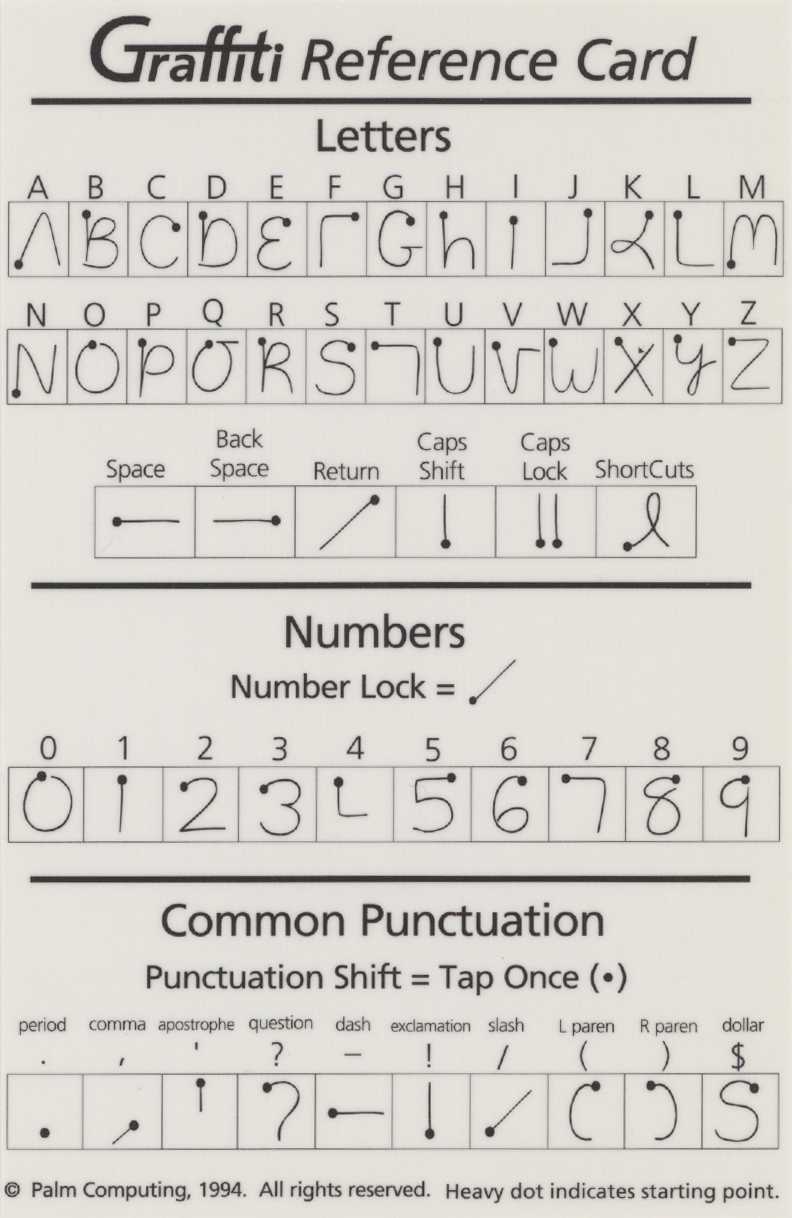
Graffiti Gestures
(Source: Wikipedia)
History
The Palm Graffiti (for Newton) Package is the boxed retail release of Graffiti, the single-stroke handwriting-recognition software that Palm Computing, Inc. produced for Apple's Newton MessagePad and printed in the United States in late 1994.1 Palm Computing had been founded in 1992 by Jeff Hawkins, formerly vice president of research at GRiD Systems Corp., where he was the principal architect of the company's pen computers and the developer of PalmPrint, then the most widely used handwriting recognizer for pen machines.2 Before starting Palm, Hawkins had initiated the collaboration between Casio, Tandy and Geoworks that produced the Zoomer PDA,2 and the company introduced its PowerInk ink-and-text technology in the Zoomer handhelds that Casio and Tandy shipped in 1993.3
Hawkins was a public skeptic of conventional handwriting recognition. In a September 1993 talk titled Will Handwriting Recognition Ever Work?, delivered at the Agenda '94 conference in Phoenix, he argued that the pen was a poor instrument for transcribing ordinary handwriting and urged developers not to rely too heavily on recognition, while hinting at new input methods that would appear the following year.2
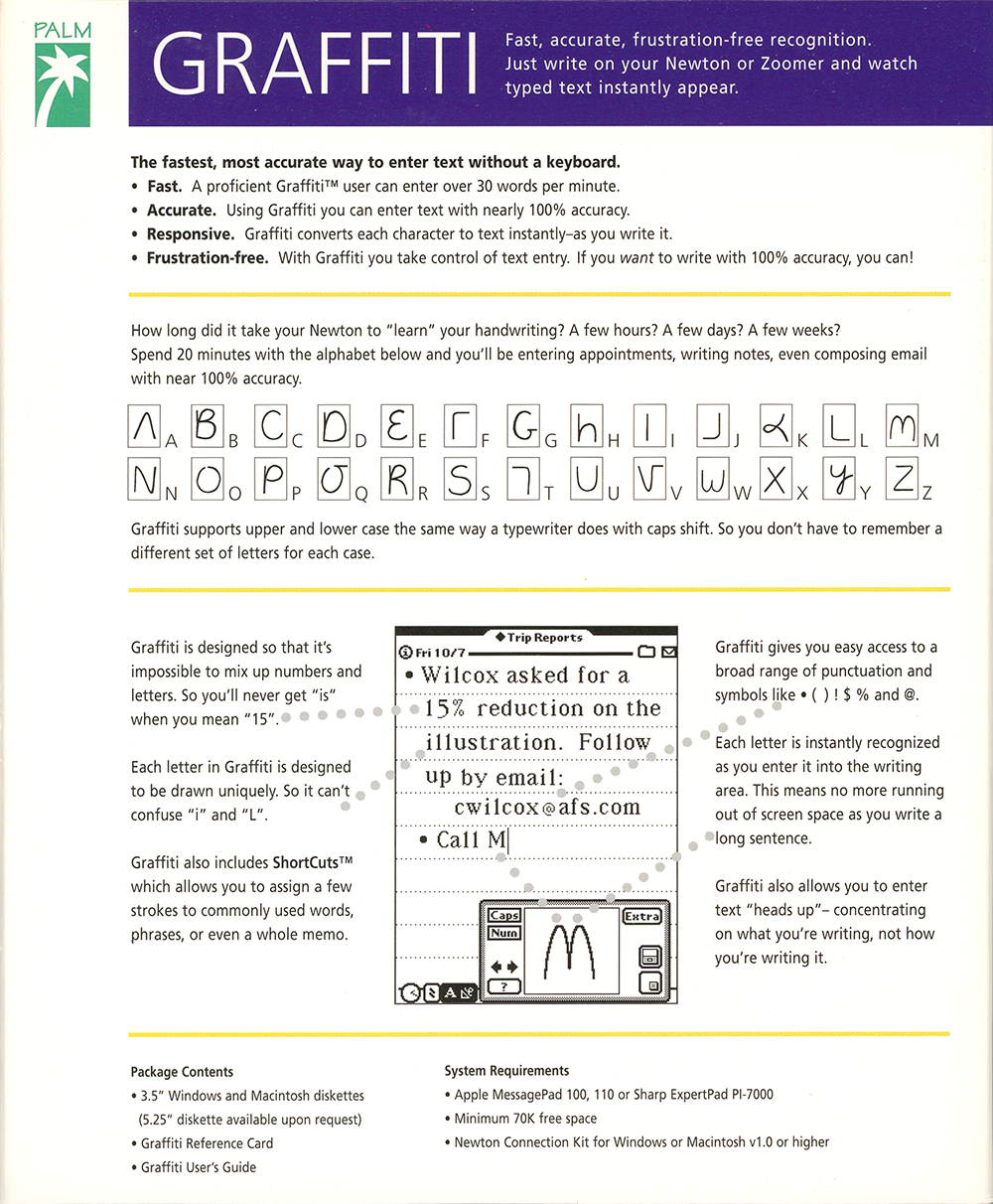
That method was Graffiti, which Palm announced on September 19, 1994 as a new way of entering text into handheld computers with a pen.4 In place of the cursive alphabet, Graffiti used a set of pre-defined single strokes that the software translated instantly into text characters, and Palm's testing found that most users learned the system in under 20 minutes and could exceed 30 words per minute with full accuracy when the correct strokes were entered.4 Priced at $79, Graffiti was offered as an add-on for Apple's Newton, General Magic's Magic Cap, Geoworks' GEOS and other pen platforms, with the Newton version slated to ship in the fourth quarter of 1994.4
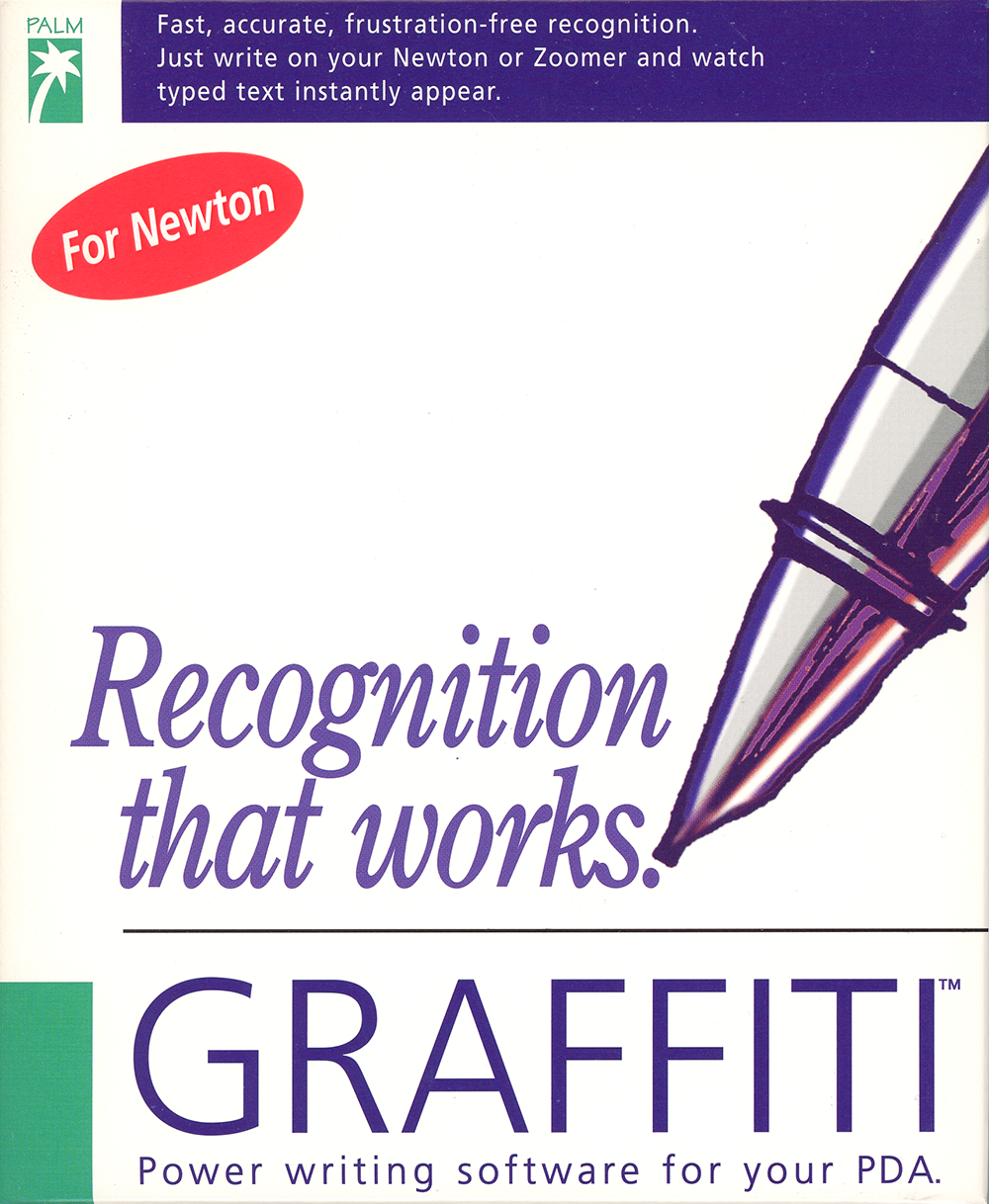
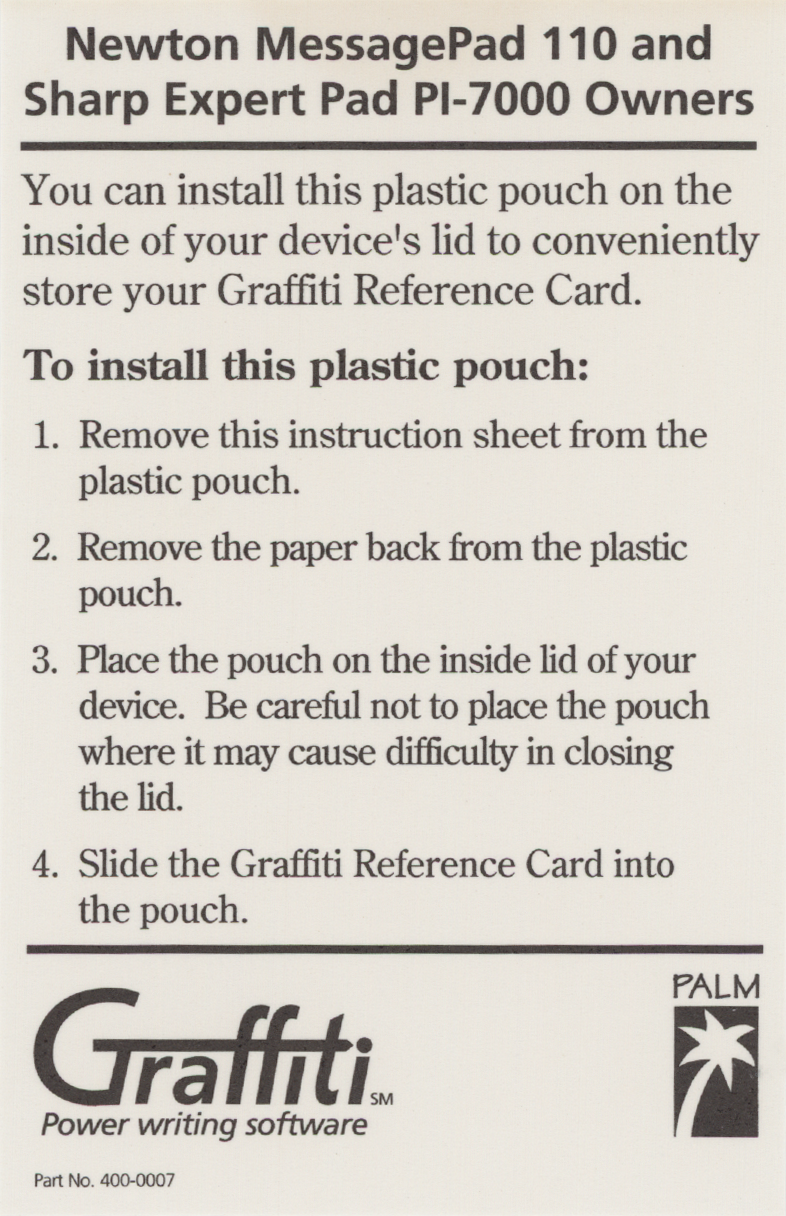
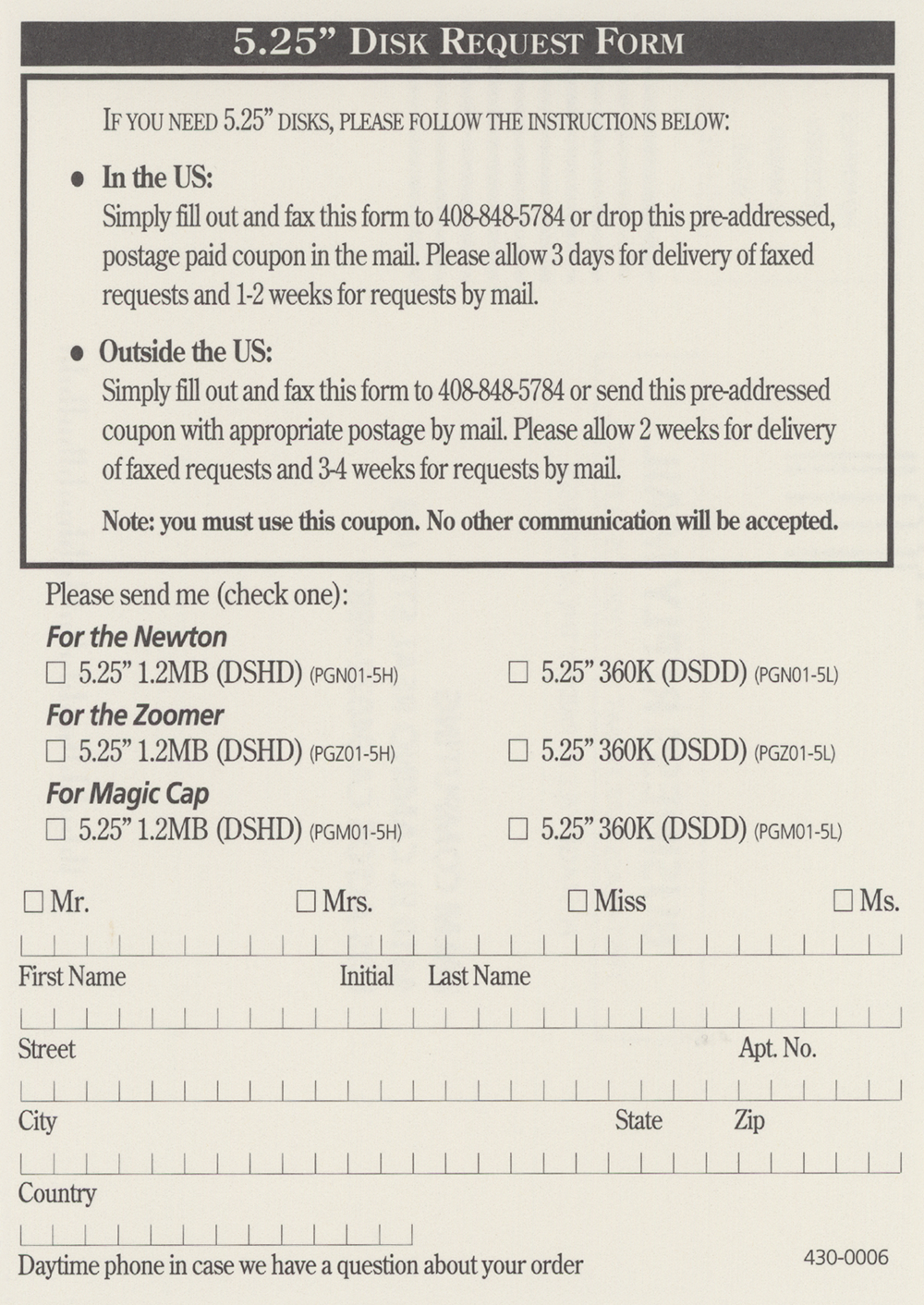
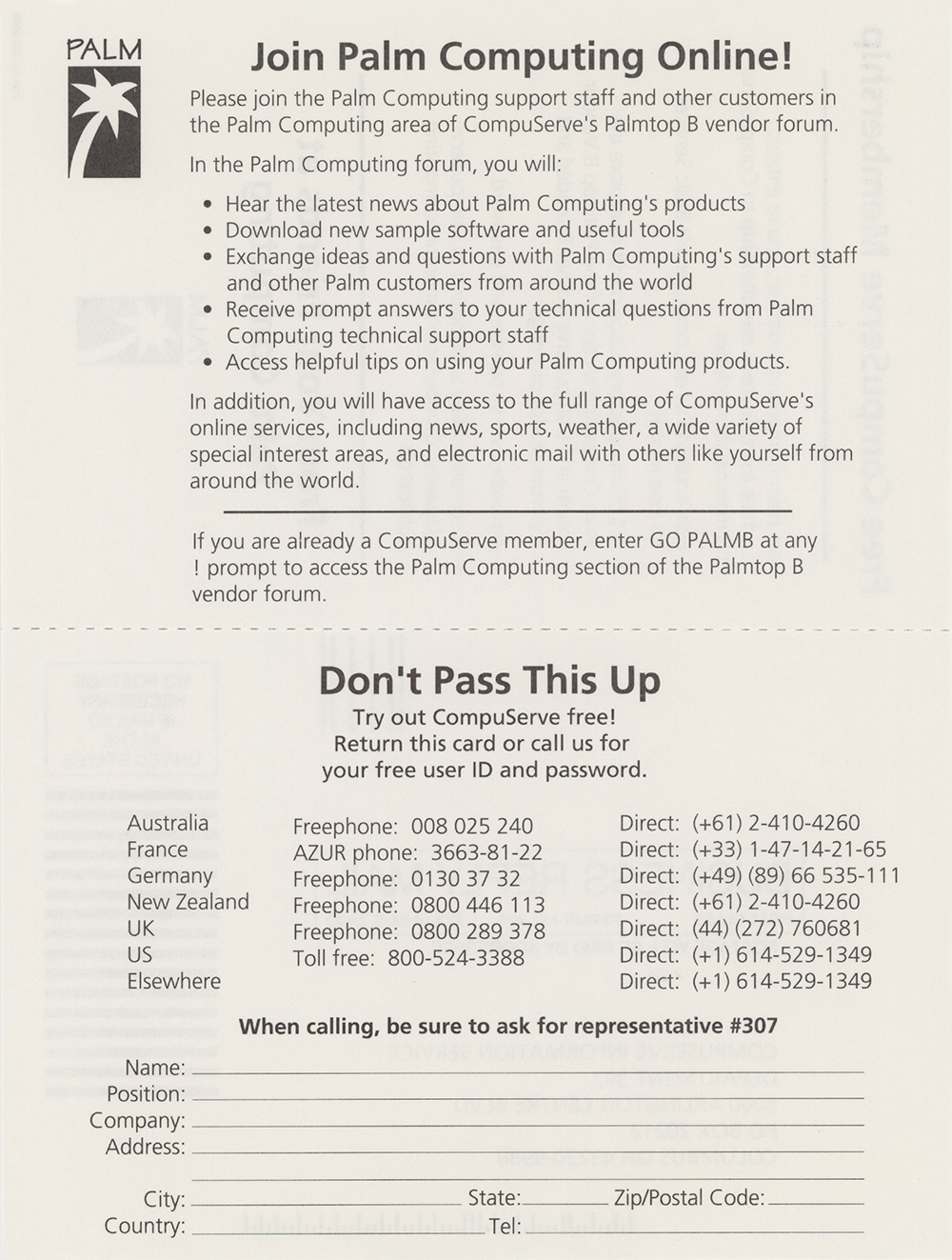
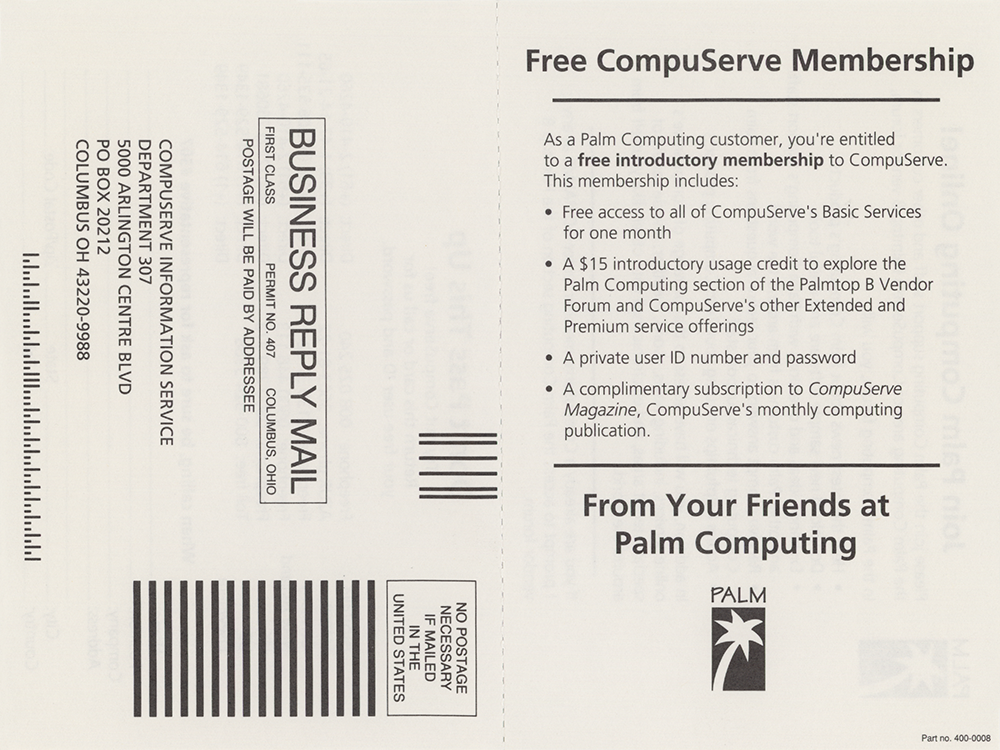
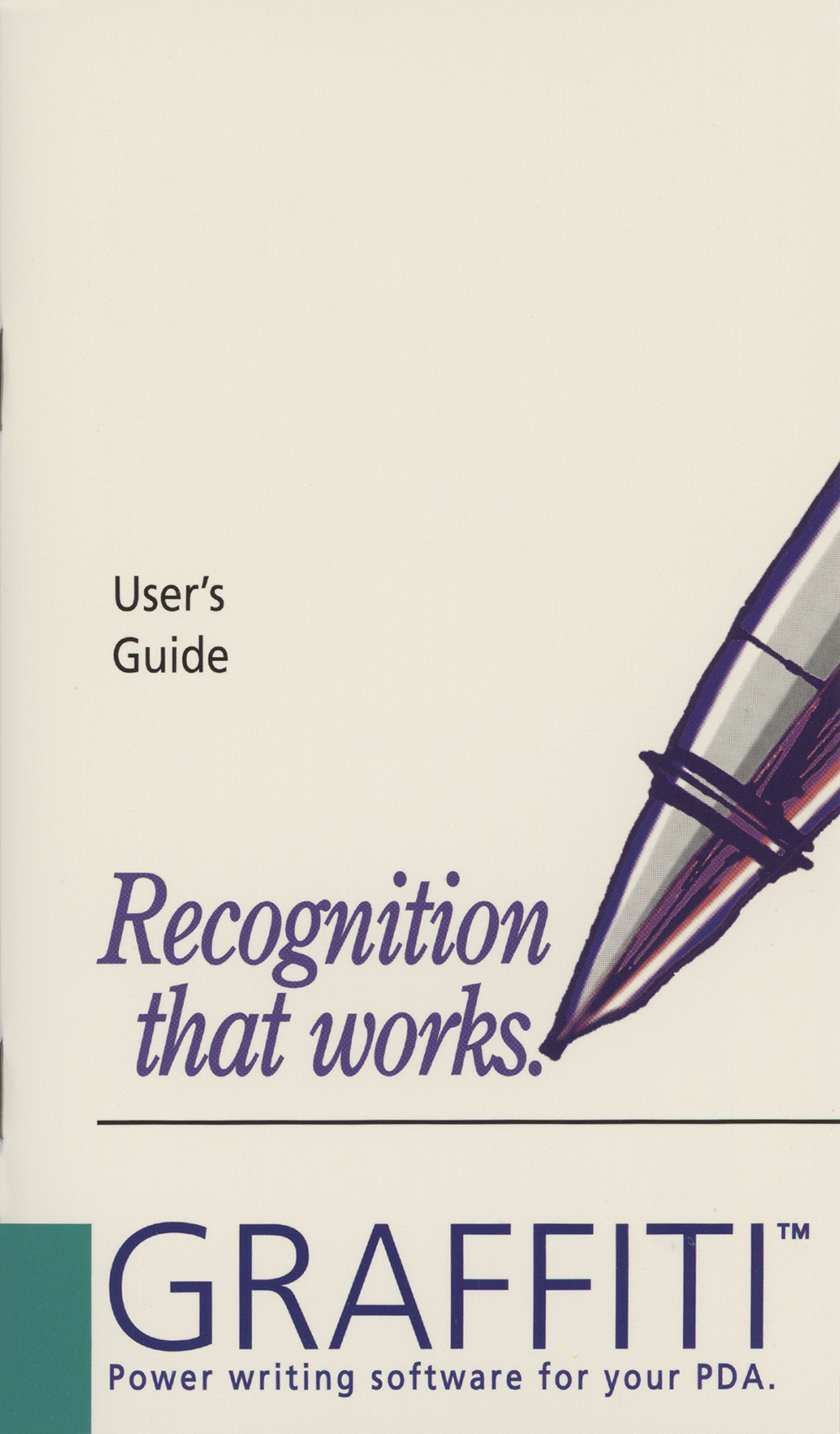
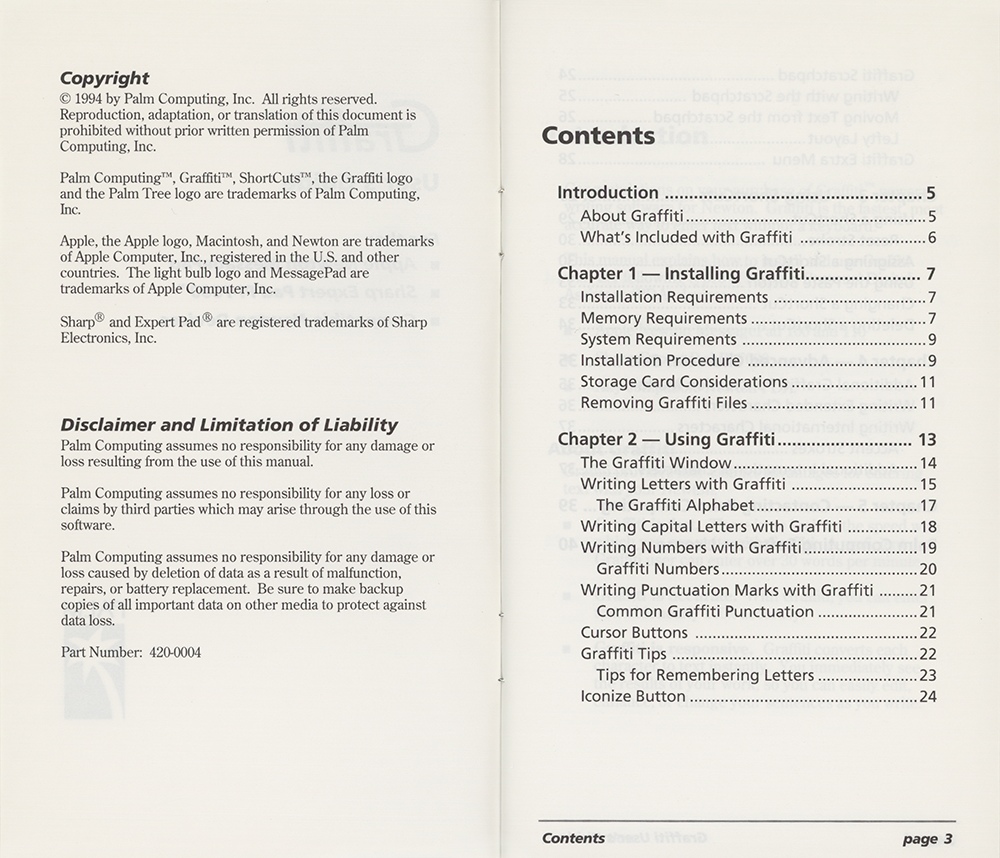
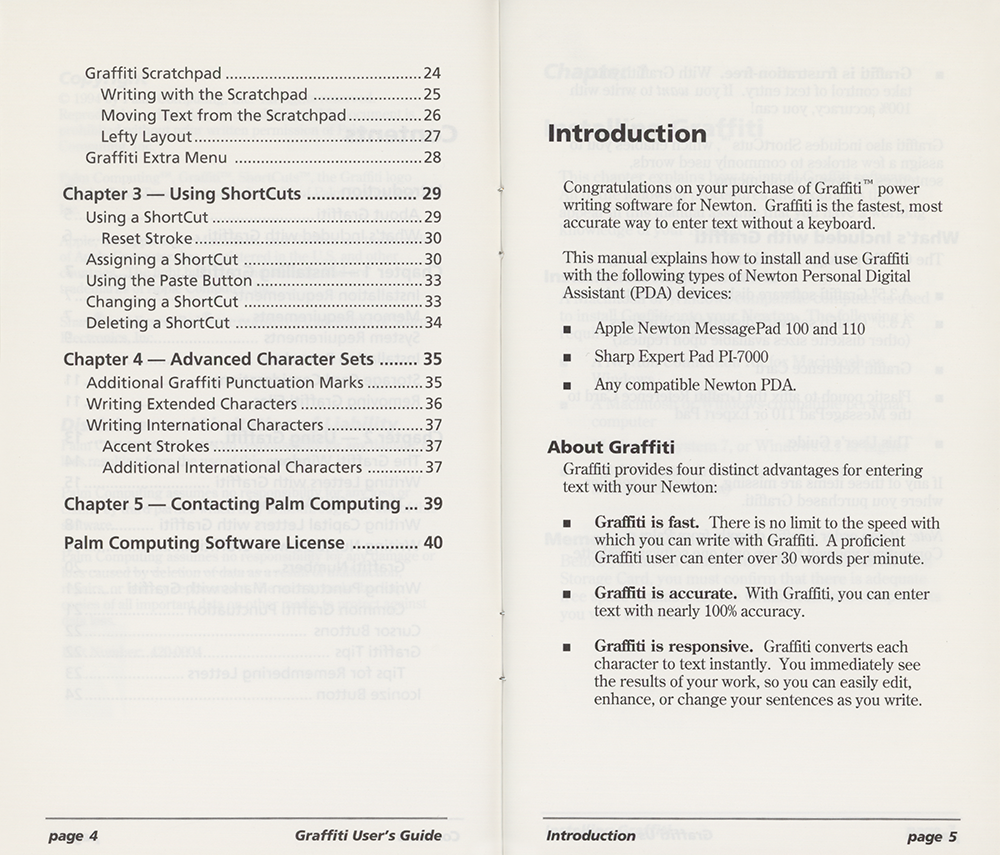
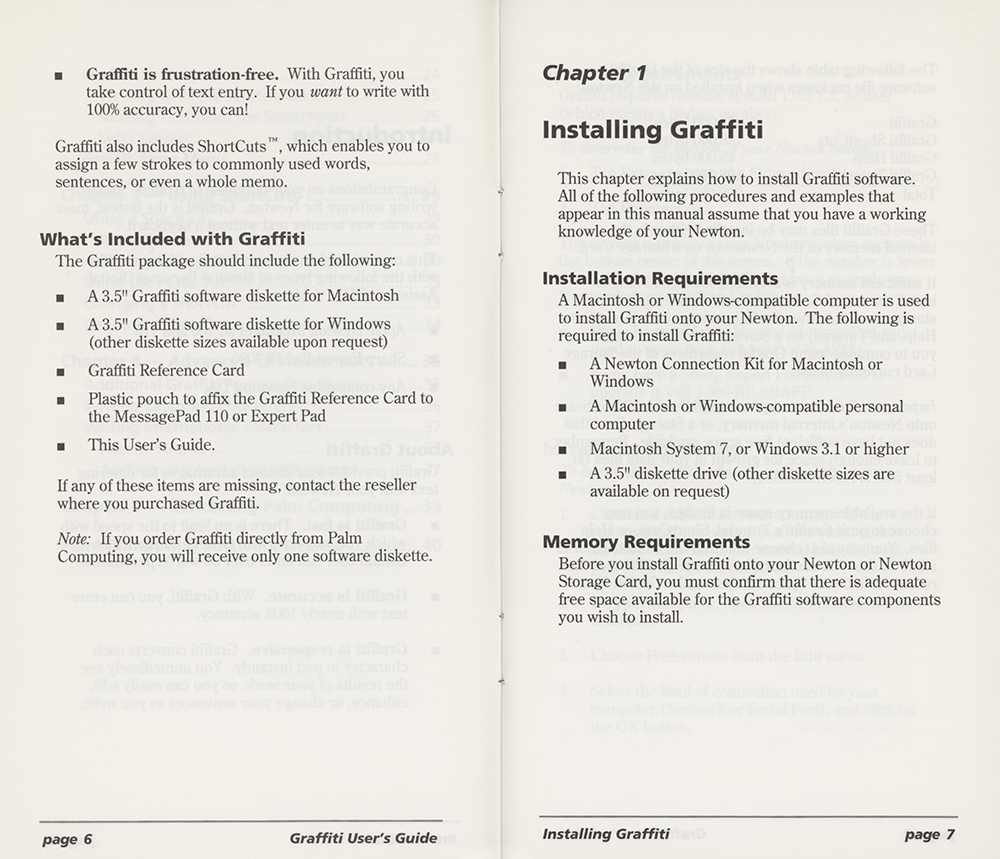
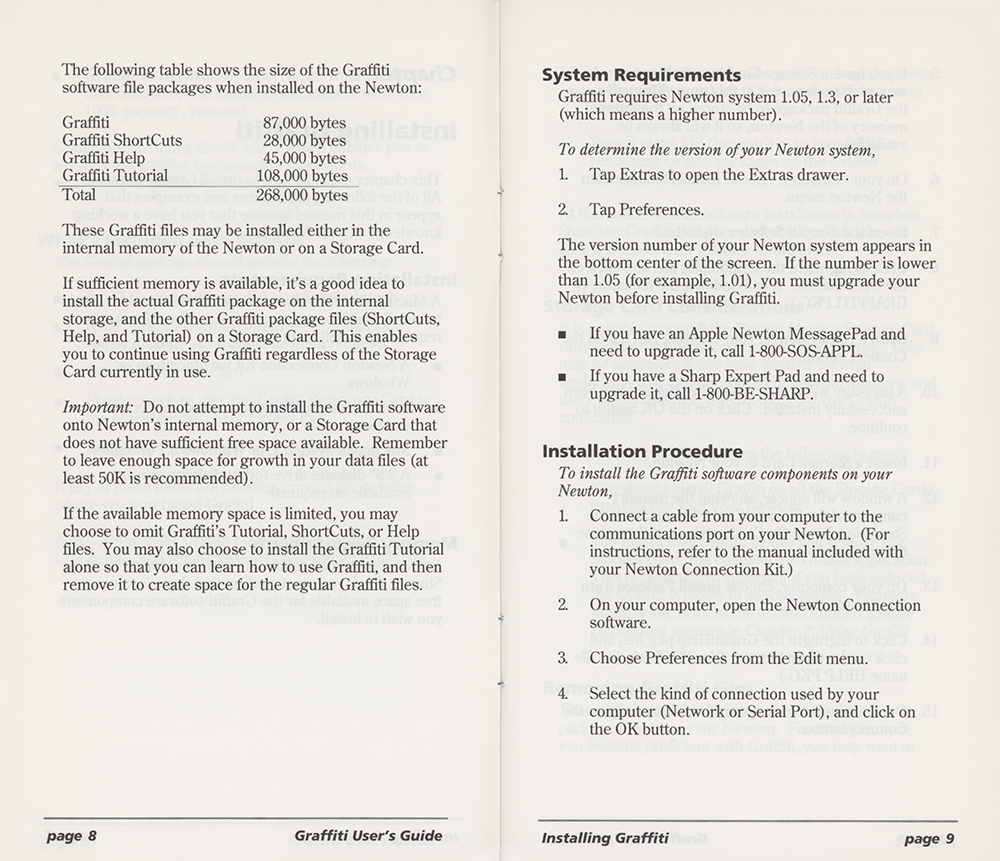
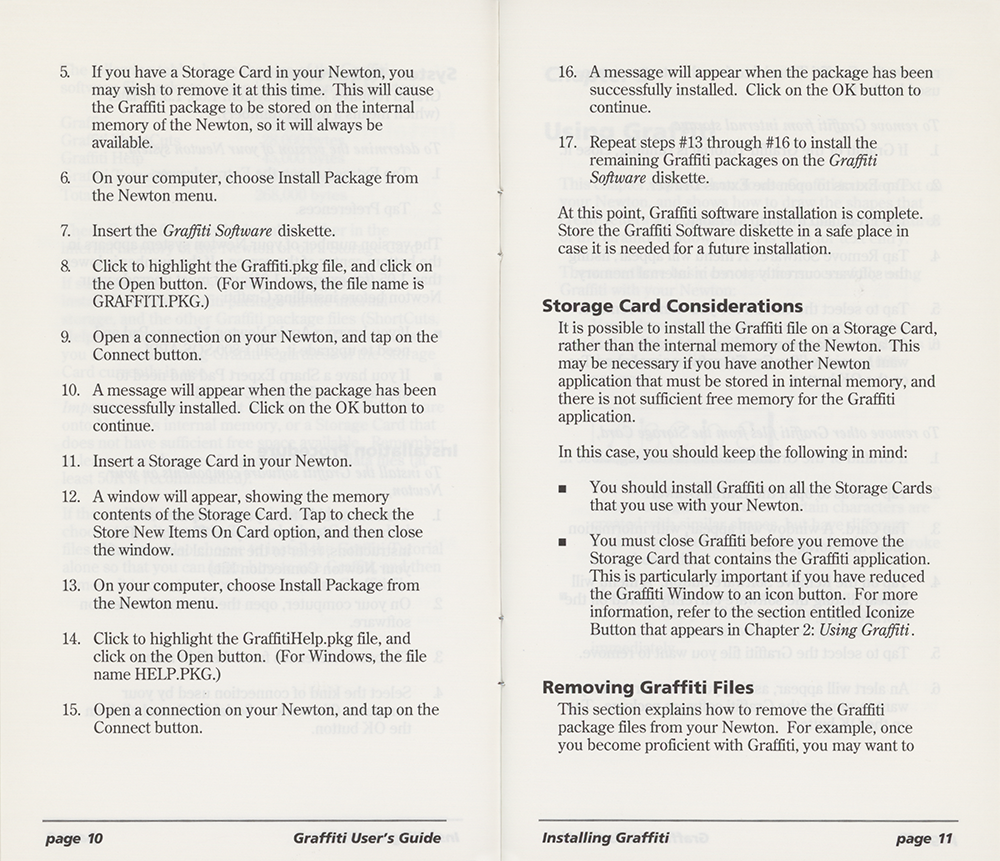
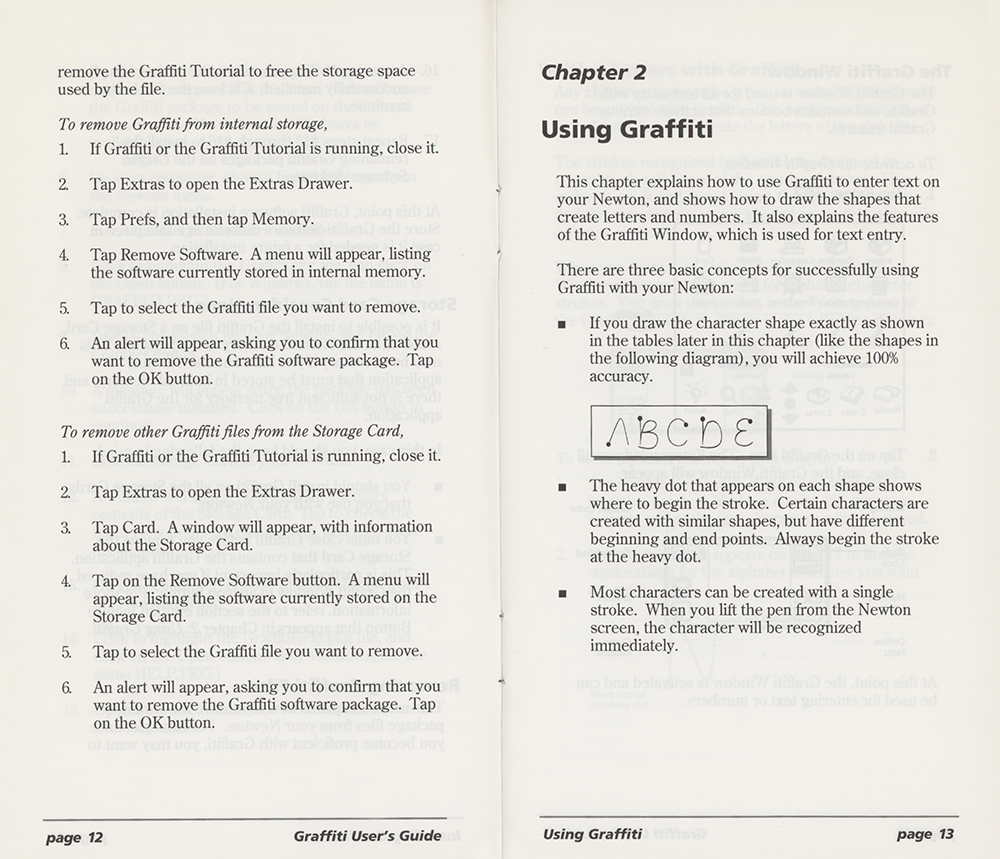
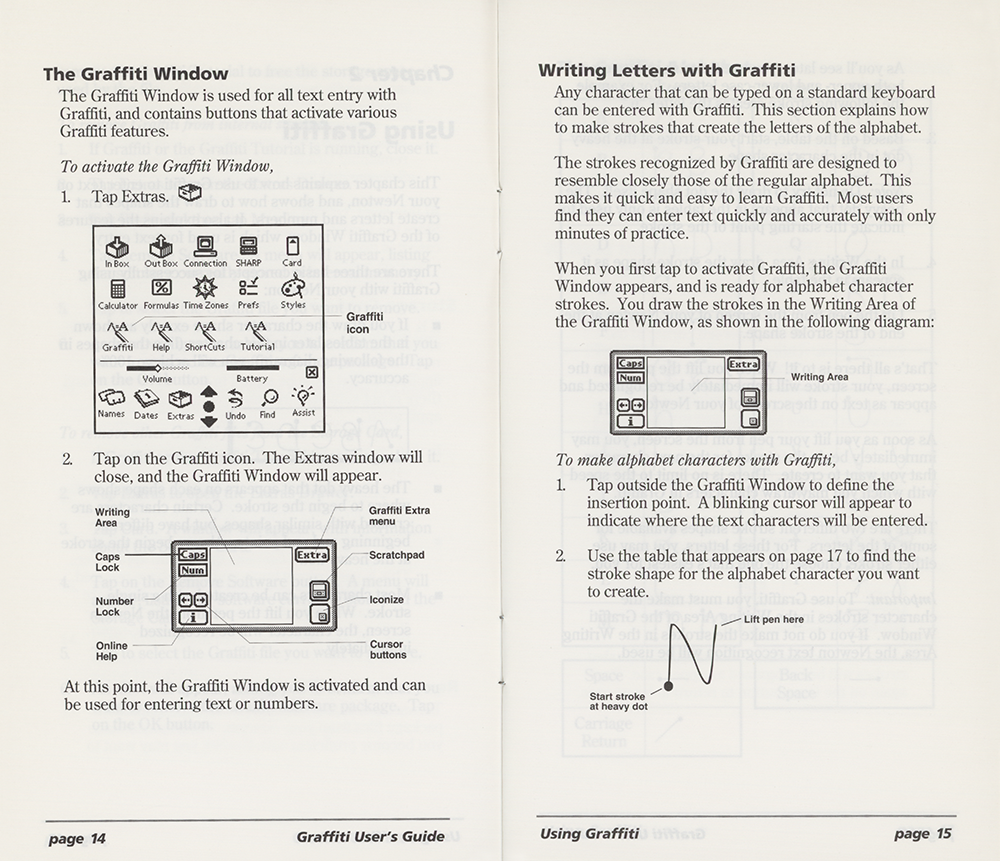
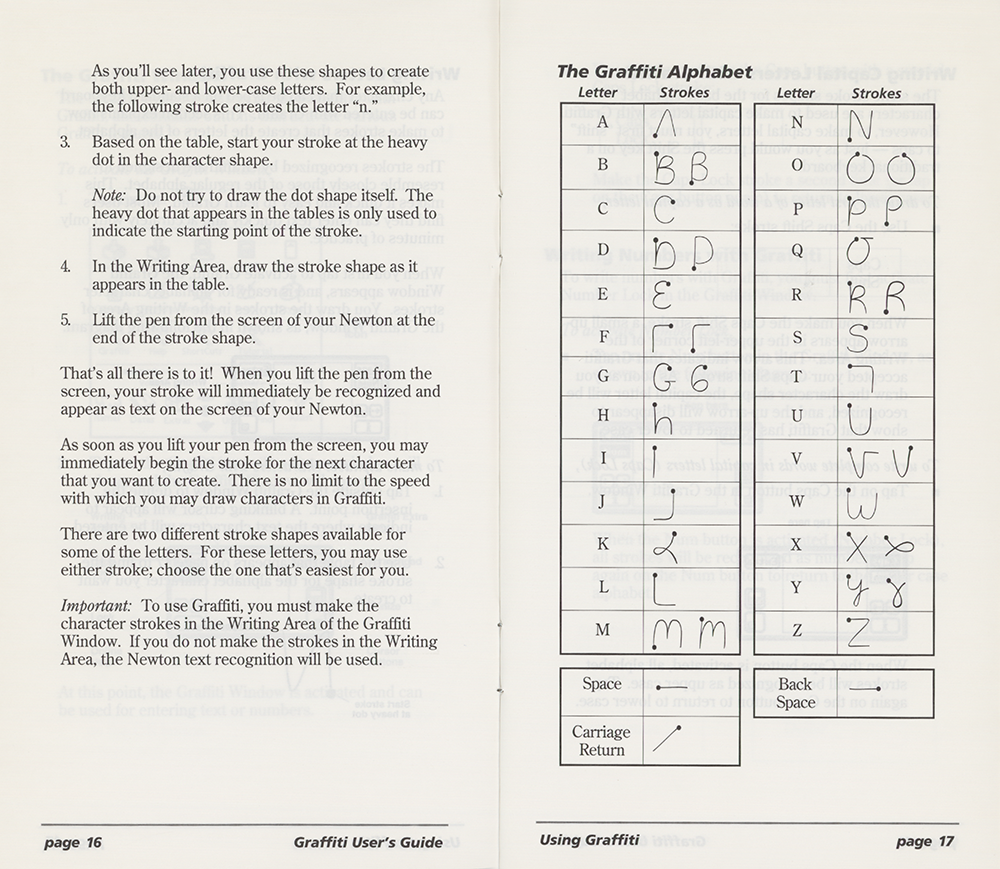
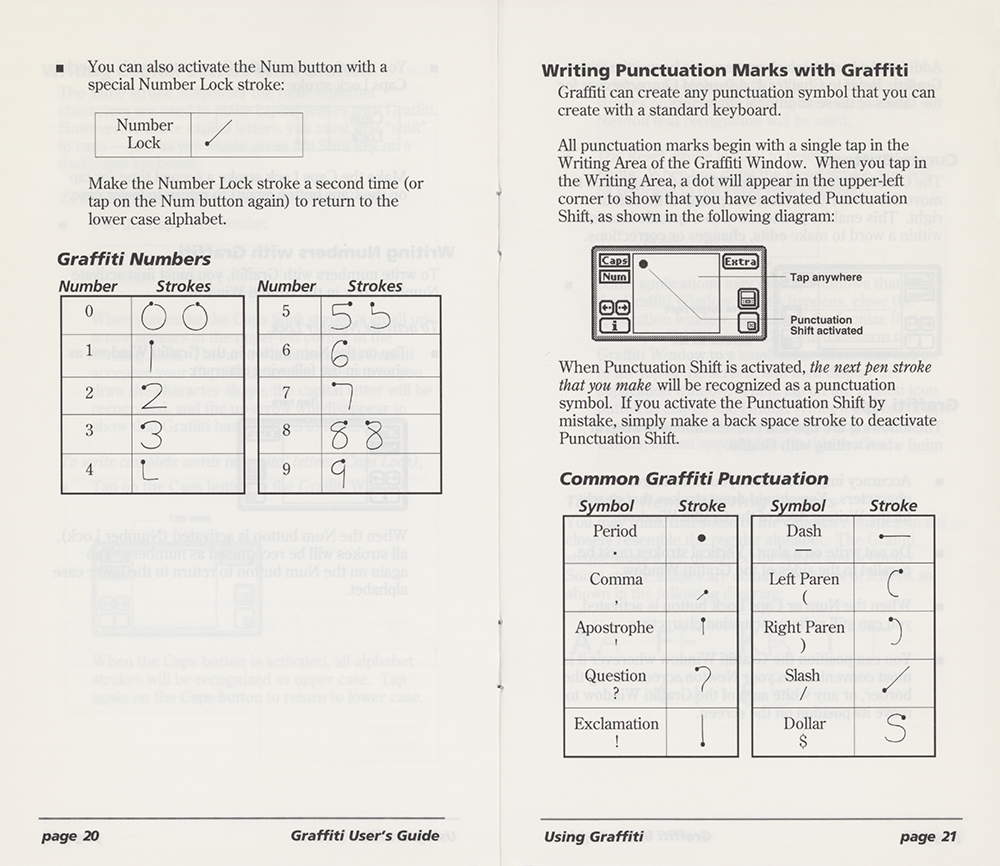
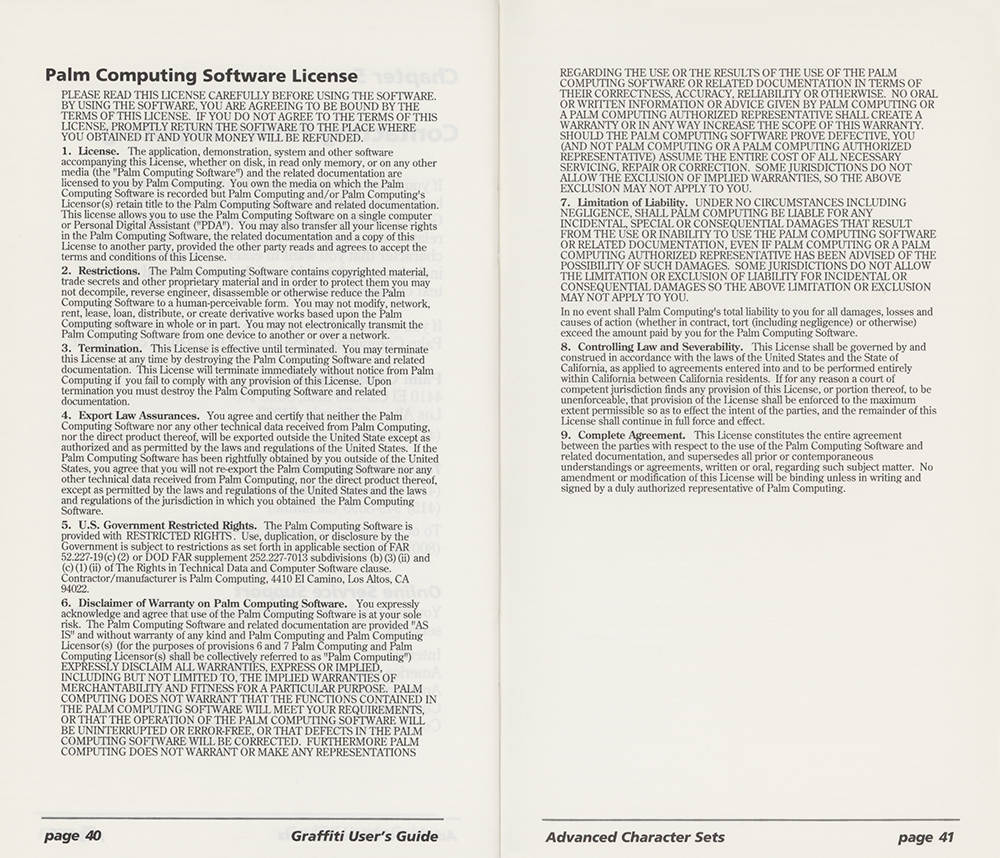
The boxed Newton edition carries the slogan "Recognition that works" and tells the buyer to "just write on your Newton or Zoomer and watch typed text instantly appear."5 Its User's Guide was printed in the United States in October 1994 and gives Palm Computing's address as 4410 El Camino Real, Los Altos, California, with technical support reachable by telephone and fax.1 The package supplied 3.5-inch Windows and Macintosh diskettes, with 5.25-inch disks available by mail or fax order on a printed request form.6 It also included a Graffiti Reference Card printed with the full stroke alphabet, numbers and punctuation,7 a snap-in pouch to mount that card inside the lid of a Newton MessagePad 110 or Sharp ExpertPad PI-7000,8 and a free introductory CompuServe membership giving access to Palm Computing's online forum.9
Graffiti found an immediate market on the Newton. By January 1995, four months after its release, Palm reported that Graffiti had become the number-one-selling add-on application for the Apple Newton MessagePad.10 By the time Palm shipped Graffiti 2.0 for Apple's Newton 2.0 at the end of 1995, more than 20,000 MessagePad owners had bought the software since its introduction in November 1994.11 Palm Computing itself had by then become a subsidiary of U.S. Robotics, which acquired the company on September 1, 1995.12
AI generated using primary sources referenced in the footnotes
Footnotes
- Palm Computing, Inc., Palm Graffiti (for Newton) Package (image scan), October 1994
- Palm Computing, Palm Computing Executive Discusses Handwriting Recognition Technology at Industry Gathering, September 24, 1993
- Palm Computing, Palm Computing Introduces PowerInk Technology for PDAs, June 3, 1993
- Palm Computing, Palm Computing Delivers Major Advance in Handwriting Recognition Technology, September 19, 1994
- Palm Computing, Inc., Palm Graffiti (for Newton) Package (image scan), 1994
- Palm Computing, Inc., Palm Graffiti (for Newton) Package (image scan), 1994
- Palm Computing, Inc., Palm Graffiti (for Newton) Package (image scan), 1994
- Palm Computing, Inc., Palm Graffiti (for Newton) Package (image scan), 1994
- Palm Computing, Inc., Palm Graffiti (for Newton) Package (image scan), 1994
- Palm Computing, Palm Computing Delivers Graffiti Power Writing Technology for Magic Cap Personal Intelligent Communicators, January 24, 1995
- Palm Computing, Palm Computing Delivers Graffiti, Award-Winning Handwriting Recognition Software, for Apple's Newton 2.0, October 30, 1995
- U.S. Robotics Corporation, U.S. Robotics Acquires Palm Computing, Inc., September 5, 1995
Oral History
Media
Jeff Hawkins – Genesis of Palm Computing
Hawkins talks about his life, his education and work experience. He started his career at Intel for 3 years and then moved to a start-up that he did not start. While working at the latter he created his first product – first pen-based computer. (Source: YouTube)
Connections
This artifact's place in the wider network of people, organizations, and artifacts. Drag to pan, scroll to zoom, and tap any node to focus its connections.