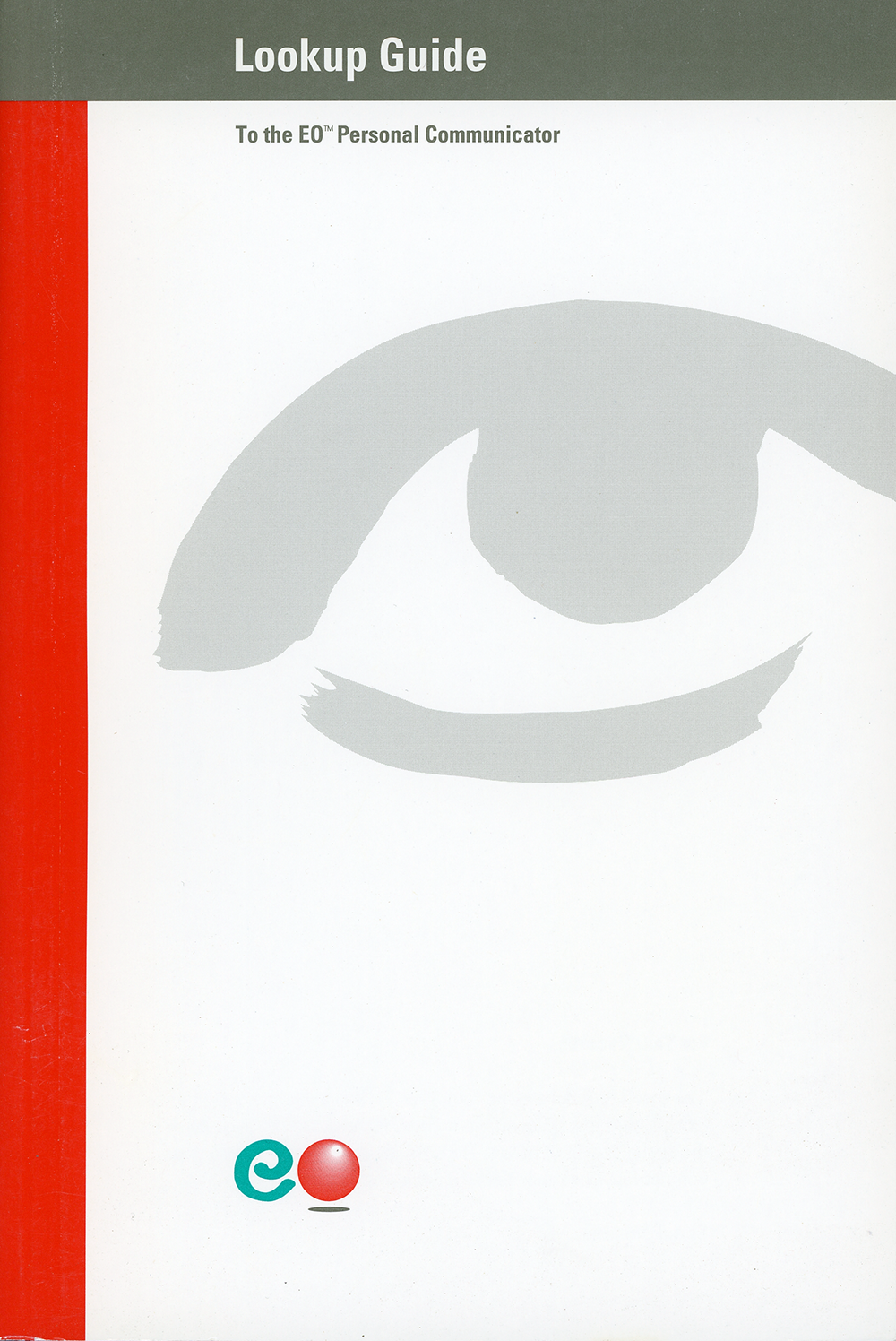
EO Incorporated – Lookup Guide: To the EO Personal Communicator
This messaging guide was part of the set of learning and reference resources that came with an EO Personal Communicator.
The other items in the series included:
- Getting Started with Your EO Personal Communicator
- The World of Messaging: An Introduction to Personal Communication
Were you involved with this artifact? If so, we would like to include your story on this page. Let us know how you contributed.
Artifact Details
EO, Incorporated
Ann Cullen
United States
English
1992, 1993
A saddle-stitched softcover booklet.
Table of Contents
- Welcome
- Your EO Personal Communicator
- Basics
- Documents
- Printing
- Editing Text
- GO Mail and GO Fax
- EO Phone
- Personal Perspective
- Calculator
- MiniText and MiniNote
- EO Sound
- Backups and Copies
- Software and Hardware Installation
- PC Connections
- Appendix
- EO Dictionary
- Index
6" x 9" (319 pages)
043-0100002-41
1993
Acquired from developer
2018-05-15
Organizations
People

Associated Products
History
The Lookup Guide: To the EO Personal Communicator is reference documentation that EO Incorporated published for owners of its EO Personal Communicator.1 Printed in the United States, the guide carries EO Incorporated's Mountain View, California address at 800A East Middlefield Road and the part number 043-0100002-41.2 EO Inc. was founded in 1991 to produce and market a new class of products it called personal communicators — devices meant to combine the power of cellular phones, fax machines, modems and pen-based computers into a single portable package — and in October 1992 the company announced a partnership with AT&T, Matsushita and Marubeni to design, build and market the first generation of them around GO Corporation's PenPoint operating system and AT&T Microelectronics' Hobbit microprocessor.3
EO unveiled the world's first personal communicators on November 4, 1992, introducing two models, the EO Personal Communicator 440 and the EO Personal Communicator 880, that put fax, electronic mail, cellular phone and personal computing capabilities into a compact device weighing 2.2 and four pounds respectively.4 Both shipped with the operating system and nine bundled applications — for faxing, electronic mail, note-taking, calculation, scheduling and address-book management — held in read-only memory, so that using one was as simple as turning it on, and every owner received an AT&T EasyLink Services mailbox for exchanging mail and faxes.4 AT&T announced two weeks later that it would market the device to the public through its Phone Centers, with the PenPoint operating system, GO Mail and GO Fax preloaded in ROM and prices ranging from $1,999 for a basic model.5
EO began shipping the EO Personal Communicator 440 in volume in April 1993, manufacturing the devices at Matsushita's plant in Franklin Park, Illinois, and filling orders directly through a toll-free number.6 In June 1993 AT&T and EO combined their efforts in an agreement that let EO carry the AT&T brand on its communicators, gave EO access to AT&T's communications technology and sales channels, and made AT&T the majority shareholder in the company.7 On June 30, 1993, the AT&T EO 440 Personal Communicator went on sale in 52 select AT&T Phone Centers across the country, with prices starting at $1,999.8 EO expanded distribution further that summer through computer superstores, the direct marketer Dell, cellular dealers and the distributor Merisel.9
Built around messaging, the communicators offered more than their built-in fax and electronic mail: in August 1993 EO announced HeadsUp, a personalized interactive newspaper delivered online directly into the AT&T EO Personal Communicator beginning that September.10 On August 13, 1993, AT&T announced that EO Inc. and GO Corp. would merge into a single company to deliver the platform of choice for personal communicators, bringing the maker of the hardware and the developer of PenPoint together under one roof.11 In December 1993 EO, by then an AT&T company, acquired Pensoft Corp. — developer of the Perspective information manager already designed into every AT&T EO Personal Communicator — to use its database architecture as a central information repository for the devices.12
AI generated using primary sources referenced in the footnotes
Footnotes
- EO Incorporated, EO Incorporated - Lookup Guide: To the EO Personal Communicator (image scan), 1993
- EO Incorporated, EO Incorporated - Lookup Guide: To the EO Personal Communicator (image scan), 1993
- EO Incorporated, EO Inc. Announces Partnership with AT&T, Matsushita and Marubeni to Build First Personal Communicators, October 1, 1992
- EO Incorporated, EO Unveils World's First Personal Communicators, November 4, 1992
- AT&T, AT&T to Market Personal Communicator in Partnership with EO, Inc., November 16, 1992
- EO Incorporated, EO First to Ship Personal Communicators in Volume, April 21, 1993
- AT&T, EO to Become AT&T's Personal Communicator Company, June 1, 1993
- AT&T, AT&T EO Personal Communicator Available in Phone Centers, June 30, 1993
- EO Incorporated, EO Expands Distribution; Dell, Merisel, Many Others to Sell AT&T EO Personal Communicators, July 23, 1993
- EO Incorporated, EO Offers Personal Interactive Newspaper Service: Free Trial for “HeadsUp” News Briefs, Delivered Online, August 5, 1993
- AT&T, GO Corp. and EO Inc. to Join Forces and Become AT&T's Personal Communicator Company, August 13, 1993
- EO Incorporated, EO Inc. Acquires Pensoft Corp., December 9, 1993
Oral History
Media
EO Personal Communicator
This show was originally broadcast on TV at De Anza College in Cupertino, California. Hosted by David Schacter and featuring Calyton Weimer of AT&T Microelectronics, the segment in this clip introduced some of the advanced features of the EO Personal Communicator and GO PenPoint operating system.
Connections
This artifact's place in the wider network of people, organizations, and artifacts. Drag to pan, scroll to zoom, and tap any node to focus its connections.