
Apple Broadens the Newton Family
From the Original Pages
Click a page to enlarge · Alt-click to open the full issue
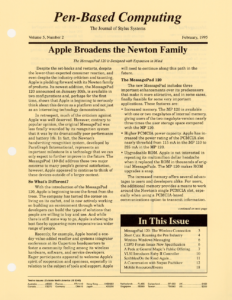
The MessagePad 120 is Designed with Expansion in Mind
Despite the set-backs and restarts, despite the lower-than-expected consumer reaction, and even despite the industry criticism and taunting, Apple is plodding forward with its Newton family of products. Its newest addition, the MessagePad 120 announced on January 30th, is available in two configurations and, perhaps for the first time, shows that Apple is beginning to seriously think about this device as a platform and not just as an interesting technology demonstration.
In retrospect, much of the criticism against Apple was well deserved. However, contrary to popular opinion, the original MessagePad was less fatally wounded by its recognition system that it was by its disappointingly poor performance and battery life. In fact, the Newton’s handwriting recognition system, developed by ParaGraph International, represents an important milestone in a technology that we can only expect to further improve in the future. The MessagePad 110 did address these two major concerns to many people’s general satisfaction, however, Apple appeared to continue to think of these devices outside of a larger context.
So What’s Different?
With the introduction of the MessagePad 120, Apple is beginning to see the forest from the trees. The company has turned the corner on living on its cachet, and is now actively working on building an environment through which developers can build the types of solutions that people are willing to buy and use. And while there is still some way to go, Apple is showing its best face by appearing more responsive to a wider range of people.
Recently, for example, Apple hosted a one-day value-added reseller and systems integrator conference at its Cupertino headquarters to foster a community feeling among its wireless hardware, software, and service developers. Eager participants appeared to welcome Apple’s spirit of cooperation and openness, especially in relation to the subject of tools and support. Apple will need to continue along this path in the future.
The MessagePad 120
The new MessagePad includes three important enhancements over its predecessors that make it more attractive, and in some cases, finally feasible for some very important applications. These features are:
- Increased memory. The MP 120 is available with one or two megabytes of internal memory, giving users of the two megabyte version nearly three times the user storage space compared with the MP 110.
- Higher PCMCIA power capacity. Apple has increased the power rating of the PCMCIA slot nearly threefold from 115 mA in the MP 110 to 325 mA in the MP 120.
- Upgradeable ROM. Apple is not interested in repeating its multimillion dollar headache when it replaced the ROM in thousands of original MessagePads. The MP 120 makes ROM upgrades a snap.
The increased memory offers several advantages to users and developers alike. For users, the additional memory provides a means to work around the Newton’s single PCMCIA slot, especially when using a PCMCIA-based communications option to transmit information.
For developers, two megabytes of memory provides the foundation for new applications that were simply not feasible until now. In fact, much of the impetus behind the MP 120 was in response to the challenges in supporting GSM-based wireless communication options in the European market.
Likewise, the improved power rating for the MP 120’s PCMCIA slot now enables people to use new add-on peripherals which draw extra power. Again, the impetus was revolved around a new generation of radio frequency and wireless local area network options that consume higher power, GSM being an example of an increasing popular radio-based wide area network.
In addition, the MessagePad 120 includes a marginally improved screen that makes use of the device more comfortable in a range of lighting situations.
Newton MessagePad 120
- CPU: ARM 610 RISC processor, 20 MHz
- Dimensions: 8″ x 4″ x 1.2″ (20.3 x 10.2 x 2.9 cm)
- Weight: 1.0 lb. (0.48 kg) without batteries
- Screen: reflective LCD, 320 x 240 pixels, 3.8″ x 2.8″ (9.6 x 7.2 cm)
- Memory (2 MB version): 687 KB of system RAM, 1,361 KB of nonvolatile user RAM
- Memory (1 MB version): 639 KB of system RAM, 385 KB of nonvolatile user RAM
- Memory (ROM): 4 MB, upgradeable
- PCMCIA: one Type II slot with 325 mA capacity
- Ports: LocalTalk and RS-232 compatible serial port
- Infrared: half-duplex transceiver, up to 38.4 Kbps within 3.28 feet (1 meter)
- Modem (2 MB version): external, 2400 bps data, 9600 bps fax
- Battery: four AA alkaline
- Pen: Cordless telescoping
- Software: Notion list manager
- Software (2 MB version): Notion list manager, Pocket Quicken for Newton, Newton-Mail, PowerNeWS
- Cost: $599 and $699 for the 1 and 2 MB versions
System Software Improvements
Among the enhancements to its system software, Apple lists the increased reliability of erasing PCMCIA flash memory cards and improvements in the ability to remember user preferences. The later is coded terminology, at least in part referring to a handwriting recognition bug in the MessagePad 110 which caused user preferences to change unpredictably, adversely affecting the system’s ability to recognize a person’s writing.
Version 1.3 of the operating system also contains features which better integrates the Newton into the world of wireless messaging. For example, notification windows such as alarms remain open even when the MessagePad goes to sleep, enabling an unattended Newton to receive notifications.
Updating Your System
For existing users of the MessagePad 100 and 110, Apple is providing a system update to version 1.3 through several popular commercial online services including eWorld, Applelink, America Online, CompuServe, Genie, and the Internet at Info.Hed.Apple.Com.
There are two versions of the system update: version 1.3 (414313) for the MessagePad 100 and version 1.3 (344311) for MessagePad 110 owners. People lacking access to any of the online services can also retrieve the update by dialing into Apple’s Newton Enhancement Server at (800) NEWTON9 or (408) 639-8669 using a PCMCIA modem or Newton serial modem.
For those that are completely disconnected, Apple is offering the System 1.3 update on diskette for a nominal shipping and handling charge through its information hotline 1-800-SOS-APPL.
All Bundled Up
To make the MessagePad 120 more attractive, Apple is including a set of handy hardware and software extras, most of which are bundled only with the 2 MB version. For example, purchasers of this configuration receive Pocket Quicken for the Newton, a complimentary month of eWorld and the PowerNeWS service, Notion, the Newton list manager, along with an external data/fax modem. People purchasing the 1 MB configuration receive only the Notion software.
Still Too Expensive?
An impressive package without doubt, however, the question remains whether US $599 and $699 for the one and two megabyte versions represent the kind of value that will project the Newton from its new-found home in the vertical market out into the mainstream. Better communication options help, however, most consumers will still base their purchases on cost justification instead of the much sought-after life-style decisions.
Transcribed from Pen-Based Computing, Volume 5, Number 2 — February 1995. Page 1.