
MessagePad 120: The Wireless Connection
From the Original Pages
Click a page to enlarge · Alt-click to open the full issue
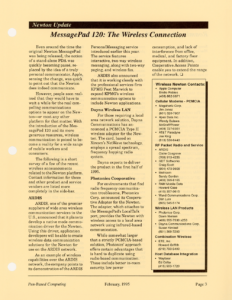
Even around the time the original Newton MessagePad was being released, the notion of a stand-alone PDA was quickly becoming passé, replaced by the idea of a truly personal communicator. Apple, sensing the change, was quick to point out that the Newton does indeed communicate.
However, people soon realized that they would have to wait a while for the real compelling communications options to appear on the Newton—or most any other platform for that matter. With the introduction of the MessagePad 120 and its more generous resources, wireless communication is poised to become a reality for a wide range of mobile workers and consumers.
The following is a short survey of a few of the recent wireless announcements related to the Newton platform. Contact information for these and other product and service vendors are listed more completely in the side-bar.
ARDIS
ARDIS, one of the premier suppliers of wide area wireless communication services in the U.S., announced that it plans to develop a native mode communication driver for the Newton. Using this driver, application developers will be able to create wireless data communication solutions for the Newton for use on the ARDIS network.
As an example of wireless capabilities over the ARDIS network, the company points to its demonstration of the ARDIS PersonalMessaging service introduced earlier this year. The service features interactive, two-way wireless messaging, along with two-way paging, and wireless fax.
ARDIS also announced that it is working closely with the professional services firm KPMG Peat Marwick to expand KPMG’s wireless communication options to include Newton applications.
Dayna Wireless LAN
For those requiring a local area network solution, Dayna Communications has announced a PCMCIA Type II wireless adapter for the Newton. The card, based on Xircom’s NetWave technology, employs a spread spectrum, frequency hopping radio system.
Dayna expects to deliver the product in the first half of 1995.
Photonics Cooperative
For environments that find radio frequency communication troublesome, Photonics Corp. announced its Cooperative Adapter for the Newton. The adapter, which attaches to the MessagePad’s LocalTalk port, provides the Newton with wireless access to a local area network using infrared-based communication.
While somewhat larger that a strictly PCMCIA-based solution, Photonics’ approach offers certain advantages that is hard to duplicate using radio-based communication. These include better in-room security, low power consumption, and lack of interference from office, medical, and factory floor equipment. In addition, Cooperative Access Points enable you to extend the range of the network.
Wireless Newton Contacts:
- Apple Computer — Emilio Robles, (408) 862-5671
Cellular Modems – PCMCIA
- Megahertz Corp. — Jim Jonez, (801) 320-7807
- Apex Data Inc. — Wendy Bulawa, McGraff/Power, (408) 727-0351
- AT&T Paradyne — Joe King, (813) 530-8443
RF Packet Radio and Service
- ARDIS — Claire Cosgrove, (708) 913-4235
- GDT Softworks — Craig Scott, (604) 473-3608
- Metricom — Sandy Gordon, (408) 399-8165
- RAM Mobile Data — Howard Case, (415) 357-3615
- Wynd Communications Corp. — Dan Luis, (805) 545-5174
Wireless LAN Products
- Photonics Corp. — Dawn Nielsen, (408) 955-7930 x253
- Dayna Communications Corp. — Susan Kimball, (801) 369-7200
Combination Wireless
- ETE, Inc. — Howard Griffith, (619) 793-5400
Host Database Integration
- Wayfarer — Ed Colby, (415) 903-1720
Transcribed from Pen-Based Computing, Volume 5, Number 2 — February 1995. Page 3.