
A Conversation with Vance Holloway and Bruce Trunck
From the Original Pages
Click a page to enlarge · Alt-click to open the full issue
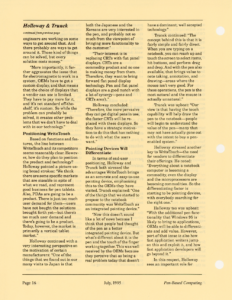
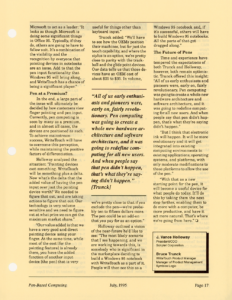
Pen computing offers a lot of promise, but several technical challenges need to be overcome before it can extend into the mainstream, both in horizontal and vertical markets. Some of the problems are common to all of mobile computing including size, weight, battery life, and sturdiness. However some are unique to pen computing.
The obvious elements here include handwriting recognition, integration of ink into regular applications, and improved digitizers. It is this final element where the rubber meets the road, since the digitizer forms such a critical part of the user’s experience with the computer.
Two people that are acutely aware of this challenge and the need to overcome it are Vance Holloway, President and COO of Scriptel Corporation and Bruce Trunck, WriteTouch Product Manager and Manager of Product Management at Symbios Logic. During the interview that follows, Holloway and Trunck repeatedly expressed their belief in the importance of making mobile computers easy to use, and how they hope to make WriteTouch an integral part of this.
Holloway’s History
Holloway and Trunck spent the first few moments describing their respective careers, including the time when their paths converged with WriteTouch. Holloway started: “I’ve spent almost my entire career in the computer industry. I started out as an accountant and I got a chance to get into the computer business in the early 60’s.”
He continued: “I worked for Honeywell, and then for NCR. I went to NCR primarily because I had a chance of becoming a part the the movement converting from mechanical accounting machines to electronic. I’ve always liked crusades.”
Holloway stayed at NCR and “then the PC [personal computer] came along and I had another crusade. I was the second person inside NCR with a PC in 1981. I went through the 80’s on that crusade. And then about 1990, I ran into handwriting recognition through a company here in Silicon Valley called CIC. I got enthralled with the technology of the pen and it became my third crusade.”
Holloway was impressed enough to bring his ideas back to NCR, where he assumed a rather historic role in pen computing. It was also around this time that he met Trunck. He recalled: “I was the original product manager for the NCR 3125 [pen computer]. It was an interesting experience, but it was also an experience that I should have recognized early on as doomed to failure. But I was so enthusiastic about this crusade.”
Holloway noted: “Looking at the 3125, we were dealing with about eight new technologies at once. In any development, if you’ve got one new technology, your risk is significant. If you’ve got two, it’s not twice as significant, it’s some factor beyond that. When you get to eight, only an idiot would do it.”
Gateway Technologist
Holloway continued: “It was about that time that I served as a gateway technologist to the PC division. I dealt with the outside world, with new technologies, and how to bring them in to develop new products at NCR. I was asked by the executive in charge of the PC division to look for some technology in the pen market that we could bring into NCR and own some intellectual property.”
Holloway recalled: “I decided that digitizers were going to be this technology. Looking around, I zeroed in on Scriptel’s electrostatic technology, noting that it would probably be significant because there were problems to overcome integrating the digitizer with the display. This was 1991. Bruce [Trunck] was on the same crusade for the electronics division.”
“We met up and decided that this was something that we should do for NCR—to form some sort of partnership with Scriptel to bring their technology down to a chip. While NCR would not own the technology, they would own the design. We put together that model, sold it to management, and got the thing started.”
“After AT&T bought NCR, I decided that I didn’t want to start another career with a major bureaucracy, so I took an early retirement. I wanted to do something else, such as consulting. Then, when the CEO of Scriptel Holding, Inc. talked me into coming with Scriptel, I changed to the other side of the fence. But from that day, Bruce and I have been working on this [WriteTouch].”
Trunck’s Tale
Trunck explained his background: “I’m a hardware designer by education, and I started working for a company in Oregon called Floating Point Systems who had a niche between a minicomputer and a Cray [supercomputer]. It’s where a lot of the floating point architecture came from, in terms of a pipelined architecture. I was a logic design engineer for about six years.”
Trunck continued: “At the time I left, I was an I/O architect. I left primarily because I wanted to move more into the systems realm. I found myself in Colorado Springs working with a company on a project to revitalize the communication system for NORAD [the air defense system]. I’ve always been motivated by the attitude ‘that can’t be done.’ I don’t know if I call that a crusade or not, but that’s always challenged me.”
Trunck explained: “I’ve also always been interested in the architecture of how to get data in and out of a computer. Initially, that was from a storage aspect, but it eventually evolved to more of a user interface aspect.”
Indeed, people who work on user interface issues find the work especially gratifying.
Trunck elaborated: “I think it’s more immediate. Allowing the world to interface better with a computer has a lot of challenges. I was offered the chance to build a system for the [24 satellite] GPS constellation that would allow someone to get the complete status.”
Trunck remembered: “At the time, that was being done with a mainframe. It wasn’t very portable, you couldn’t take it over to Desert Storm and view the whole constellation. A lot of people involved in building that system said it couldn’t be done. But we were able to do it.”
From there, Trunck moved to NCR Microelectronics as a product manager. His role was to go out and find new products and new ways of making money from silicon. He confided: “One thing that has always interested me was mobile computing. I started focusing on the product opportunities in the mobile computing environment. I think the first place to start is with problems that need to be solved.”
“Looking at the [NCR] 3125, we were dealing with about eight new technologies at once. In any development, if you’ve got one new technology, your risk is significant. If you’ve got two, it’s not twice as significant, it’s some factor beyond that. When you get to eight, only an idiot would do it.” — [Holloway]
Back to the NCR 3125
Jumping back to the history of the NCR 3125, Holloway described the vision for a machine radically different from what would ultimately ship to customers. “Ironically, the 3125 started out as a combination of pen and keyboard. That was the direction I wanted to go. It was like an early version of the [GRiD] Convertible. But the decision was made that people don’t need a keyboard on a pen computer.”
Holloway continued: “So we abandoned the keyboard and went for a pure pen computer. It wasn’t clear how significant the problems of handwriting recognition were. That was the fundamental flaw. And since the handwriting recognition wasn’t there, the 3125 was diverted to vertical markets.”
Holloway conceded that the initial dream of seeing 3125-toting executives scribbling away on airplane flights had to be at least temporarily abandoned. Holloway noted: “That was the vision. It was for horizontal markets using these computers in places where it wasn’t convenient to use a keyboard.”
The FCC Blues
So what led to the 3125’s downfall? Was it mostly the handwriting recognition? Holloway explained: “There isn’t a lot of factors. I think that the people who read Doonesbury decided that handwriting recognition was the problem, but it wasn’t really. It was mostly the cost.
We started out with the 3125’s cost objective to sell the product at about $1500.”
Holloway continued: “One of the factors that got the cost out of hand was the digitizer. You start by trying to add a digitizer sensor panel with an LCD over it, and then the glass and the pen. When you try to get a signal up through this noisy electrical environment, a lot of shielding has to be done, and a lot of cost has to be added.”
“When we went to the FCC to get Class B certification, normally we wrapped a computer up to prevent RF noise from getting out. But now you can’t wrap up the top of the pen computer because you’ve got to get a signal out to the pen. We went through six months to get the Class B certification from the FCC because, at that time, the FCC didn’t even know how to do the test.”
Holloway elaborated: “Their method of testing was without a human being present. They measured the frequencies using monitors placed so many feet away. Then they decided that it’s not the right environment, this always operates with someone using a pen. Of course, the minute you put a pen with a person nearby, the person becomes a huge antenna broadcasting noise. Suddenly, you couldn’t pass FCC.”
“So we went through about six months and a lot of cost involving shielding connectors before we ever got Class B certification from the FCC. When we got through, we probably had about $450 in cost tied up with the digitizer, although the digitizer cost about $65 if you look at the materials.”
Holloway concluded: “Everything that you had to put into this device was leading edge, state of the art, which doesn’t compute with low cost. The cost, for all of those reasons, got so out of hand. Now, whether or not it would have sold at $1500 you could argue. But certainly, it had no chance selling at $4500.”
Part of the Hype
By this time, of course, GRiD Systems had already been selling pen computers for a couple of years. Holloway described GRiD’s influence on him: “I looked at the GRiD, but one of the clear problems that it had was the digitizer. This solidified my thinking. At that time, the digitizer in a pen computer was viewed as another peripheral, and the selection was made the same way.”
“You went out and looked at the disk drives, and the disk specifications, you negotiated a price, you plugged it in, and you were off and running. Digitizers were the same way. It solidified my thinking that the electrostatic technology was, to the best I could tell, the best way to do this. Or at least one of the best ways.”
In hindsight, following his deep involvement with the ill-fated NCR 3125, does Holloway see himself as having been caught up in the hype, or a part of it? He joked: “I guess I was part of the hype. Looking back, the mistake I made in being part of the hype was forgetting how long and what you have to go through to bring a new technology to fruition. I forgot to look back and notice that the PC started in 1974 and it became a viable commercial product in about 1983. It took almost ten years.”
Holloway continued: “How long did we live with the “Year of the Network?” A lot of us forgot how long it takes for a technology to take root. I quite frankly do believe that it’s still going to happen, we’re just going through the growth of a new technology. If you believe that mankind has existed with pens and pads—ever since they got away from chisel and tablet I guess—if you believe that this paradigm isn’t going to come into the electronic age…it’s going to happen. It may take another five years, another ten years, but it’s going to happen.”
Trunck is also positive about the concept of pen computing. “I believed the model that the pen made more sense. The pen was a more natural and familiar interface. I think it’s still a little early to call it dead. But we get that all the time, the pen is dead, why are you guys talking to us?”
Keeping the Faith
With all that happened with the 3125, what was the motivation behind keeping the digitizer project alive? Trunck explained the decision to persevere through the good and the bad: “We had a number of customer drivers in a lot of market segments. Apple was a driver and still is for the technology. Samsung as well.”
Trunck continued: “NEC wanted to put this in their original Versa. IBM was doing a second generation tablet that never saw the light of day—they wanted to put this in there. Compaq was already experiencing the digitizer issues on their Concerto and so they were following the program. OEMs in general were already far enough along to know that what they were working with wasn’t going to solve their problem. That kept the project going.”
So what was Apple’s interest? Trunck explained: “It was for their PIE Division, before they were PIE. They were looking at it for follow-on Newton products. It was never really being looked at, or intended for, the original Newton that was announced. It was for a larger screen Newton device. In fact, the [larger prototype Newton] had the Scriptel corded technology in it.”
And what about Apple’s interest in WriteTouch today? Trunck described: “Their interest in it now is that they are having good success with the Newton in vertical markets. However, the membrane that they are using today isn’t viewed as being rugged enough for those markets.”
Holloway picked up the story: “They invested a lot in their membrane technology. And they probably would stick with it except for the durability issue. It’s mylar and, in some of the dirtier environments like sand or grease, you can sandpaper that mylar. It’s mostly durability issues. They have to get something where the top exposed surface is glass.”
Moving the Development Forward
Trunck described how the first chip for WriteTouch was available within a year, however, it failed to perform according to specification. “So we really spent two years back at the drawing board before we put another piece of silicon out. We changed the architecture of the system, not just within the silicon, but also in terms of algorithms, pen cartridge design, and the sensor panel went through a transformation as well.”
“[The FCC’s] method of testing was without a human being present… Then they decided that it’s not the right environment, this always operates with someone using a pen. Of course, the minute you put a pen with a person nearby, the person becomes a huge antenna broadcasting noise. Suddenly, you couldn’t pass FCC.”
Holloway added: “Like a lot of complex development efforts, I think everyone underestimated what it was going to take to solve the problem. After the first year, we had a piece of silicon that didn’t work.”
However, Trunck described the motivation to continue advancing the electrostatic design: “The electromagnetic digitizer, which we always felt was the competing technology more so than the membrane, was an I/O device that needed to be outside the system.”
“The WriteTouch technology was inherently outside the system and therefore had the best potential for resolving all the issues including performance, signal-to-noise, and ease of integration. These were high on any OEM’s list who had dealt with the electromagnetic design.”
WriteTouch Design Goals
Trunck described the high-level design goals for WriteTouch: a flat panel display, a cordless pen, and support for touch input capabilities. Holloway added: “That defined a lot of the physics about what you can and can’t do. It was never designed nor intended to be a real competitor to a peripheral digitizer sitting on a desk, cabled to a computer.”
Working within these goals, the WriteTouch team was able to put together a system that Holloway feels has a couple of unique advantages over its competition. He enumerated: “Number one, the digitizer system is external to the rest of the system. So therefore, you can isolate it from the rest of the electrical noise in the system. Number two, it supports finger touch and pen input in the same system. The physics don’t work for these features in an electromagnetic system.”
Being external to the system, WriteTouch also offers new promise for pen computers employing large active matrix screens. However, Holloway concedes that the physics of other technologies does not preclude the use of active matrix, once some significant hurdles are crossed.
He noted: “Even with the problems with large active matrix color displays, we know that Sharp and Wacom engineers are working on some ways to get around that. And there probably are ways to get around it. Those kind of things can be solved, but every solution costs money.”
“More importantly, it further aggravates the issue that for electromagnetic to work in a system, OEMs have to get a custom display, and that means that the choice of displays that a vendor can use is limited. They have to pay more for it, and it’s not standard off-the-shelf, it’s custom. So while the problem can probably be solved, it creates other problems that we don’t have to deal with in our technology.”
Positioning WriteTouch
Based on functions and features, the line between WriteTouch and its competitors seems reasonably clear. However, where do they plan to position the product and technology? Holloway painted a picture using broad strokes: “We think there are some specific markets that are sizeable in spite of what we read, and represent good business for pen tablets. Also, PDAs are going to be a product. There is just too much user demand for them—users have not bought the solutions brought forth yet—but there’s too much user demand and there’s going to be a product. Today, however, the market is primarily a vertical tablet market.”
Holloway continued with a very interesting perspective on the motivation of certain manufacturers: “One of the things that we found out in our many visits to Japan is that both the Japanese and the Koreans are very interested in the pen, and probably not so much from the viewpoint of bringing more functionality to the customer.”
“Their interest is in replacing CRTs with flat panel displays. CRTs are a commodity product and no one is making money from them. Therefore, they want to bring forward flat panel display technology. Pen and flat panel displays are a good match with a lot of synergy—pens and CRTs aren’t.”
Holloway concluded: “Therefore, the more pervasive they can get digital pens in use, the faster CRTs will be replaced with these displays. So they have a strategic motivation to do this that has nothing to do with what the users want.”
Pointing Devices Will Differentiate
In terms of end-user positioning, Holloway and Trunck both stressed the advantages WriteTouch brings as an accurate and easy-to-use pointing device, emphasizing this to the OEMs they have visited. Trunck explained: “One of the things that we started to propose to the notebook community was WriteTouch as an integrated pointing device.”
“Now this doesn’t sound like a lot of news because I think that people had thought of the pen as a better integrated pointing device. But what’s different about it is the pen and the touch of the finger working together. This was well received by the OEMs because they perceive that as being a real problem today that doesn’t have a dominant, well accepted technology.”
Trunck continued: “The concept behind this is that it is fairly simple and fairly direct. When you are typing on a notebook, you can reach up and touch the screen to select items, hit buttons, and perform drag and drop. And with the pen also available, that brings value to note taking, annotation, and drawing—areas where the mouse isn’t very good. For these operations, the pen is the most natural and the mouse is actually unnatural.”
Trunck was upbeat: “Our view is that having the touch capability will help draw the pen to the notebook—people will begin to understand the value of the pen—many that may not have actually gone out with the intent to buy a pen-enabled system.”
Holloway stressed another key to WriteTouch—the need for vendors to differentiate their offerings. He noted: “Everything about a notebook computer is becoming a commodity, even the display and the microprocessors are becoming commodities. So the differentiating factor is starting to be pointing devices, with everybody searching for the right one.”
Holloway too was upbeat: “With the additional pen functionality that Windows 95 is likely to bring to applications, OEMs will be able to differentiate and add value. However, part of that issue is also how fast application writers jump on this and exploit it, and how fast application developers will go beyond it.”
In this respect, Holloway sees an important role for Microsoft to act as a leader: “It looks as though Microsoft is doing some significant things in Office 95. Typically, if they do, others are going to have to follow suit. It’s a combination of the visibility and the recognition by everyone that pointing devices in notebooks are an issue. Add to that the pen input functionality that Windows 95 will bring along, and WriteTouch has a chance of being a significant player.”
Pen at a Premium?
In the end, a large part of the issue will ultimately be decided by how customers view finger pointing and pen input. Currently, pen computing is seen by many as a premium, and in almost all cases, the devices are positioned as such. To achieve mainstream success, WriteTouch will have to overcome this perception, while maintaining the positive factors of differentiation.
Holloway analyzed the situation: “Pointing devices cost something. WriteTouch will be something plus a delta. Now what’s the delta that the added value of having the pen input over just the pointing device worth? We needed to figure that out, and are taking actions to figure that out. Our technology is very volume sensitive and we need to figure out at what price we can get the maximum market share.”
“Our value added is that we have a very good and direct pointing device using your finger. At the same time, while most of the cost [for the pointing feature] is already there, you have the added function of another input device [the pen] that is very useful for things other than keyboard input.”
“All of us early enthusiasts and pioneers were, early on, fairly revolutionary. Pen computing was going to create a whole new hardware architecture and software architecture, and it was going to redefine computing for all new users. And when people say that pen didn’t happen, that’s what they’re saying didn’t happen.” — [Trunck]
Trunck added: “We’ll have to see how the OEMs position their machines, but for just the touch capability, and where the stylus is an option, we’re pretty close to parity with the trackball and the glide point devices. Our data tells us that these devices have an OEM cost of about $25 to $35. In volume, we’re pretty close to that if you exclude the pen—we’re probably ten to fifteen dollars more. The pen could be an add-on that you pay for as an option.”
Holloway outlined a vision of the near-future he’d like to see: “The most likely scenario that I see happening, and we are working towards this, is somebody who is significant in the marketplace deciding to build a Windows 95 notebook with WriteTouch as a part of it. People will then see this as a Windows 95 notebook and, if it’s successful, others will have to build Windows 95 notebooks. All the parts of that get dragged along.”
The Future of Pens
Time and experience have tempered the expectations of both Trunck and Holloway, however, both remain optimistic. Trunck offered this insight: “All of us early enthusiasts and pioneers were, early on, fairly revolutionary. Pen computing was going to create a whole new hardware architecture and software architecture, and it was going to redefine computing for all new users. When people say that pen didn’t happen, that’s what they’re saying didn’t happen.”
“But I think that electronic ink will happen. It will be more evolutionary and it will get integrated into existing computing environments in existing applications, operating systems, and platforms, with only moderate modifications to those platforms to allow the use of the pen.”
“With that as a new starting point for the pen, it will become a useful device for what people do today. It’ll do this by taking them the next step further, enabling them to do more with a computer, be more productive, and have it act more natural. That’s where we’re going from here.”
J. Vance Holloway
President/COO
Scriptel Corporation
Bruce Trunck
WriteTouch Product Manager Manager of Product Management
Symbios Logic
Transcribed from Pen-Based Computing, Volume 5, Number 7 — July 1995. Pages 12, 13, 14, 15, 16, 17.