
A Conversation with WMS’ Jon Covington
From the Original Pages
Click a page to enlarge · Alt-click to open the full issue
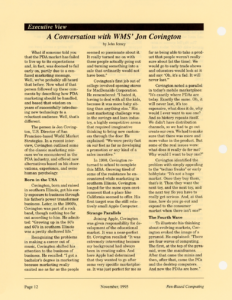
What if someone told you that the PDA market has failed to live up to its expectations and, in fact, was doomed to fail early on, partly due to a confused marketing message. Well, we’ve probably all heard that before. Now what if that person followed up these comments by describing how PDA marketing should be handled, and based that wisdom on years of successfully introducing new technology to a reluctant audience. Well, that’s different.
The person is Jon Covington, U.S. Director of San Francisco-based World Market Strategies. In a recent interview, Covington outlined some of the classic marketing miscues we’ve encountered in the PDA industry, and offered new alternatives based on his observations, experience, and some human psychology.
Born in the USA
Covington, born and raised in southern Illinois, got his early exposure to business through his father’s power transformer business. Later, in the 1960’s, Covington was part of a rock band, though nothing too far out according to him. He admitted: “Growing up in the 50’s and 60’s in southern Illinois was a pretty sheltered life.”
Recognizing the problems in making a career out of music, Covington shifted his attention to the business of business. He recalled: “I got a bachelor’s degree in marketing because marketing really excited me as far as the people seemed so passionate about it. It really turned me on with these people actually going out and turning something into a sale that ordinarily would not have been.”
Covington’s first job out of college involved opening stores for MacDonalds Corporation. He remembered: “I hated it, having to deal with all the kids, because it was more baby sitting than anything else.” His next marketing challenge was in the savings and loan industry, a highly competitive arena that required imaginative thinking to bring new customers through the door. He explained: “We were pretty fast on our feet as far as developing a promotion or any kind of a sales incentive.”
In 1980, Covington returned to school to complete this MBA. Growing tired of some of the resistance he encountered while marketing in southern Illinois, Covington longed for the more open environment that a place like California seemed to offer. His first target was the still relatively small Apple Computer.
Strange Parallels
Joining Apple, Covington was given responsibility for development of the educational market. It was a near-perfect fit. Covington recalled: “It was extremely interesting because my background had always been in creating sales. And here Apple had determined that they wanted to go after some very specific marketplaces. It was just perfect for me as far as being able to take a product that people weren’t really sure about [at the time]. We would go to early trade shows and educators would look at it and say: ‘Oh, it’s a fad. It will never last.'”
Covington noted a parallel in today’s mobile marketplace: “It’s exactly where PDAs are today. Exactly the same. Oh, it will never last, it’s too expensive, what does it do, why would I ever want to use one? And so history repeats itself. We didn’t have distribution channels, so we had to go out create our own. We had to make sure that there was more and more value in the product. But some of the real issues were: what does it really do for me? Why would I want to buy one?”
Covington identified the problem with simply appealing to the “techno freaks” or early hobbyists: “It’s not a huge market. Once they buy them, that’s it. Then they want the next toy, and the next toy, and the next toy. So you have to really get serious. And, at that time, how do you go out and expand to the consumer market when there isn’t one?”
The Fourth Wave
To illustrate his thinking about evolving markets, Covington evoked the image of a pyramid. He explained: “There are four waves of computing. The first, at the top of the pyramid, were the mainframes. After that came the minis and then, after that, came the PCs and the desktop computers. And now the PDAs are here.”
He continued: “Each one of those waves were separate from the one before. For example, IBM really introduced the mainframe, but DEC came in with the mini because IBM couldn’t make the transition. And then it was Radio Shack and some of the others like Apple that came in with the microcomputer.”
But, according to Covington, even these leaders are having a tough time making the PDA transition. He credits pioneers such as Psion and industrial manufacturers such as Symbol Technologies and Telxon as the early innovators. He noted: “Apple is really late. It has come the way IBM entered the PC market a couple of years down the road.” Covington summarized: “So these shifts reoccur basically the same way. Everybody niches out a specific segment and they go after it. And they stay with it, but they never really make the transition to the next one.”
It is here that Covington has found his opportunity. He explained: “What I’m doing is going through a second generation as far as market development is concerned. The computer industry has a whole new market in new technology and it’s not just the size of PDAs or hand-held computers—it’s really the capabilities.”
Revealing some strategy, he noted: “Businesses are always the first innovators to really go out, spend the money, and say this is what they want. Most people familiar with Maslow’s hierarchy of needs, as far as individuals are concerned, realize that self-actualization is at the top of the pyramid as far as what they eventually want to achieve. Well for business, it’s much simpler. They don’t need shelter and they don’t need security. They were created and exist only for the production of profit. They want not only the money back, they want a return.”
The Self-Actualizing PDA
Stepping back a bit, Covington described Maslow’s hierarchy of needs, a principle that has clearly influenced his thinking about marketing to consumer desires. “It’s a hierarchy of needs for mankind, and the first need is for security and safety. The next is for shelter, and others are for food and basic necessities. It’s in a lot of psychology books and it goes through a pyramid. At the top is self-actualization—becoming all that you can be in awareness and in self-actualization. That’s what people are really about.”
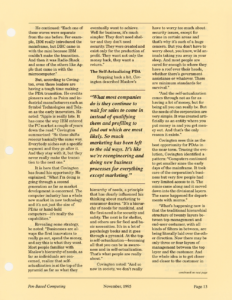
“What most companies do is they continue to wait for sales to come in instead of qualifying them and profiling to find out which are most likely. So much marketing has been left to the old ways. It’s like we’re reengineering and doing new business processes for everything except marketing.”
Covington noted: “And so now in society, we don’t really have to worry too much about security issues, except for crime in certain areas and that’s why it’s such a huge concern. But you don’t have to worry about, you know, wild animals taking you away in your sleep. And most people are cared for enough to where they have a roof over their heads, whether there’s government assistance or whatever. There are minimum standards for survival.”
“And the self-actualization comes through not as far as having a lot of money, but for being all you can really be. But the needs of the corporation are very simple. It was created artificially as an entity where you put money in and you get money out. And that’s the only reason it exists.”
Covington sees this as the best opportunity for PDAs in the near term. Tracing the evolution, Covington identified a pattern: “Computers continued to get smaller since the early days of the mainframe. It took care of the corporation’s business but very few people had very limited access to it. The minis came along and it moved down into the divisional layers. The same happened for departments with micros.”
“What’s happening now is that the traditional hierarchial structure of twenty layers between top management and end-user customer, with all kinds of filters in between, are being literally laid over the other direction. Now there may be only three or four layers of management between the top layer and the customer. And the whole idea is to get closer and closer to the customer in order to be able to understand what the needs are so that they can meet them.”
Covington sees this as the ideal fit for PDAs and hand-held technology. He explained: “The real benefit as far as the fourth wave of computing is concerned is where PDAs fit in all the things we’ve talked about. Mainframes, minis, and PCs are all set within the confines of the organization or the corporation—within an office or within some kind of physical structure. Well, most people don’t work that way anymore because people and customers are out and about, away from their desk.
“Take utility companies, for instance. Sixty-five per cent of their work force is mobile. And they’ve already spent all the money to increase productivity within the physical structure itself. So what’s left for them to do other than to look at how to increase efficiency for the mobile work force. You can’t strap a PC to your back and go out—it just doesn’t work. And notebooks work to a certain extent but it’s a little bulky.”
“So the whole idea is that it has got to be moved down as far as possible and still being able to maintain communication within the corporate structure while increasing efficiency. For instance, what some companies are doing in the utility industry is that if you’ve got a telephone repairman, he goes and logs out from the office in the morning. He’s got six jobs that he’s supposed to work on during the day. He gets to the first job and finds out that it’s going to take four times as long as he thought. And there’s no way he can go finish the other four until after four or five o’clock when he gets off.”
“Even by calling in, they couldn’t shift all the jobs because someone else may find out that they in fact can’t do that job and they move on to the next one. So what would happen is, by not being able to shift jobs, the guy who had originally been assigned to six jobs just stayed on it until it was done. So there’s a lot of overtime that was paid and there’s other guys who came back to the shop early. Now, with PDAs and two-way communication, they can move those jobs back and forth and they save a lot that way.”
PDAs Save Lives!
So why is the PDA essential in this scenario? Wouldn’t a simple cellular phone work just as well? No, according to Covington. He insisted: “With the PDA, you have not only the communications aspect, but also things like circuit diagrams. When a utility lineman is out on an emergency call during a storm with breaks in the line or whatever, they have to go and do high-power line reinstalls or connections. And often times, these lines are inconsistent as far as the way they’re set up.”
“So when you’re working with a hundred thousand volts or whatever, and sometimes it’s hot and sometimes it’s not, a cellular phone isn’t going to do any good at being able to call back and have someone say, ‘well, it’s the big black cable that’s a tenth of a centimeter bigger than the other one, and it’s supposed to be on the left hand side.’ But with the PDA, the guy can have it in his hand and he can look and see for this pole number exactly how these things are wired.”
“So it’s much safer for him and it offers some time savings because before, he would have to go down from where he was on the pole, go back to the truck and check. With the PDA, he can do it immediately while he’s up there, whether it’s loaded into the PDA or whether he uses it to communicate back to the power company through the truck.”
The Role of World Market Strategies
Covington described how his company, World Market Strategies, fits into this puzzle: “WMS is a market development company, continuing to do the things that I’ve been doing for twenty years, which is going out and developing market-places and helping people do the things they hate to do, which is sell products. WMS is based in the UK and in the US. Some of our largest customers are IBM, Motorola and others, and we do a lot of profiling for them as far as helping them decide which accounts are most likely to actually purchase in the next six months, nine months, or a year.”
Covington noted: “What most companies do is they continue to wait for sales to come in instead of qualifying them and profiling to find out which are most likely. So much marketing has been left to the old ways. It’s like we’re reengineering and doing new business processes for everything except marketing. You can have all these other components, but if there’s no one that can go out and really sell and has the direct connection with the customer, everything else is lost.”
“That was one of the problems with PDAs when they first came out. They tried to—they wanted it to—be a consumer market because it was easier to go and market by mass advertisement than have to go out and create the marketplace.”
“Getting back to World Market Strategies, we believe that a market should be developed in a certain way and with a focus on the customer that is undying. Not trying to satisfy just symptoms of what it is that they might have in the way of a problem, but really going in, identifying, and truly understanding what the problem is and how we really do.”
“We do a lot of client server things as far as the technology, but we’re doing PDAs probably as a proof of concept in market development and as our personal mission to be able to show that it is important for people to really look at. With PDAs I saw all the same cycles that were happening from the microcomputer era happen again. But instead of people actually trying to go out and do something about creating the marketplace, they were abandoning the market. The technology was right, it was just being used and focused towards the wrong people. So it seemed like they had forgotten everything they had learned before.”
Building Gee-Whiz Toys
Covington illustrated with an example: “With Apple’s launch of the Newton, Scully’s promotion was an over-hype of the capability of technology and a lot of expectations were unrealistic. It’s like so many of the technology companies that do such a wonderful job of building toys. They have great technicians go out and build something, but they have a perfect solution to a problem that doesn’t exist.”
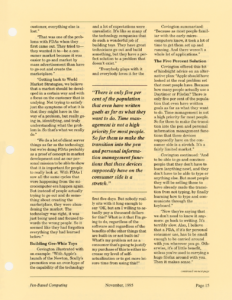
“There is only five per cent of the population that even have written goals as far as what they want to do. Time management is not a high priority for most people. So for them to make the transition into the pen and personal information management functions that these devices supposedly have on the consumer side is a stretch.”
“Everybody plays with it and everybody loves it for the first five days. But nobody really sits with it long enough to say ‘OK, but am I willing to actually pay a thousand dollars for this? What is it that I’m going to do, regardless of the software and regardless of the benefits of the other things that are built-in or not built-in? What’s my problem set as a consumer that’s going to justify my purchase of this to either increase my level of self-actualization or to get more leisure time from using this?'”
Covington summarized: “Because as most people familiar with the early microcomputers know, it took a lot of time to get them set up and running. And there weren’t a whole lot of applications.”
The Five Percent Solution
Covington offered this bit of hindsight advice on an alternative plan: “Apple should have looked at the real problem set that most people have. Because how many people actually use a Daytimer or Filofax? There is only five per cent of the population that even have written goals as far as what they want to do. Time management is not a high priority for most people. So for them to make the transition into the pen and personal information management functions that these devices supposedly have on the consumer side is a stretch. It’s a fairly limited market.”
Covington continued: “And to be able to go and convince people that they don’t have to learn [anything new], and they don’t have to be able to type or anything else. But most people they will be selling these to have already made the transition from not typing, by finally learning how to type and communicate through the keyboard.”
“Now they’re saying that we don’t need to know it anymore: go back to writing. It’s terribly slow. Also, I believe that a PDA, if it’s for personal consumer use, has to be small enough to be carried around with you wherever you go. Otherwise, it’s of little benefit, unless you’re used to carrying a huge filofax around with you. Then it makes sense.”
Putting it all into perspective, Covington concluded: “I think their target market was completely wrong. I think they had the technofreaks in mind and they thought there was a sufficiently large number out there to keep them rolling. And there wasn’t.”
PDA Shortcomings
Covington, an avid Psion user, offered some personal insights into why most PDAs are suffering from a perception problem. He began: “I think there were some problems as far as the ability of being able to input information. Even if there was a great connection kit from your PC into the Newton, it still takes too much effort to put something into [the device]. The idea behind a personal information management system, or the Newton, was that you could write information once, it would recognize your handwriting, and then you could manipulate it in a To Do list, as an appointment, or in a database or something. And then you’d have access to it, and that’s great.”
“But the problem is that it takes so long to be able to put something in there and figure out how to manipulate the data back and forth—cut and paste and all the other things—that it’s just too difficult.”
Covington painted the classic scenario: trying to input information that is being dictated without hesitation. He observed: “The person is not going to sit there and say ‘well wait just a minute, my screen’s coming up, or my batteries are low—wait, let me change the batteries. Oh, I have to reset it, wait a minute. Wait, I have to get out of the game in order to get back.'”
Covington concluded: “You can’t do it. You need to have something that’s instant on and is able to store information in such a way where you can go [back and find it]. So the concept behind the PDA is brilliant because it is an extension of ourselves and eventually, the way it will work, it will be able to remind us to do things.”
Educating the Marketplace
As the industry marches towards the elusive consumer market, Covington stressed the importance of creating a system by which we can educate the potential user as to the benefits of this new technology. Once again, Covington reached back into his earlier days with Apple to illustrate this point: “We have to be taught. One of the reasons why Apple did the education market was because we had a long-term [situation] where if we went and worked with the teachers, educators, and administrators, showing them the benefits of it, then they could then go and generate other people to be able to use the device.”
Covington noted: “And it was a very good and sound strategy. The only market that Apple really has left is education. That’s it. Because we did a good job as far as creating that market. It wasn’t by accident. We went out and spent a lot of effort in defining what it was that they really needed to do and made sure that we stayed on top of it. So the same thing has to take place with PDAs or handheld computers to be really effective, whether it’s for the consumer or the corporate user.”
He added: “Corporations have training departments and they’re expecting each one of their people to be trained to a certain amount. But individually, we don’t spend too much time in a year on organizing skills so we can be more efficient. Most people don’t even go to a seminar during the year for any kind of improvement. For us, in our society and in a lot of western societies, education kind of stops after school and doesn’t continue.”
Through this educational process, Covington believes that individuals will begin to see how PDAs can help achieve self-actualization. And while he noted how the success of Apple’s recent infomercial on television can be applied to the PDA market, he stressed that selling such a personal device is a very individual experience. “One at a time, that’s the way it has to be sold.”
Pricing PDAs Properly
Up until this point, Covington had essentially been throwing straight fast balls right down the middle. In baseball terms, however, his next set of comments was a classic curve ball. Essentially, Covington complained that the early PDA market had been mis-priced—on the low side. In other words, early PDAs should have been priced even higher than they were!
He explained: “I would have had the margins set differently. The PDA industry said, ‘hey look, we’re going to be in the consumer market, we want consumer margins, which means we have no latitude, and we have no capability to go out and create or develop this market.”
“So with margins of fifteen to forty percent, on a low-end item where there may only be a hundred or two hundred dollars a unit, not a lot of investment can be done in order to really train someone. So one of the biggest problems that they had was pricing. Everybody’s worried about price and price elasticity thinking that if you lower the price enough, people will buy it.”
Covington contends that a new technology needs to be priced to match its value, He recalled that: “We were selling Apple ][s for three thousand dollars. Then, coming out with a PDA that needs a lot of hand-holding and a lot of explanation for six-ninety-five or five-ninety-five is ridiculous.”
“We were selling Apple ][s for three thousand dollars. Then, coming out with a PDA that needs a lot of hand-holding and a lot of explanation for six-ninety-five or five-ninety-five is ridiculous. That was definitely not high enough because it’s not a price issue, it’s a value issue.”
He continued: “That was definitely not high enough because it’s not a price issue, it’s a value issue. Right now, in any of the magazines, you can buy a Newton MessagePad 100 for a hundred and fifty dollars. And they still can’t get rid of them. So what is the magic price? Twenty-nine-ninety-five? No. Fifteen dollars? No. It’s still going to be a paperweight. It’s not big enough to be doorstop or a boat anchor. So how much is a paperweight worth?”
I reminded him that the $150 MessagePad and AST Zoomers actually sold pretty quickly. However, Covington was not swayed. He responded: “Right. And let’s go and see what they’re doing with them today. It’s an important question. What are they doing with them today? Because in order for technology to proceed, it has to be accepted. It has to be grasped and loved especially in the early adaptor phase.”
Back to his earlier point, Covington emphasized that Apple and other companies simply spend too little on education. “Almost all the companies spend all their money on promotion, hype, and expectations that the consumer is going to want to have this wonderful device to solve all these problems. People don’t buy anything unless they’re trying to solve a problem.”
Tapping the Infomercial
Is this approach feasible for the large audience that PDA manufacturers are trying to attract? Covington says: “Definitely. Even infomercials would work for this. It would be very easy for Psion to be able to do a thirty-minute infomercial showing just a day in the life of someone using the features and saying, ‘hey, this is how you turn it on, this is what I get out of it, this is how I use it when I go to the hardware store.'”
Covington added: “When I get an idea and I’m on the bus or sitting in a bar or somewhere else, I can write it down and I can trap it immediately because the real reason that I’m promoting PDAs is that I really think it’s the tool to help people achieve self-actualization. It’s about being able to understand yourself and being able to to deal with your assets and liabilities, and know what it is you really want to do.”
“It’s also about knowing what makes you happy or unhappy, because often times we get upset about things but we don’t know why. And if we just have a place to record things where we can get to them again, you know, that’s the real value of the device.”
Feelin’ Groovy
Asked whether PDAs are the place to be, Covington was very positive: “It is. It’s early pioneer days and you can always tell pioneers by the arrows in their back. And of course, there’s a lot of wounded ones and a lot of dead ones. But for every soldier that dies, there’s someone that clears the path to make it easier for the people in the future to go ahead.”
“PDAs are here forever and it’s going to be one of the most important things as far as helping people do, and be, all that they can be whether it’s in business, or on their own, or just picking the kids up from school or whatever.”
Jon Covington
World Market Strategies Ltd.
U.S. Director
4307 17th Street
San Francisco, CA 94114
(415) 252-8008
(415) 252-8055 (fax)
[email protected]
Transcribed from Pen-Based Computing, Volume 5, Number 11 — November 1995. Pages 12, 13, 14, 15, 16, 17.