GO Corporation Correspondence – PenPoint SDK 1.0a (May 29, 1992)
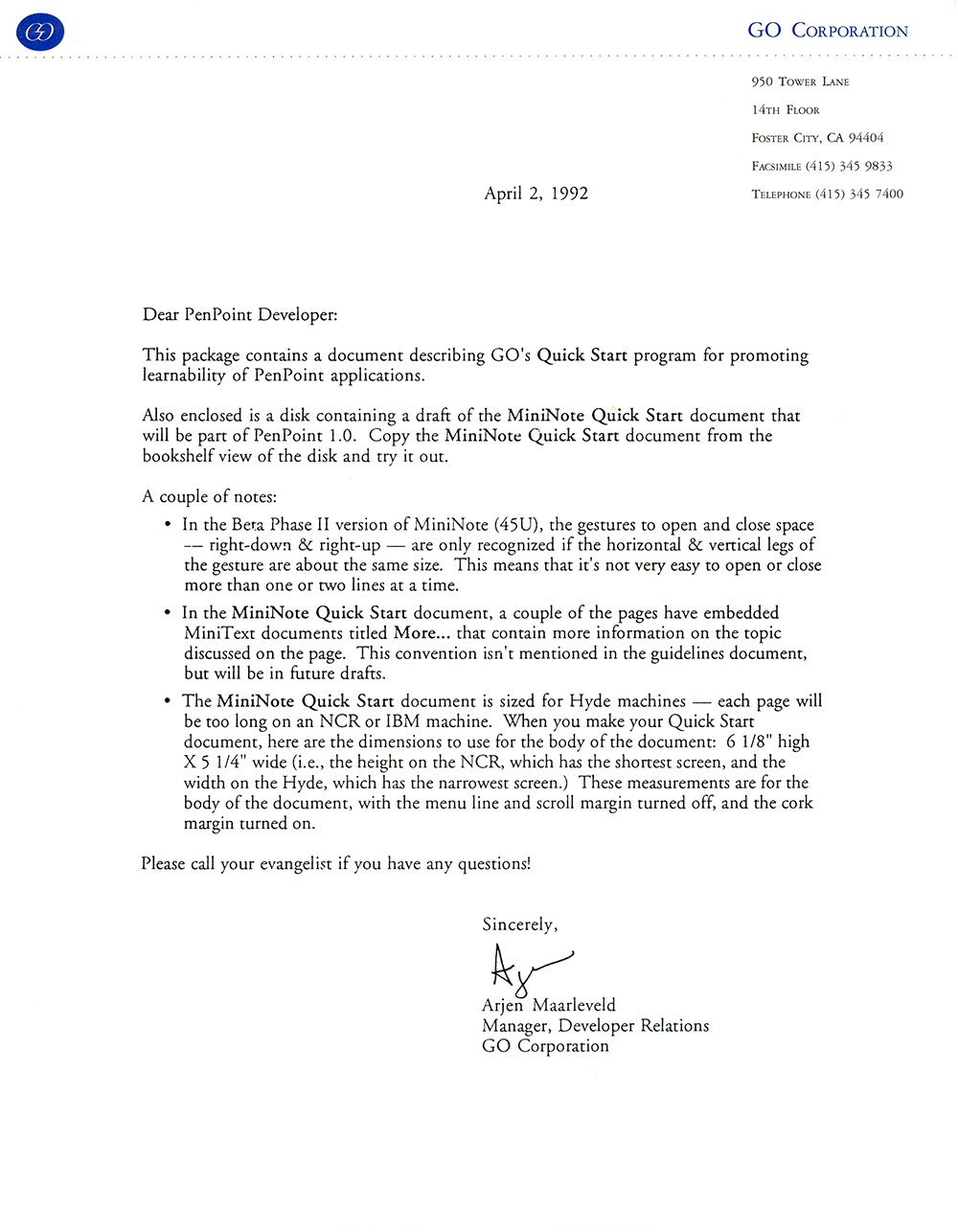
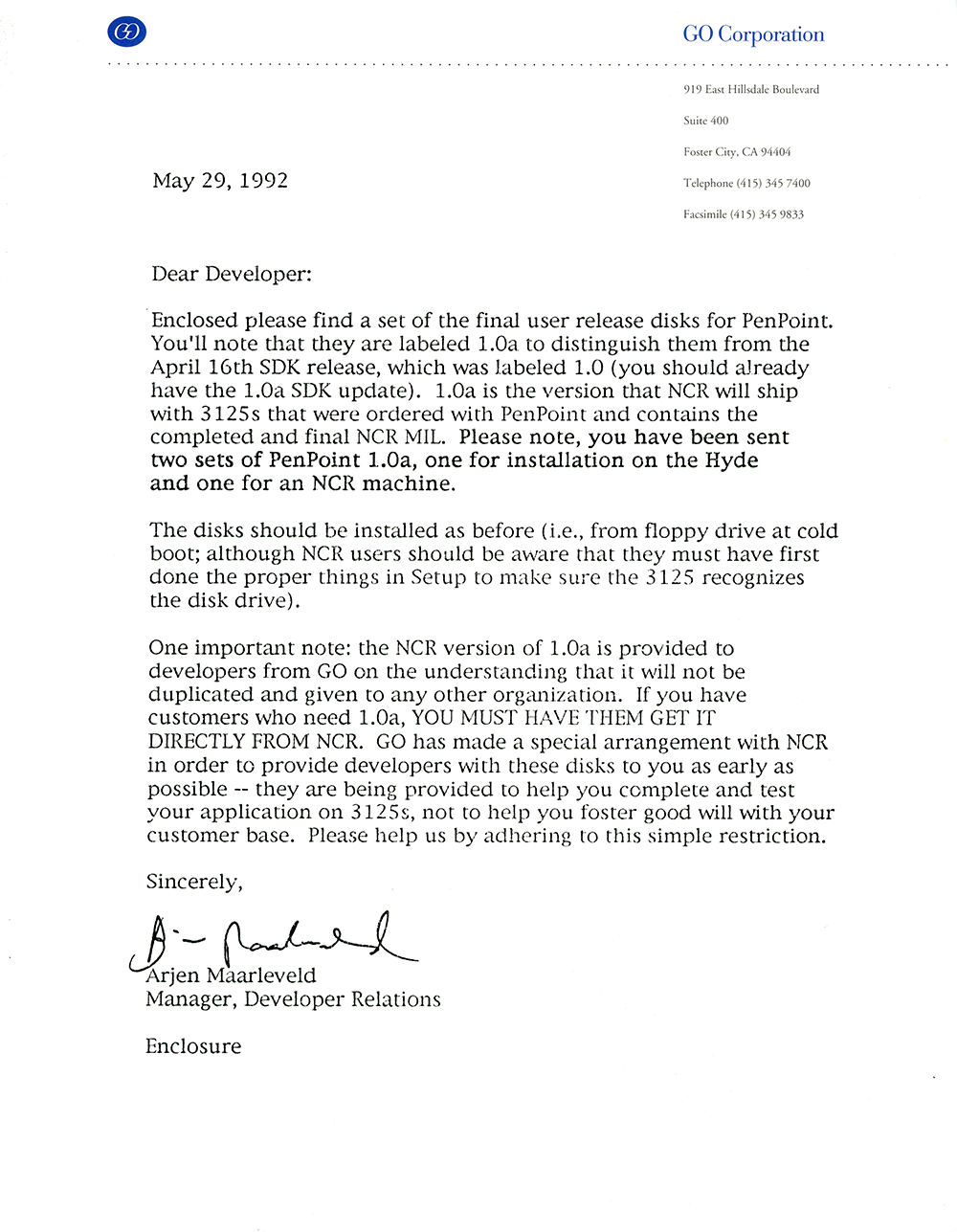
A letter on GO Corporation stationery from Arjen Maarleveld, Manager Developer Relations, about the final user release disks for the PenPoint (for developers).
It’s interesting to note that GO requested developers not to share this release directly with NCR 3125 customers, but instead requested that developers forward customers to NCR.
Were you involved with this artifact? If so, we would like to include your story on this page. Let us know how you contributed.
Artifact Details
GO Corporation
Arjen Maarleveld
United States
English
May 29, 1992
A letter on GO Corporation stationery.
8.5" x 11"
1992
Acquired from developer
2018-05-15
Organizations


History
GO Corporation Correspondence - PenPoint SDK 1.0a is a letter dated May 29, 1992, sent to PenPoint developers by Arjen Maarleveld, GO Corporation's Manager of Developer Relations.1 It accompanied a set of final user-release disks for PenPoint labeled version 1.0a, distinguished in the letter from the April 16, 1992 Software Development Kit release that carried version 1.0.1 GO had announced the commercial availability of PenPoint on April 16, 1992, shipping the PenPoint Software Development Kit — an executable copy of the operating system with tools and documentation — through GO Corporation, Merisel, and Ingram/Micro D.2
According to the letter, version 1.0a was the release NCR Corporation would ship with the System 3125 notepads that customers had ordered with PenPoint.1 NCR had announced the System 3125 on June 24, 1991, an Intel 386-based pen notepad that supported both GO's PenPoint and Microsoft's Windows for Pen Computing operating systems.3 GO demonstrated PenPoint running on the 3125 the same day, describing it as the first announced Intel 386-based pen hardware platform and presenting the notepad's portability together with PenPoint's interface as a new tool for mobile professionals.4
By October 1991, GO had shipped its Developer Release of PenPoint to more than 500 individuals and organizations and launched a multi-phase Beta Program aimed at a production release of PenPoint 1.0 in the first quarter of 1992.5 The May 1992 letter continued that developer-support effort, sending two sets of the 1.0a disks — one for the Hyde and one for an NCR machine.1 GO had made a special arrangement with NCR to give developers the NCR version early so they could complete and test their applications on the 3125, and asked that the NCR release not be shared, directing any customers who needed 1.0a to obtain it directly from NCR.1
AI generated using primary sources referenced in the footnotes
Footnotes
- GO Corporation, GO Corporation Correspondence - PenPoint SDK 1.0a (May 29, 1992) (image scan), May 29, 1992
- GO Corporation, GO Corp. Announces Availability of PenPoint, April 16, 1992
- NCR Corporation, NCR Corporation Announces the NCR System 3125, June 24, 1991
- GO Corporation, GO Corporation Sees Pen Computing Market Emerge with NCR Announcement of Pen Hardware Platform, June 24, 1991
- GO Corporation, GO Expands Licensing, Education and Beta Programs to Accelerate Mobile Computer Market Development, October 21, 1991
Oral History
Media
GO Corporation – Introducing PenPoint (1991)
GO Corporation used this video to promote the developer release of the PenPoint OS in 1991. PenPoint was one of the first operating systems designed specifically to run on mobile devices. Featuring: Dr. Norm Vincent (State Farm), Terry Conner (EDS), Phillipe Kahn (Borland), Jack Blount (Novell), David Reed (Lotus), Alan Lefkof (Grid), Vern Raburn (Slate), Dan Bricklin (Slate), and Jim Cannavino (IBM).
PenPoint Demonstration 1991
GO Corporation’s 1991 promotional video about their pen-based operating system, aimed at software developers. Includes an extensive demo by Robert Carr, architect of the operating system, where he shows the notebook metaphor, their use of gestures, the embedded document architecture, and more.
Connections
This artifact's place in the wider network of people, organizations, and artifacts. Drag to pan, scroll to zoom, and tap any node to focus its connections.