GO Corporation Correspondence – Quick Start Program (April 2, 1992)
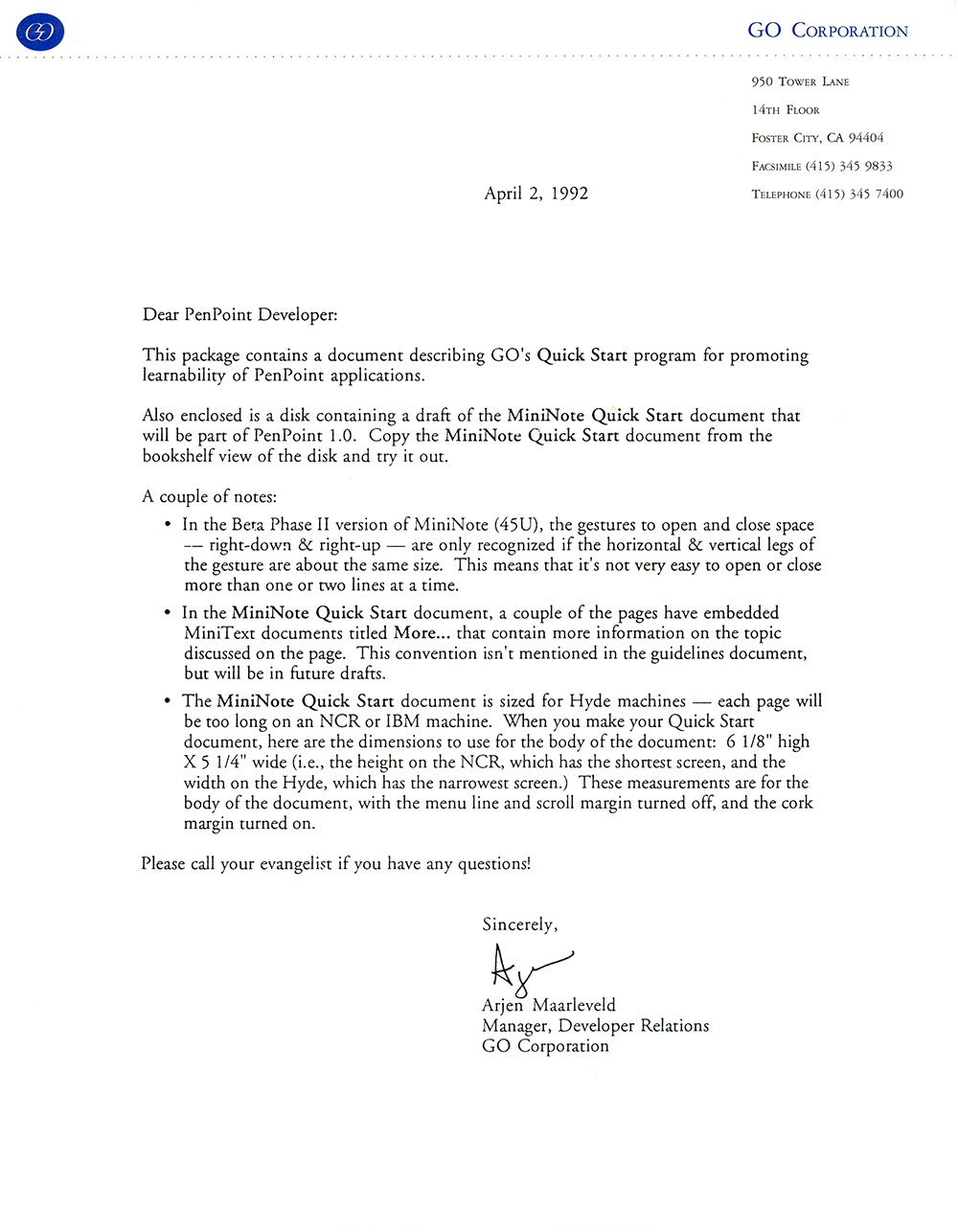
A letter on GO Corporation stationery from Arjen Maarleveld, Manager Developer Relations, about the GO Quick Start program for promoting learnability of PenPoint applications.
Were you involved with this artifact? If so, we would like to include your story on this page. Let us know how you contributed.
Artifact Details
GO Corporation
Arjen Maarleveld
United States
English
April 2, 1992
A letter on GO Corporation stationery.
8.5" x 11"
1992
Acquired from developer
Organizations


History
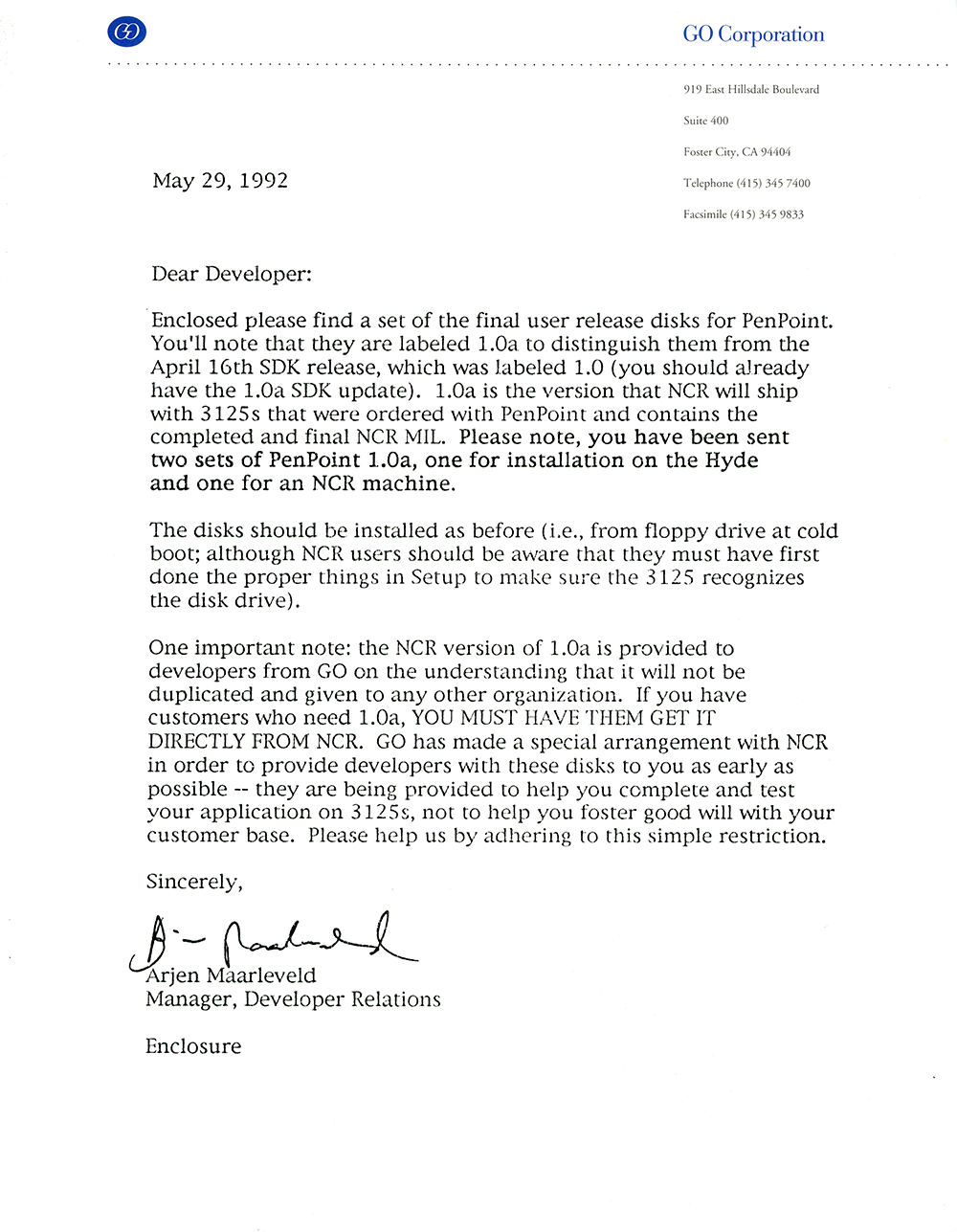
This letter, dated April 2, 1992 and addressed to PenPoint developers, was sent by Arjen Maarleveld, Manager of Developer Relations at GO Corporation, to introduce GO's Quick Start program for promoting the learnability of PenPoint applications. It accompanied a document describing the program and a disk holding a copy of the MiniNote Quick Start document that GO planned to bundle with PenPoint 1.0, offered to developers as a working model from which to build Quick Start documents for their own applications.1
Quick Start documents were short tutorials that GO designed to get a user started with PenPoint and its applications in ten minutes or less, bundled with the operating system and its standard applications, with GO intending to make Quick Start documents available for third-party applications as well.2
Maarleveld included several technical notes for developers working with the enclosed materials. He explained that in the Beta Phase II release of MiniNote, the right-down and right-up gestures used to open and close space were recognized only when the horizontal and vertical parts of the gesture were about the same size, which made it difficult to open or close more than a line or two at a time. He also noted that some pages of the MiniNote Quick Start document contained embedded MiniText documents labeled “More…” that carried additional information not yet described in the program's guidelines, and he warned that the document had been sized for one class of target machine and would run too long on an NCR or IBM screen, advising developers to size their own Quick Start documents to fit the shortest and narrowest screens across the supported hardware.3
GO Corporation announced the commercial release of PenPoint two weeks later, on April 16, 1992, shipping the PenPoint Software Development Kit alongside the operating system it had first unveiled to the developer community in January 1991.4
AI generated using primary sources referenced in the footnotes
Footnotes
- GO Corporation, GO Corporation Correspondence - Quick Start Program (April 2, 1992) (image scan), April 2, 1992
- GO Corporation, GO Corp. Announces Availability of PenPoint, April 16, 1992
- GO Corporation, GO Corporation Correspondence - Quick Start Program (April 2, 1992) (image scan), April 2, 1992
- GO Corporation, GO Corp. Announces Availability of PenPoint, April 16, 1992
Oral History
Media
GO Corporation – Introducing PenPoint (1991)
GO Corporation used this video to promote the developer release of the PenPoint OS in 1991. PenPoint was one of the first operating systems designed specifically to run on mobile devices. Featuring: Dr. Norm Vincent (State Farm), Terry Conner (EDS), Phillipe Kahn (Borland), Jack Blount (Novell), David Reed (Lotus), Alan Lefkof (Grid), Vern Raburn (Slate), Dan Bricklin (Slate), and Jim Cannavino (IBM).
PenPoint Demonstration 1991
GO Corporation’s 1991 promotional video about their pen-based operating system, aimed at software developers. Includes an extensive demo by Robert Carr, architect of the operating system, where he shows the notebook metaphor, their use of gestures, the embedded document architecture, and more.
Connections
This artifact's place in the wider network of people, organizations, and artifacts. Drag to pan, scroll to zoom, and tap any node to focus its connections.