GO Corporation PenPointers November 1992 (Newsletter)
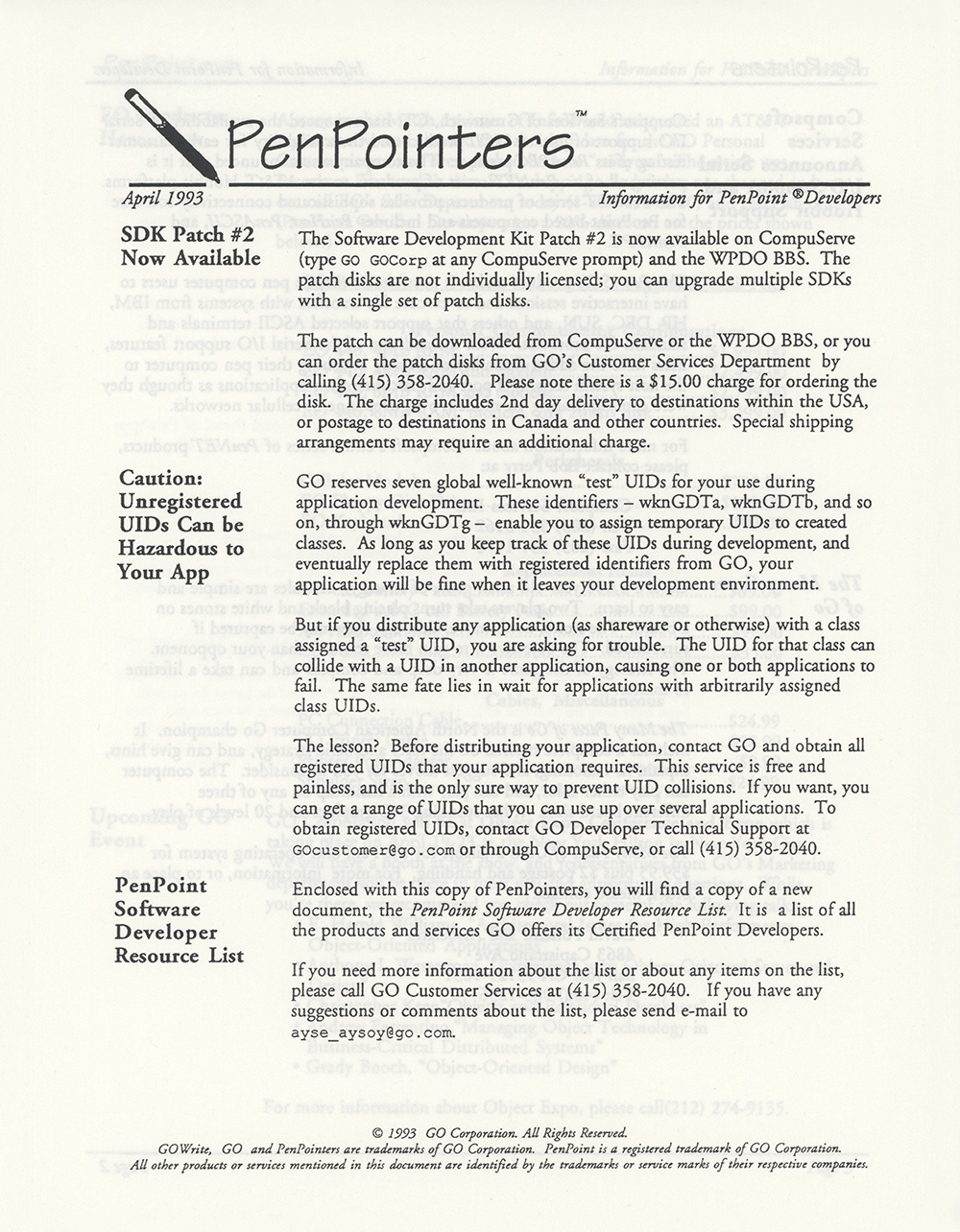
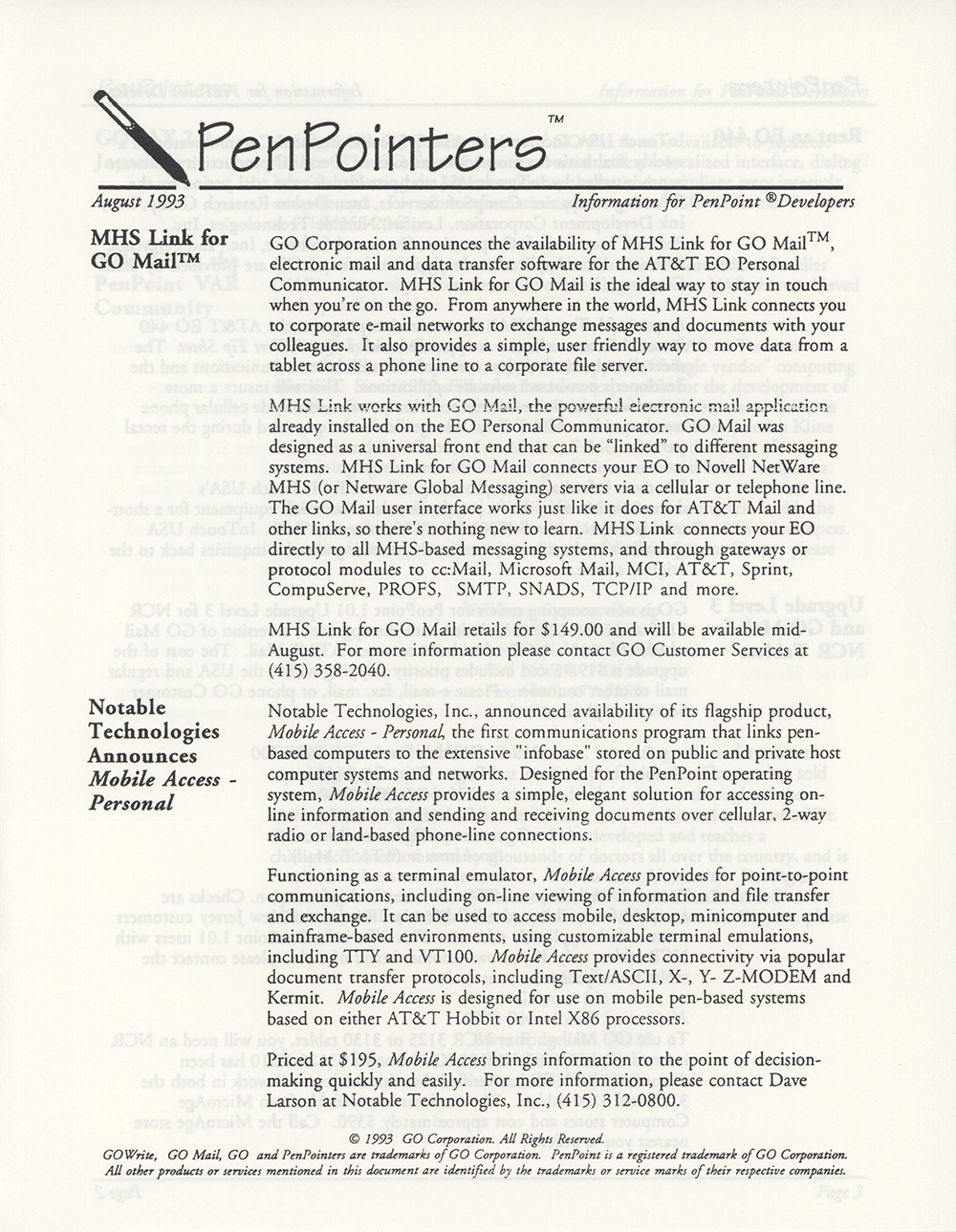
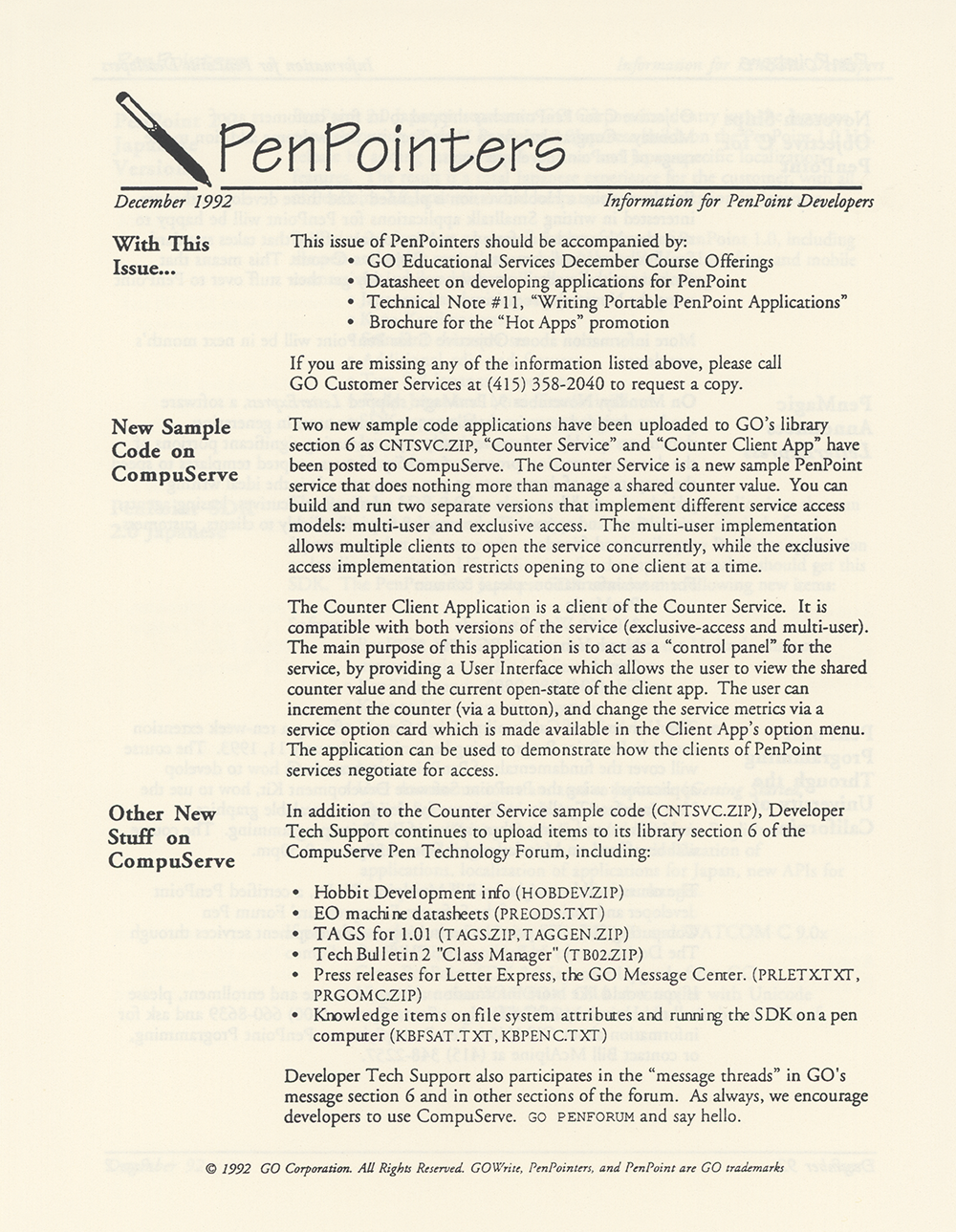
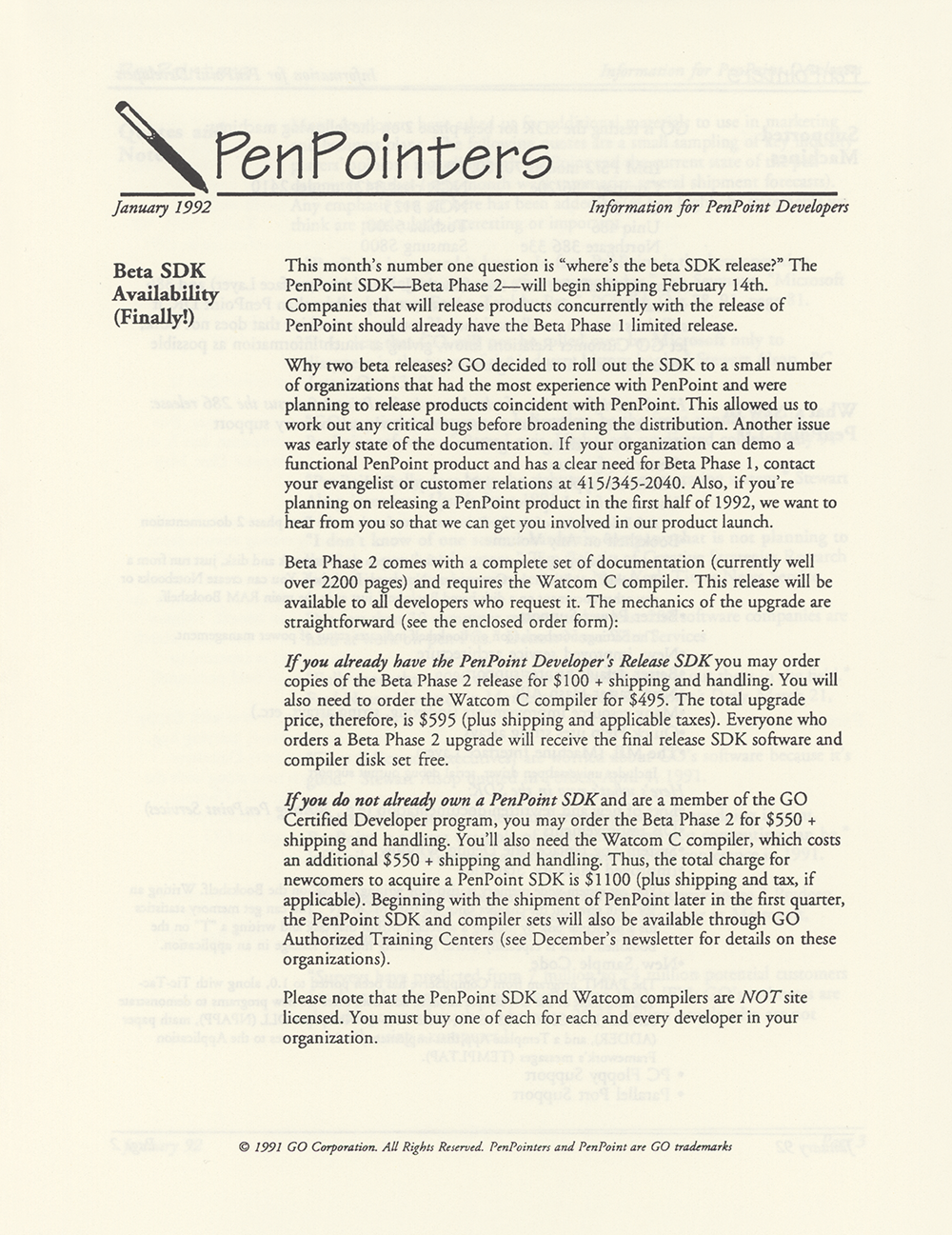
PenPointers was the official software developers newsletter published by GO Corporation. Issues contained corporate updates, descriptions of new operating system features, hardware compatibility notes, and tips and techniques, among other information.
Were you involved with this artifact? If so, we would like to include your story on this page. Let us know how you contributed.
Artifact Details
GO Corporation
United States
English
November 1992
Four page, black & white, saddle-stitched, paper.
8.5" x 11" (4 pages)
PenPointers November 1992
1992
Direct from publisher
2020-07-03
Organizations

History
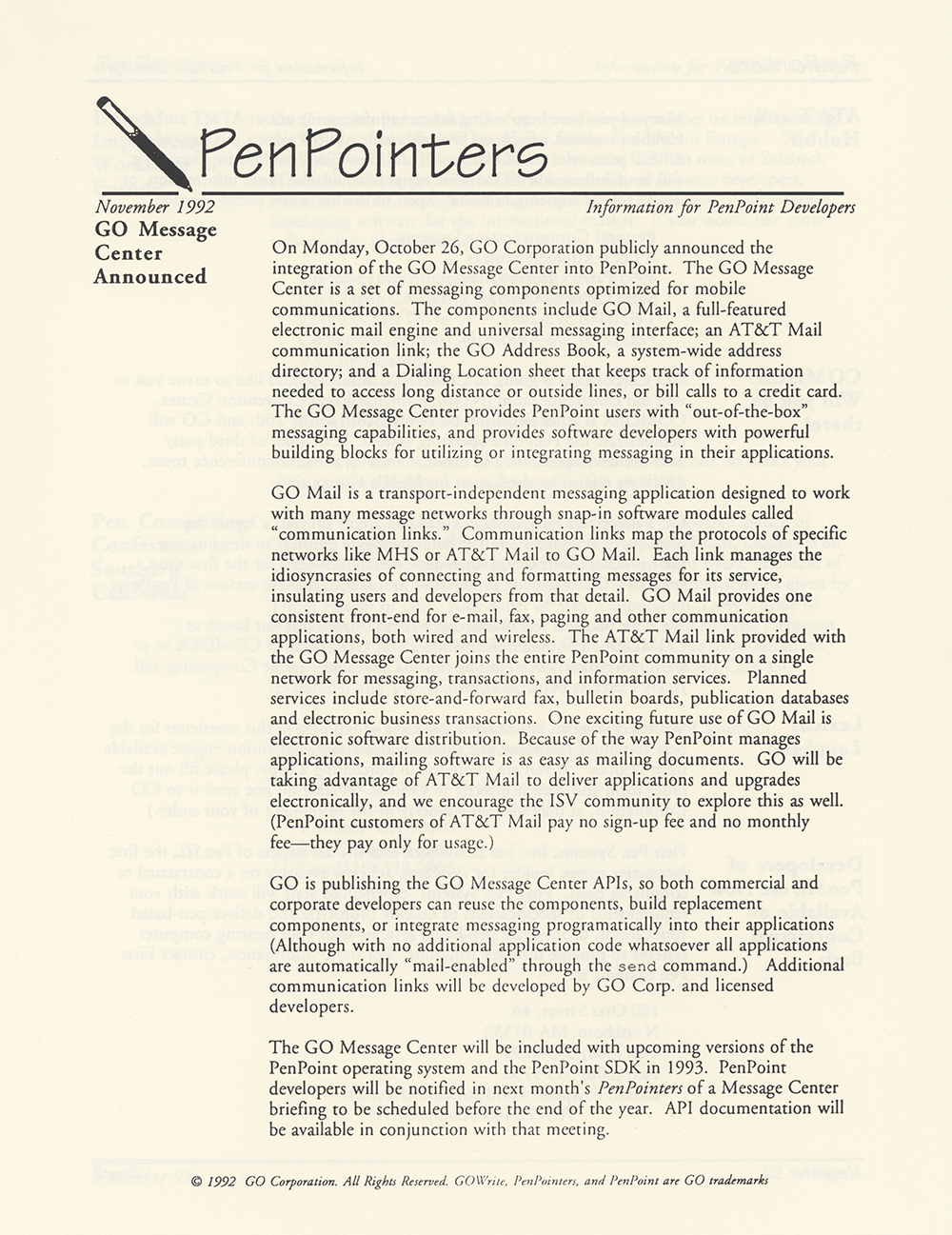
The November 1992 issue of PenPointers, GO Corporation's newsletter for PenPoint developers, led with the announcement of the GO Message Center.1 GO had publicly disclosed the Message Center on Monday, October 26, 1992, presenting it as a tightly integrated set of object-oriented messaging components that would ship as a standard part of the PenPoint mobile operating system.2 The components bundled GO Mail, a full-featured electronic mail engine and universal messaging interface; an AT&T Mail communication link; a system-wide GO Address Book accessible from any PenPoint application; and a Dialing Location sheet, and GO simultaneously introduced GO Fax, the first commercially available application built on the Message Center, at a suggested list price of $199 and availability in the fourth quarter of 1992.2 The newsletter described GO Mail as transport-independent, connecting to messaging networks through software modules called communication links and providing a single front end for electronic mail, fax, and paging.1 It told developers that the GO Message Center would be included with upcoming versions of the PenPoint operating system and software developer's kit in 1993, with a Message Center briefing to be scheduled before the end of the year.1
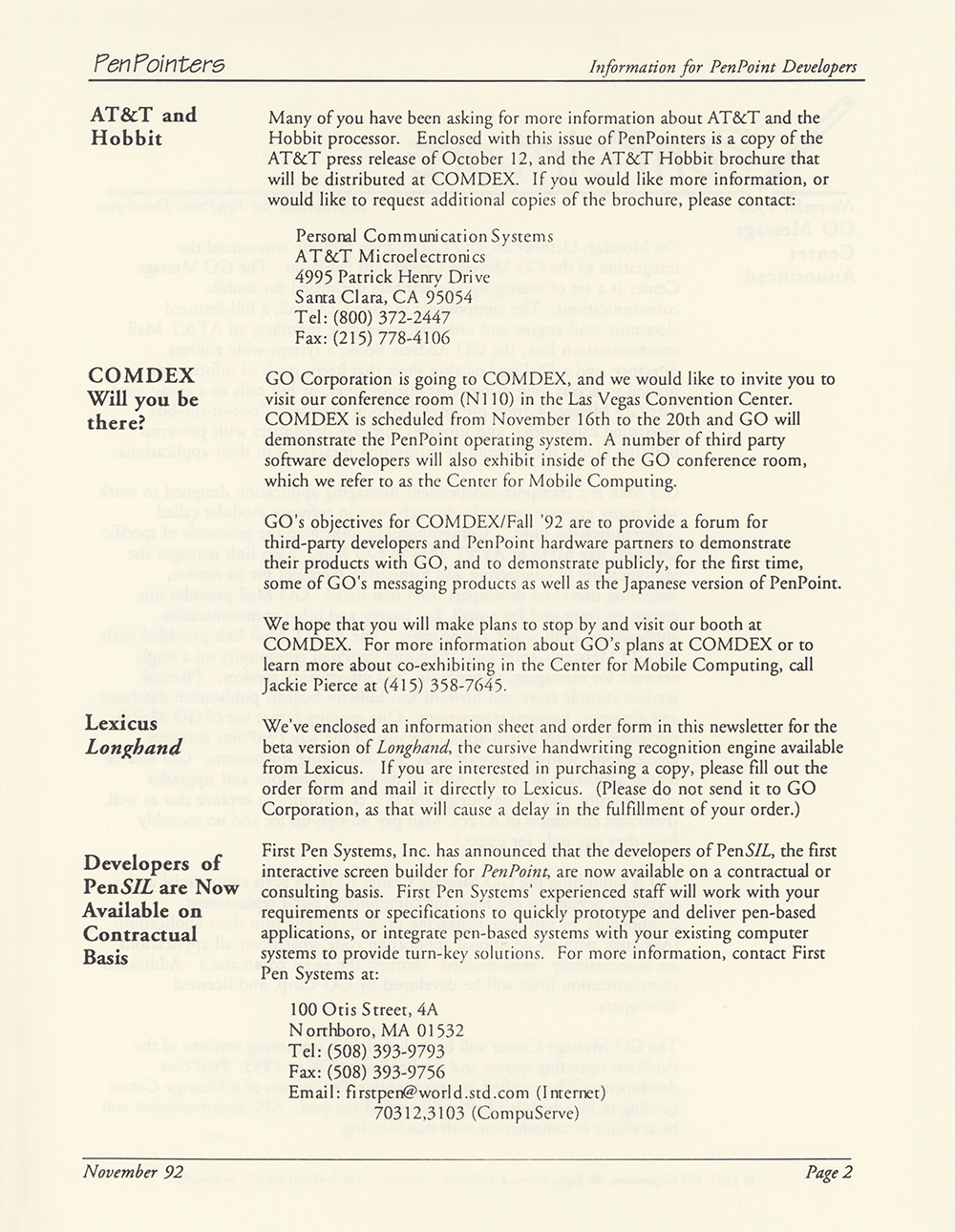
The AT&T Mail link grew out of a separate agreement GO and AT&T EasyLink Services had announced the same day, under which every PenPoint user would eventually be tied to AT&T's public messaging network and its more than 20 million electronic mail users in over 160 countries.3 PenPoint users would receive the AT&T Mail communication link free, paying only for messages they sent or information services they accessed.3 The issue enclosed AT&T's October 12 press release and an AT&T Hobbit brochure prepared for COMDEX, answering developer questions about AT&T and the Hobbit processor.1 AT&T Microelectronics and GO had made that development relationship public in July 1992, agreeing to optimize PenPoint for AT&T's new Hobbit line of low-power RISC microprocessors aimed at the emerging personal communicator market.4
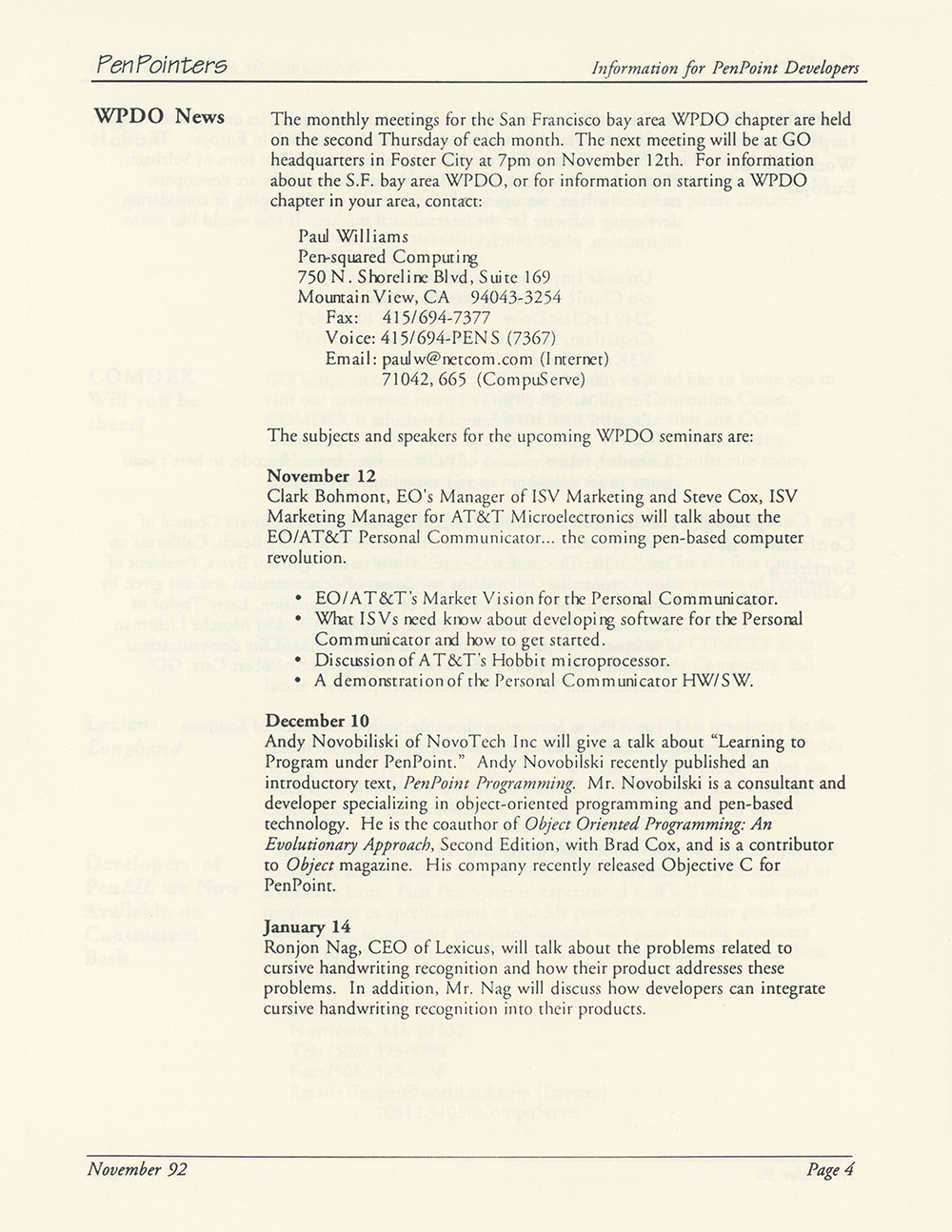
That market had taken shape over the preceding weeks: on November 4, 1992, EO Inc. unveiled the world's first personal communicators, the EO Personal Communicator 440 and 880, both built around the Hobbit processor and the PenPoint operating system.5 AT&T followed on November 16, 1992, announcing that it would market the AT&T Personal Communicator 440 — designed and supplied by EO — through its Phone Centers in early 1993.6 The newsletter's seminar calendar previewed this hardware directly, scheduling a November 12 talk by EO's and AT&T Microelectronics' ISV marketing managers on developing software for the EO/AT&T Personal Communicator.1
For COMDEX/Fall '92, the newsletter announced that GO would host a conference room — N110 at the Las Vegas Convention Center, which it called the Center for Mobile Computing — where it would demonstrate PenPoint alongside third-party developers.1 GO planned to show some of its messaging products publicly for the first time at the show, along with the Japanese version of PenPoint.1
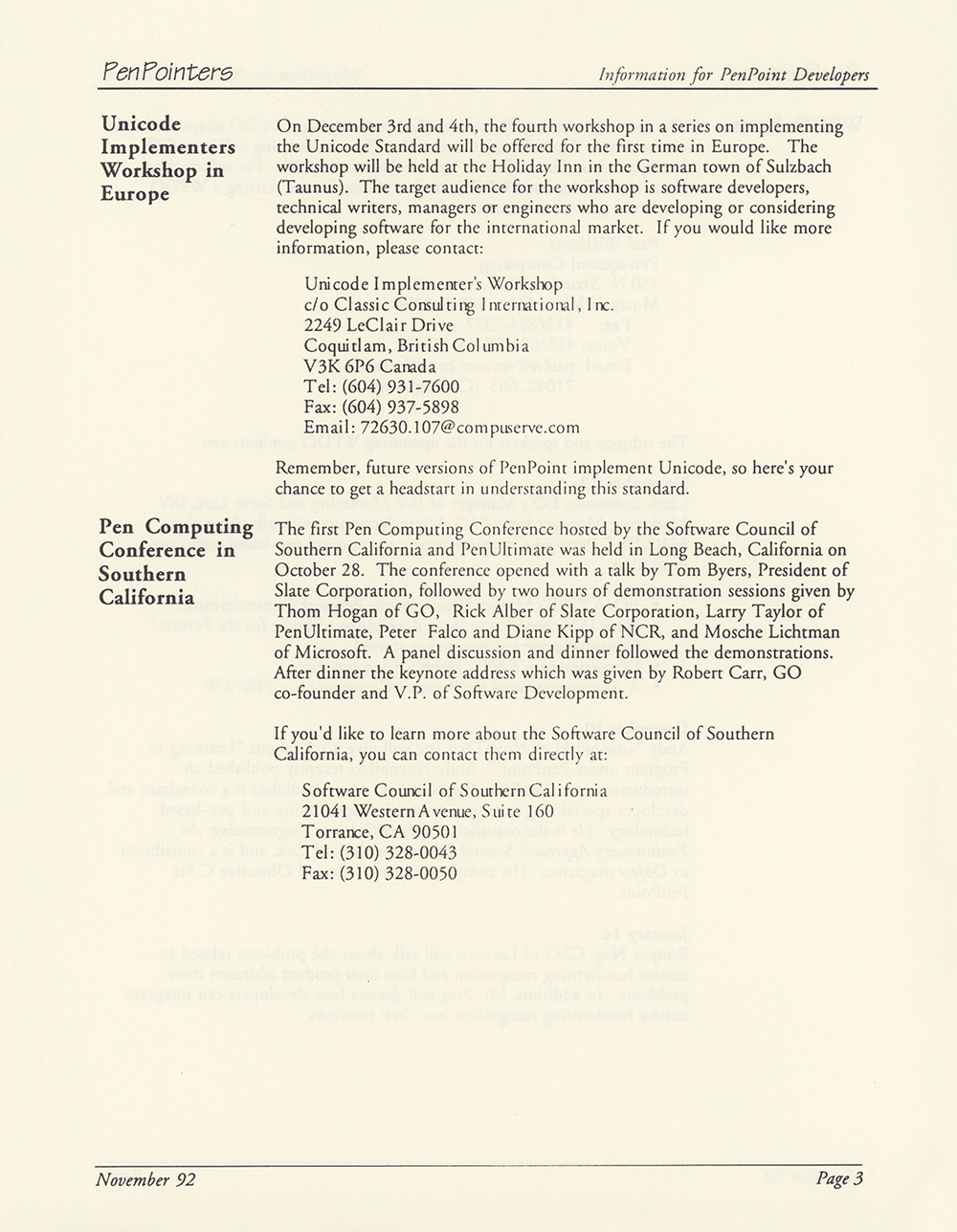
The issue also reported on the first Pen Computing Conference, hosted by the Software Council of Southern California and PenUltimate in Long Beach on October 28, 1992, which opened with a talk by Slate Corporation president Tom Byers and closed with a keynote by GO co-founder and vice president of software development Robert Carr.1 It announced a Unicode Implementors Workshop to be held in Europe on December 3 and 4, 1992, noting that future versions of PenPoint would implement the Unicode standard.1 The San Francisco Bay Area WPDO chapter's seminar calendar also listed a December session on programming under PenPoint and a January 1993 talk on cursive handwriting recognition by Lexicus chief executive Ranjan Nag.1
AI generated using primary sources referenced in the footnotes
Footnotes
- GO Corporation, GO Corporation PenPointers November 1992 (Newsletter) (image scan), November 1992
- GO Corporation, GO Introduces Messaging and Fax Capabilities in PenPoint, October 26, 1992
- GO Corporation, AT&T EasyLink Services and GO Corp. Establish Worldwide Network for PenPoint Users, October 26, 1992
- AT&T Microelectronics and GO Corporation, AT&T Microelectronics and GO Corporation Announce Development Relationship, July 13, 1992
- EO Inc., EO Unveils World's First Personal Communicators, November 4, 1992
- AT&T, AT&T to Market Personal Communicator in Partnership with EO, Inc., November 16, 1992
Oral History
Media
GO Corporation – Introducing PenPoint (1991)
GO Corporation used this video to promote the developer release of the PenPoint OS in 1991. PenPoint was one of the first operating systems designed specifically to run on mobile devices. Featuring: Dr. Norm Vincent (State Farm), Terry Conner (EDS), Phillipe Kahn (Borland), Jack Blount (Novell), David Reed (Lotus), Alan Lefkof (Grid), Vern Raburn (Slate), Dan Bricklin (Slate), and Jim Cannavino (IBM).
Connections
This artifact's place in the wider network of people, organizations, and artifacts. Drag to pan, scroll to zoom, and tap any node to focus its connections.