
And They’re Off!
From the Original Pages
Click a page to enlarge · Alt-click to open the full issue
But You Need A Score Card to Know the Players
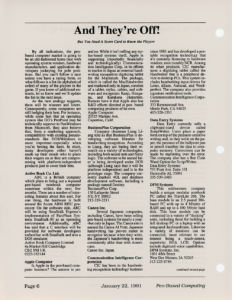
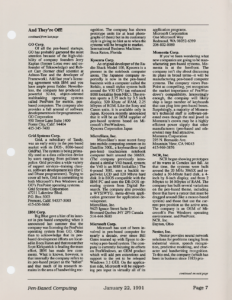
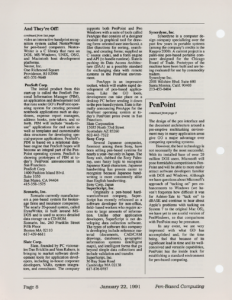
By all indications, the pen-based computer market is going to be an old-fashioned horse race with operating system vendors, hardware manufacturers, and application developers jockeying for pole positions. But you can’t follow a race unless you have a racing form, so what follows is a list (in alphabetical order) of many of the players in the game. If you know of additional entrants, let us know and we’ll update the list in the next issue.
As the race analogy suggests, there will be winners and losers. Consequently, some companies are still hedging their bets. For instance, while some feel that an operating system like GO’s PenPoint may be technically superior to PenWindows from Microsoft, they also believe that, from a marketing approach, compatibility with existing pseudo-standards like DOS/Windows is more important — especially when you’re betting the farm. In short, many developers either haven’t made up their minds who to place their wagers on or they are compromising with platform-independent products just to cover their bets.
Active Book Co. Ltd.
ABC is a British company which plans to bring out a 4-pound pen-based notebook computer sometime within the next few months. There are a number of interesting features about this unit. For one thing, the hardware is built around the Acorn ARM RISC processor. On the software side, ABC will be using Smalltalk Express’s implementation of ParcPlace Systems Smalltalk-80 as an operating environment. Additionally, ABC has said that a C interface will be provided for software developers unfamiliar with Smalltalk and also a DOS emulator.
Active Book Company Limited
4a Market Hill Cambridge
CB2 3NJ UK
0223-355144
Apple Computer
Is Apple in the pen-based computer business? The answer is yes and no. While it isn’t selling any stylus-based systems itself, Apple is supporting (reportedly financially and technologically) Communication Intelligence Corp. in its efforts to market in Japan an external handwriting recognition digitizing tablet for the Macintosh. The package, which is called the MacHandwriter and marketed only in Japan, consists of a tablet, stylus, cables, and software and recognizes Kanji, Hiragana, and Karakana characters. Rumors have it that Apple also has R&D efforts directed at pen-based computing products of its own.
Apple Computer
20525 Mariani Ave.
Cupertino, Calif.
BusinessPlus Corporation
Company chairman Liang Liang told us that BusinessPlus is developing software libraries for handwriting recognition. According to Liang, they are basing their research on a variety of technologies, including both neural nets and fuzzy logic. The software to be named later is being developed under DOS (although Liang says that it will be platform independent) and is in the prototype stage. The company currently markets 4GL and database development software, including a package named Destiny.
BusinessPlus Corp.
150 Lafayette Street
NY, NY 10013
212-219-2211
Canon Inc.
Several Japanese companies, including Canon, have been selling pen-based systems for nearly a year — but only in Japan. The Canon unit is named the Canon AI Note. Japanese handwriting has proven easier to recognize because when they write, the Japanese’s handwriting is more consistently alike than with Americans.
Canon Inc. Japan
Communication Intelligence Corporation
CIC has been in the handwriting recognition technology business since 1981 and has developed a portable recognition technology that it’s currently licensing to hardware vendors, most notably NCR. Among its other products, CIC manufactures a digitizing tablet called the Handwriter that is a peripheral device to desktop PCs. This system includes handwriting input drivers for Lotus, dBase, Autocad, and WordPerfect. The company also provides signature verification tools.
Communication Intelligence Corporation
333 Ravenswood Ave.
Menlo Park, CA 94025
415-328-1311
Data Entry Systems
Data Entry currently sells a clipboard-sized device called ScriptWriter. Users place a paper form on top of the pressure-sensitive writing and, as they write on the paper, the pressure of the ballpoint pen or pencil transfers the data to computer memory. Corrections can be made by reprinting over the error. The company also has a Bar Code Wand Option for ScriptWriter.
Data Entry Systems
701 Pratt Ave. Suite 101
Huntsville, AL 35801
205-539-2483
DFM Systems
This midwestern company builds a unique modular notebook PC called the TraveLite 286. The base module is an 2.5 pound 286-based PC with up to 4 Mbytes of RAM and up to a 100 Mbyte hard disk. This base module can be connected to a variety of “docking” units, including those for building a full desktop PC or a laptop with an integrated keyboard/case. Likewise a variety of monitors can be connected, most relevant to our interest being a touch-screen, supertwist EGA LCD. Options include digitized voice capabilities.
DFM Systems, Inc.
1601 48th Street
West Des Moines, IA 50265
515-225-6744
GO Corp.
Of all the pen-based startups, GO has probably garnered the most attention because of the high-visibility of company founders Jerry Kaplan (former Lotus exec and co-founder of Teknowledge) and Robert Carr (former chief scientist at Ashton-Tate and the developer of Framework). Add last year’s licensing agreement with IBM and you have ample press fodder. Nevertheless, the company has produced a powerful 32-bit, object-oriented multitasking operating systems called PenPoint for mobile, pen-based computers. The company also provides a full arsenal of software development tools for programmers.
GO Corporation
950 Tower Lane Suite 1400
Foster City, Calif. 94404
415-345-7400
Grid Systems Corp.
Grid, a subsidiary of Tandy, was an early entry in the pen-based market with its DOS-, 8086-based GridPad. The system is being primarily used as a data collection device by users ranging from pollsters to police. Grid provides a wide variety of support services — training classes, software development kits (for C and Dbase programmers). Trying to cover all bets, Grid is committing to both Microsoft’s Pen Windows and GO’s PenPoint operating systems.
Grid Systems Corporation
47211 Lakeview Blvd.
P.O. Box 5003
Fremont, Calif. 94537-5003
415-656-1666
IBM Corp.
Big Blue gave a hint of its interest in pen-based computing when it announced last summer that the company was licensing the PenPoint operating system from GO. Other than to acknowledge that its pen-based development efforts are located in Boca Raton and that researcher Scott Kirkpatrick is leading the team effort, IBM has made few comments. What is known, however, is that internally the company refers to its pen-based project as the “tablet” and that much of its research remains in the area of handwriting recognition. The company has shown prototype units (or at least photographs of them) but in its customary style is giving no hint as to when the systems will be brought to market.
International Business Machines
Boca Raton, Florida
Kyocera Corp.
As original developer of the Radio Shack Model 100, Kyocera is a pioneer in the notebook computer arena. The Japanese company reportedly is now in the pen-based business with a computer called the Refalo, a small stylus system built around the V30 CPU (an enhanced 8088 lookalike from NEC). The system sports a 2.75 inch by 3.5 inch display, 320 Kbyte of RAM, 2.25 Mbytes of ROM. Like the Sony and Canon units, it is available only in Japan. Kyocera recently announced that it will be an OEM supplier of pen-based systems based on Microsoft’s PenWindows.
Kyocera Corporation Japan
MicroSlate, Inc.
MicroSlate’s most recent foray into mobile computing centers on its Datellite 300L, a keyboardless (and pen-less) touchscreen notebook computer built around the 386SX. (The company previously introduced a similar V40-based, system; the V40 is an 8088 lookalike.) The 6-pound 300L uses a backlit supertwist LCD and 120 Mbyte hard disk. It is BIOS compatible with the IBM PC and uses the DR-DOS operating system from Digital Research. The company also provides a WYSIWYG, menu-driven application generator for application development.
MicroSlate, Inc.
9625 Ignace Street Suite D
Brossard Quebec J4Y 2P3 Canada
514-444-3680
Microsoft Corp.
Microsoft has sort of been involved in pen-based computer for nearly a decade, ever since Bill Gates teamed up with Epson to develop a pen-based system. The company is currently focusing its efforts on PenWindows, an OEM product which will add pen extensions and support to the yet to be released Windows 3.1 GUI. On the application side, Microsoft will be supporting pen input in virtually all of its application programs.
Microsoft Corporation
One Microsoft Way
Redmond, WA 98052-6399
206-802-8080
Momenta Corp.
If you’ve been wondering what new companies are going to be manufacturing pen-based systems, Momenta is at the forefront. The company isn’t shy about discussing its plans in broad terms — it will be manufacturing pen-based computer systems. The company views PenPoint as compelling, yet recognizes the market importance of PenWindows’s compatibility. Interestingly enough, the company will likely ship a large number of keyboards that can plug into pen-based boxes. Surprisingly, a majority of Momenta’s technical staff is software-oriented even though the real jewel in Momenta’s crown may be a highly efficient power supply that other manufacturers (pen-based and otherwise) may find attractive.
Momenta Corporation
295 N. Bernardo Ave.
Mountain View, CA 94043
415-969-3876
NCR, Inc.
NCR began showing prototypes of its wares at Comdex last fall. At that time, the systems were built around the 20 MHz 386SX and included a 30-Mbyte hard disk, a 4-inch by 8-inch display, and from 2 Mbytes to 16 Mbytes of RAM. The company has built several variations on the pen-based theme, including those that have a cursor that must be dragged around (like a mouse-based system) and those that use the current pen position as the active area. The company is an OEM of Microsoft’s Pen Windows operating environment. and PenPoint.
NCR, Inc.
Dayton, Ohio
Nestor, Inc.
Nestor provides neural network solutions for problems ranging from industrial vision, speech recognition, predictive modeling, and character and handwriting recognition. To this end, the company (which has been in business since 1983) provides an interactive handprint recognition system called NestorWriter for pen-based computers. NestorWriter is a C library that runs on DOS, MS-Windows, UNIX, OS/2, and Macintosh host development platforms.
Nestor, Inc.
One Richmond Square
Providence, RI 02906
401-331-9640
PenSoft Corp.
The initial product from this start-up is called the PenSoft Personal Information Manager (PIM), an application and development tool that runs under GO’s PenPoint operating system for creating personal notebook applications such as daytimers, expense report managers, address books, note-takers, and so forth. PIM will include “ready-to-use” applications for end users as well as templates and customizable data structures for developing special-purpose applications. PenSoft’s PIM is based on a relational database engine that PenSoft hopes will become an integral part of the PenPoint operating system. PenSoft is showing prototypes of PIM at today’s PenPoint announcement in San Francisco.
PenSoft Corp.
1400 Fashion Island Blvd.
Suite 1050
San Mateo, CA 94404
415-358-1575
Scenario, Inc.
Scenario currently manufacturers a pen-based system for brokerage firms and insurance companies. The nearly 20-pound system, called DynaWriter, is built around MS-DOS and is used to access detailed data storage on a CD-ROM.
Scenario, Inc.
260 Franklin Street
Fifth Floor
Boston MA 02110
617-439-6611
Slate Corp.
Slate, founded by PC visionaries Dan Bricklin and Vern Raburn, is bringing to market software development tools for application developers, including in-house corporate developers, VARs, system integrators, and consultants. The company supports both PenPoint and Pen Windows with a suite of tools called PenApps that consists of a designer module (a graphical tool for drawing form-oriented user interfaces), a filer (functions for sorting, searching, and creating forms; supplied as C source code), and a form engine and API (to handle runtime). Slate is pushing its Data Access Architecture (DAA) as a possible standard for exchanging data with remote systems in the PenPoint environment.
PenApps is an impressive toolset, which will enable rapid development of pen-based applications. Like the GO tools, development can take place on a desktop PC before sending it down to the pen-based system. Slate is formally announcing PenApps for the PenPoint operating system at today’s PenPoint press event in San Francisco.
Slate Corporation
15035 North 73rd Street
Scottsdale AZ 85260
602-443-7322
Sony Corp.
Several Japanese companies, foremost among them Sony, have been selling pen-based systems for nearly a year — but only in Japan. The Sony unit, dubbed the Sony Palmtop, uses fuzzy logic to recognize Japanese Kanji characters. Japanese handwriting has proven easier to recognize because Japanese handwriting is more consistently alike than English handwriting.
Sony Corp. Japan
SuperScript, Inc.
Originally a pen-based hardware/software company, SuperScript has recently refocused as a software developer for non-office, field-based workers who require access to large amounts of information. Unlike other application developers, SuperScript is not developing data collection software. The types of software this company is developing include reference material (documents, CAD/CAM drawings, databases), geographic information systems (intelligent maps), and intelligent forms that go beyond simple data collections and include validation and transfer.
SuperScript, Inc.
36 Bay State Road
Cambridge MA 02138
617-876-0787
Synerdyne, Inc.
Synerdyne is a computer design company specializing over the past few years in portable systems (among the company’s credits is the Kaypro 2000). A current project is a palm-size pen-based portable computer designed for the Chicago Board of Trade. Prototypes of the machine have been built and are being evaluated for use by commodity traders.
Synerdyne Inc.
2001 Wilshire Blvd. Suite 600
Santa Monica, Calif. 90403
213-453-0404
Transcribed from Pen-Based Computing, Volume 1, Number 1 — January 22, 1991. Pages 6, 7, 8.