
Roaming Around the Mobile Computing Industry
From the Original Pages
Click a page to enlarge · Alt-click to open the full issue
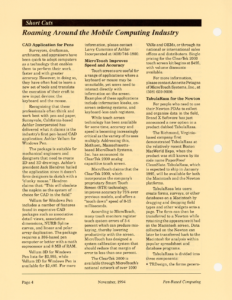
CAD Application for Pens
Surveyors, draftsman, architects, and appraisers have been quick to adopt computers as a technology that enables them to perform their work faster and with greater accuracy. However, in doing so, they have often had to learn a new set of tools and translate the execution of their craft to new input devices: the keyboard and the mouse.
Recognizing that these professionals often think and work best with pen and paper, Sunnyvale, California-based Ashlar Incorporated has delivered what it claims is the industry’s first pen-based CAD application: Ashlar Vellum for Windows Pen.
The package is suitable for mechanical engineers and designers that need to create 2D and 3D drawings. Ashlar’s president Jack Hendren hailed the application since it doesn’t force designers to sketch with a “clunky mouse.” Hendren claims that: “This will obsolete the napkin as the system of choice for CAD in the field!”
Vellum for Windows Pen includes a number of features found in expensive CAD packages such as associative detail views, associative dimensions, NURB Spline curves, and linear and polar array duplication. The package requires a 386-based computer or better with a math coprocessor and 8 MB of RAM.
Vellum 3D for Windows Pen lists for $2,995, while Vellum 2D for Windows Pen is available for $2,495. For more information, please contact Larry Cummins of Ashlar Incorporated at (408) 746-1800.
MicroTouch Improves Speed and Accuracy
Touch screens are useful for a range of applications where a keyboard or mouse may be unsuitable, yet users need to interact directly with information on the screen. Examples of these applications include information kiosks, on-screen ordering systems, and keyboard-less cash registers.
While touch screen technology has been available for some time, accuracy and speed is becoming increasingly critical as the variety of its uses multiply. Addressing this, Methuen, Massachusetts-based MicroTouch Systems, Inc. has announced its ClearTek 2000 analog capacitive touch screen.
MicroTouch claims that the ClearTek 2000, which incorporates the company’s proprietary Smart Touch Screen (STS) technology, improves accuracy by 75% over previous models, and offers a “touch down” speed of 8-15 milliseconds.
According to MicroTouch, many touch monitors register touch system errors of 3-4 percent which can produce mis-keying, thereby lowering productivity with the screen. MicroTouch has designed a system calibration system that should reduce that margin of error to less than one percent.
The ClearTek 2000 is available through MicroTouch’s national network of over 1000 VARs and OEMs, or through its national or international sales offices and distributors. Single pricing for the ClearTek 2000 touch screen kit begins at $495, with volume discounts available.
For more information, please contact Annette Petagna of MicroTouch Systems, Inc., at (508) 659-9000.
TabulaRasa for the Newton
For people who need to use their Newton PDAs to collect and organize data in the field, Brand X Software has just announced a new option in a product dubbed TabulaRasa.
The Richmond, Virginia-based company first demonstrated TabulaRasa at the relatively recent Boston MacWorld Expo, when the product was still known by its code name PaperFree/CleanSlate. TabulaRasa, which is expected to ship in January 1995, will be available for both the Macintosh and the Newton platforms.
TabulaRasa lets users create forms, surveys, or other databases on a Macintosh by dragging and dropping field types and other widgets onto a page. The form can then be transferred to a Newton while retaining the appearance it had on the Macintosh screen. Data collected on the Newton can later be transferred back to the Macintosh for analysis within popular spreadsheet and database programs.
TabulaRasa is divided into three components:
- TRDesign, the forms generator on the Macintosh.
- TRCollect, for data entry on a Newton or PowerBook.
- TRDistribute, a server component for collecting data from several field-based clients.
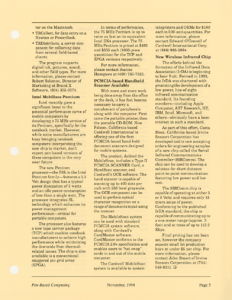
The program supports digital ink, pictures, sound, and other field types. For more information, please contact Robert Solomon, Director of Marketing at Brand X Software, (804) 355-0374.
Intel Mobilizes Pentium
Intel recently gave a significant boost to the potential performance curve of mobile computers by developing a 75 MHz version of its Pentium, specifically for the notebook market. However, while some manufacturers are busy bringing notebook computers incorporating the new chip to market, don’t expect pen-based versions of these computers in the very near future.
The new Pentium processor—the fifth in the Intel Pentium family—features a 3.3 Volt design that has a typical power dissipation of 3 watts and an idle power consumption of less than a single watt. The processor integrates SL technology which enhances its power management performance—critical for portable computers.
The processor also features a new tape carrier package (TCP) which enables notebook manufacturers to achieve high performance while minimizing the downside from thermal-related issues. The chip is also available in a conventional staggered pin grid array (SPGA).
In terms of performance, the 75 MHz Pentium is up to twice as fast as its equivalent Intel DX4 processor. The 75 MHz Pentium is priced at $495 and $535 each (1000-piece quantities) for the TCP and SPGA versions respectively.
For more information, please contact Joanne Hasegawa at (408) 765-7525.
PCMCIA-based Handheld Scanner Available
With more and more work being done away from the office or the desk, it has fast become necessary to carry a complement of peripherals along with the computer. First came the portable printer, then the portable CD-ROM. Now Folsom, California-based Cardwell International is offering one of the first PCMCIA-based hand-held document scanners designed for mobile systems.
The product, dubbed the MobileScan, includes a Type II PCMCIA SCANNER Card, a HandScan scanner, and Cardwell’s OCR software. The hand scanner is capable of scanning up to 400 dots per inch with 256 level greyscale. The OCR component can be used to perform optical character recognition on a range of documents input using the scanner.
The MobileScan system can be used with standard PCMCIA system software, along with Cardwell’s CardMaster software. CardMaster conforms to the PCMCIA 2.0+ specification and enables users to “hot swap” cards in and out of the mobile computer.
The Cardwell MobileScan system is available to system integrators and OEMs for $180 each in 500-unit quantities. For more information, please contact Edward O’Connell of Cardwell International Corp. at (916) 985-1884.
New Wireless Infrared Chip
The efforts behind the formation of the Infrared Data Association (IrDA) is beginning to bear fruit. Formed in 1993, the IrDA was chartered with promoting the development of a low power, line-of-sight infrared communication standard. Its founding members—including Apple Computer, AST Research, HP, IBM, Intel, Microsoft, and others—obviously have a keen interest in such a standard.
As part of this effort, Costa Mesa, California-based Irvine Sensors Corporation has developed and is now accepting orders for engineering samples of a new chip called the Serial Infrared Communications Controller (SIRComm). The chip can be used to develop a solution for short distance point-to-point communication featuring low power and low cost.
The SIRComm chip is capable of operating at either 3 or 5 Volts and requires only 15 micro amps of power. Conforming to the published IrDA standard, the chip is capable of communicating up to a one meter range (approx. 3 feet) and at rates of up to 115.2 Kbps.
Final pricing has not been set, however the company expects small lot production buys at under $5 per chip. For more information, please contact John Stuart of Irvine Sensors Corporation at (714) 549-8211.
Transcribed from Pen-Based Computing, Volume 4, Number 9 — November 1994. Pages 4, 5.