
Sony’s Magical Tour de Force
From the Original Pages
Click a page to enlarge · Alt-click to open the full issue
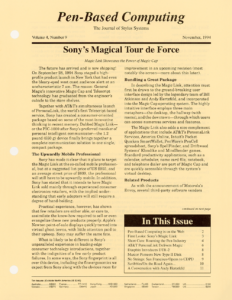
Magic Link Showcases the Power of Magic Cap
The future has arrived and is now shipping! On September 28, 1994 Sony staged a high-profile product launch in New York that had even the bleary-eyed west coast audience alert at an uncharacteristic 7 am. The reason: General Magic’s innovative Magic Cap and Telescript technology has graduated from the engineer’s cubicle to the store shelves.
Together with AT&T’s simultaneous launch of PersonaLink, the world’s first Telescript-based service, Sony has created a consumer-oriented package based on some of the most innovative thinking in recent memory. Dubbed Magic Link—or the PIC-1000 after Sony’s preferred moniker of personal intelligent communicator—the 1.2 pound (550 g) device finally brings together a complete communication solution in one single, compact package.
The Upwardly Mobile Professional
Sony has made it clear that it plans to target the Magic Link at the so-called mobile professional, but at a suggested list price of US $955, and an average street price of $899, the professional will still have to be upwardly mobile. In addition, Sony has stated that it intends to have Magic Link sold mainly through experienced consumer electronics retailers, with the implied understanding that early adopters will still require a degree of hand-holding.
Practical experience, however, has shown that few retailers are either able, or care to, assimilate the know-how required to sell or even evangelize these new products properly. Apple’s Newton point-of-sale displays quickly turned into virtual ghost towns, with little attention paid to their upkeep. Sony may suffer the same fate.
What is likely to be different is Sony’s unparalleled experience in leading-edge consumer technology introductions, together with the indignities of a few early product failures. In some ways, the Sony fingerprint is all over this device, including the fine ergonomics we expect from Sony along with the obvious room for improvement in an upcoming revision (most notably the screen—more about this later).
Bundling a Great Package
In describing the Magic Link, attention must first be drawn to the ground-breaking user interface design led by the legendary team of Bill Atkinson and Andy Hertzfeld, and incorporated into the Magic Cap operating system. The highly intuitive interface employs three main metaphors—the desktop, the hallway (with rooms), and the downtown—through which users can access numerous services and features.
The Magic Link also adds a nice complement of applications that include AT&T’s PersonaLink Services, America Online, Intuit’s Pocket Quicken SmartWallet, PenWare’s PenCell spreadsheet, Sony’s SpellFinder, and Driftwood Systems’ Klondike and MindBender games. Standard productivity applications, such as a calendar, scheduler, name card file, notebook, and telephone dialer are part of Magic Cap and are quickly accessible through the system’s virtual desktop.
Related Products
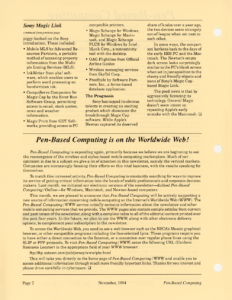
As with the announcement of Motorola’s Envoy, several third-party software vendors piggy-backed on the Sony introduction. These included:
- Mobile MLS by Advanced Resources Partners, a portable method of accessing property information from the Multiple Listing Services (MLS).
- InkWriter from aha! software, which enables users to perform word processing on handwritten ink.
- CompuServe Companion for Magic Cap by the River Run Software Group, permitting access to email, stock quotes, news and weather information.
- Magic Print from GDT Softworks, providing access to PC compatible printers.
- Magic Xchange for Windows, Magic Xchange for Macintosh, and Magic Xchange PLUS for Windows by IntelliLink Corp., a connectivity tool with the desktop.
- OAG Flightline from Official Airline Guides
- Wireless messaging services from SkyTel Corp.
- FreeStyle by Software Partners, Inc., a forms-based database application.
The Prognosis
Sony has tapped its obvious talents in creating an exciting product which showcases the breakthrough Magic Cap software. While Apple’s Newton captured the lion’s share of kudos over a year ago, the two devices seem strangely out-of-league when set next to each other.
In some ways, the comparison harkens back to the days of the early IBM PC and the Macintosh. The Newton’s empty dark screen looks surprisingly similar to the PC’s blank screen when set in juxtaposition to the cheery and friendly objects and icons of Sony’s Magic Cap-based Magic Link.
The good news is that by aggressively licensing its technology, General Magic doesn’t seem intent on repeating Apple’s early mistake with the Macintosh.
Transcribed from Pen-Based Computing, Volume 4, Number 9 — November 1994. Pages 1, 2.