
A Peek at General Magic’s Public Offering
From the Original Pages
Click a page to enlarge · Alt-click to open the full issue
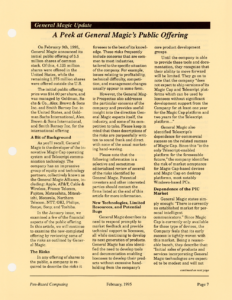
On February 9th, 1995, General Magic announced its initial public offering of 5.5 million shares of common stock. Of this, 4.125 million shares were offered in the United States, while the remaining 1.375 million shares were offered outside the U.S.
The initial public offering price was $14.00 per share, and was managed by Goldman, Sachs & Co., Alex. Brown & Sons Inc., and Smith Barney Inc. in the United States, and Goldman Sachs International, Alex. Brown & Sons International, and Smith Barney Inc. for the international offering.
A Bit of Background
As you’ll recall, General Magic is the developer of the innovative Magic Cap operating system and Telescript communication technology. The company has an impressive group of equity and technology partners, collectively known as the General Magic Alliance, including: Apple, AT&T, Cable & Wireless, France Telecom, Fujitsu, Matsushita, Mitsubishi, Motorola, Northern Telecom, NTT, OKI, Philips, Sanyo, Sony, and Toshiba.
In the January issue, we examined a few of the financial aspects of the public offering. In this article, we will continue to examine the now-completed offering by reviewing some of the risks as outlined by General Magic.
The Risks
In any offering of shares to the public, a company is required to describe the risks it foresees to the best of its knowledge. These risks frequently include concerns that are common to most industries, tailored to the specific situation of the company. For example, issues relating to profitability, technical difficulty, competition, and management changes usually appear in some form.
However, the General Magic Prospectus also addresses the particular concerns of the company and provides useful insight into the direction General Magic expects itself, the industry, and some of its competition to take. Please keep in mind that these descriptions of the risks are purposefully written to sound frank and direct with none of the usual marketing hand-waving.
Please note that the following information is a selective and sometimes editorialized review of several of the risks identified by General Magic. Potential investors and other interested parties should contact the firms listed at the end of this article for more information.
New Technologies, Limited Resources, and Potential Bugs
General Magic describes its need to respond promptly to market feedback and provide technical support to licensees, all while continuing to develop its next generation of products. General Magic has also identified the need to develop tools and documentation enabling licensees to develop their products without excessive handholding from the company’s core product development groups.
Until the company is able to provide these tools and documentation, they recognize that their ability to move forward will be limited. They go on to note that the company “does not expect to ship versions of its Magic Cap and Telescript platforms which can be used by licensees without significant development support from the Company for at least one year for the Magic Cap platform and two years for the Telescript platform…”
General Magic also identified Telescript’s dependence for commercial success on the related success of Magic Cap. Since this “is the only Telescript-enabled platform for the foreseeable future,” the company identifies the risk of market acceptance for Magic Cap-based devices and Magic Cap on desktop platforms, most notably Windows-based PCs.
Dependence of the PIC Market
General Magic states simply enough: “There is currently no established market for personal intelligent communicators.” Since Magic Cap is currently only available for these type of devices, the Company feels that its early success is tightly-woven with this market. Being a reasonable bunch, they describe that: “Initial sales of products and services incorporating General Magic technologies are expected to be modest and will not provide sufficient revenue for the Company to fund its development efforts or achieve profitability for at least several years.”
Of course, this is the message that Marc Porat, president and CEO of General Magic, has been presenting all along, eloquently encompassed in any of his various “generational view” speeches.
Dependence on Magic Cap for Windows
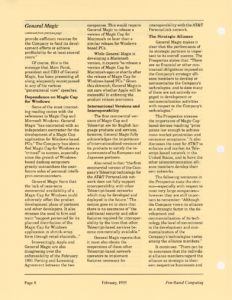
Some of the most interesting reading comes with the references to Magic Cap and Microsoft Windows. General Magic “has contracted with an independent contractor for the development of a Magic Cap application for Windows-based PCs.” The Company has identified Magic Cap for Windows as “critical” to success, especially since the growth of Windows-based desktop computers greatly outnumbers the near-future sales of personal intelligent communicators.
General Magic fears that the lack of near-term commercial availability of a Magic Cap for Windows could adversely affect the product development plans of partners and other developers. It also stresses the need to hire and train “support personnel for its planned distribution of the Magic Cap for Windows application in shrink-wrap form through retail channels…”
Interestingly, Apple and General Magic are also disagreeing over the enforceability of the February 1991 Porting and Licensing Agreement between the two companies. This would require General Magic to release a version of Magic Cap for Macintosh no later than a similar release for Windows-based PCs.
While General Magic is developing a Macintosh version, it expects “to release a version of Magic Cap for Macintosh upon or shortly after the release of Magic Cap for Windows-based PCs.” Given this skirmish, General Magic is not sure whether Apple will be successful in enforcing the product release provisions.
International Versions and Interoperability
The first commercial versions of Magic Cap and Telescript are for English language products and services, however, General Magic fully acknowledges the importance of internationalized versions of its products to satisfy the requirements of its European and Japanese partners.
Also noted is that: “the first commercial version of the Company’s Telescript technology for the AT&T PersonaLink network does not fully support interoperability with other Telescript-based networks which may be developed and deployed in the future.” The section goes on to state that there is no assurance of “the additional security and other features required for interoperability by the time that other Telescript-based services become commercially available.”
General Magic reports that it must also obtain the cooperation of these other Telescript-based network operators to implement features necessary for interoperability with the AT&T PersonaLink network.
The Strategic Alliance
General Magic makes it clear that the performance of its strategic partners is important to its overall success. The Prospectus states that: “There are no financial or other contractual obligations imposed on the Company’s strategic alliance members to develop or commercialize the Company’s technologies, and to date many of them are not actively engaged in development or commercialization activities with respect to the Company’s technologies.”
The Prospectus stresses the importance of Magic Cap-based devices reaching “price points low enough to achieve mass market penetration and consumer acceptance.” It also discusses the need for AT&T to enhance and market its Telescript-based network in the United States, and to have the other telecommunication alliance members develop their own networks.
The following sentences of the Prospectus state the obvious—especially with respect to most very large companies—however they are still important to remember: “Although the Company views its alliance as a strategic factor in the development and commercialization of its technology, the level of commitment to the development and commercialization of the Company’s technologies varies among the alliance members.”
It continues: “There can be no assurance that the individual alliance members regard the alliance as strategic to their own respective businesses and operations or that they will not reassess their commitment to the Company at any time in the future.” General Magic acknowledges that several of the alliance members are, to varying degrees, in competition with products from the Company and, plainly put, could conceivably jump ship if things go bad.
Application and Service Developers
It’s no surprise that General Magic identifies the need for third-party application and service developers as key to the adoption and success of Telescript. It also acknowledges that limited resources have forced it to restrict the number of third-party developers with which it can directly work.
Realizing its importance, General Magic is developing a toolkit for electronic merchants and publishers which will enable them to develop and test communicating applications written in the Telescript language. The initial version of the Telescript Development Kit (“TDK”) is based on the first commercial release of the Telescript technology, and is intended for use by a small number of technically sophisticated developers.
Unfortunately for developers eager to get a piece of the Telescript pie, General Magic forecasts that: “Significant additional development will be required to enhance the TDK as new versions of the Telescript platform are released and to make the TDK usable by larger numbers of less-sophisticated developers.” However, they make it clear that they recognize the importance of such tools.
General Magic also describes the importance of continuing to enhance its Magic Cap Software Developer Kit (“SDK”) for the first-generation Magic Cap platform, and develop a new kit for the second generation platform.
Incompatibilities With the Second Generation
Key to any platform is the topic of user and developer migration to a new generation of the technology. The first and current generation of Magic Cap is designed to operate using Motorola’s 68000 family of processors (the 68349 specifically).
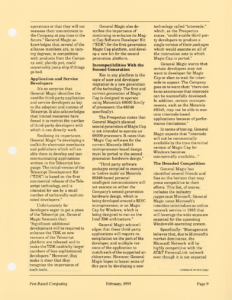
The Prospectus states that General Magic’s planned second generation of Magic Cap is not intended to operate on 68000 processors. It notes that: “Magic Cap software for the current Motorola 68349 microprocessor-based design must be ported to the second generation hardware design.”
“Third party software packages compiled to execute in ‘native mode’ on Motorola 68349-based personal intelligent communicators will not execute on either the Company’s second generation hardware design, which is being developed around a RISC microprocessor, or on Magic Cap for Windows, which is being designed to run on the Intel X86 architecture.”
General Magic acknowledges that these third-party applications will require re-compilation on the part of the developer, and multiple versions of the application to match each of the supported architectures. However, General Magic hopes to lessen some of this pain by developing a new technology called “intercode,” which, as the Prospectus states, “could enable third-party developers to produce a single version of their packages which would execute on all of the instruction sets to which Magic Cap is ported.”
General Magic warns that certain developers may not want to develop for Magic Cap or elect to wait for intercode to appear. The Company goes on to warn that: “there can be no assurances that intercode can be successfully developed. In addition, certain microprocessors, such as the Motorola 68349, may not be able to execute intercode-based applications because of performance limitations.”
In terms of timing, General Magic expects that “intercode will not be commercially available by the time the initial version of Magic Cap for Windows becomes commercially available…”
The Dreaded Competition
General Magic has identified several friends and foes on the horizon that may prove competitive to their efforts. This list, of course, includes the industry juggernaut Microsoft. General Magic notes Microsoft’s intention to introduce an online network service in 1995 that will leverage the wide exposure expected for the upcoming Windows95 operating system.
Specifically: “Management believes that, due to Microsoft’s market dominance, the Microsoft Network will be highly competitive with the AT&T PersonaLink network even though it is not expected to deploy mobile agent technology.”
General Magic also mentions an academic and industry research project named Safe-TCL. It states that: “While the Company does not believe that any of these technologies implement the key architectural features of Telescript agents, Safe-TCL is currently being proposed for commercial use in the Internet community, where it could present an alternative to Telescript as a de facto communication standard for enhanced electronic networks.”
Not to understate the situation, General Magic also states that many of its competitors expected to offer alternative products or services “have substantially greater financial resources, research and development capabilities, and sales and marketing staffs and distribution channels than the Company.”
General Magic also notes that: “several of the alliance members are in direct or indirect competition with the Company and among themselves…” Examples of these include Apple’s Newton, Motorola’s Marco and Toshiba, which has announced a relationship with Geoworks.
Getting More Information
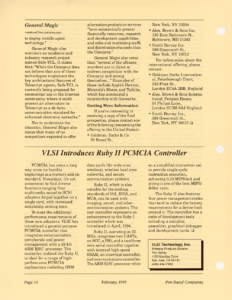
If you’re interesting in receiving a copy of the final prospectus, please contact one of the following (concerning the offering in the United States):
- Goldman, Sachs & Co. 85 Broad St., New York, NY 10004
- Alex. Brown & Sons Inc. 135 East Baltimore St., Baltimore, MD 21202
- Smith Barney Inc. 388 Greenwich St., New York, NY 10013
For information about the international offering, please contact:
- Goldman Sachs International, Peterborough Court, 133 Fleet St., London EC4A 2BB, England
- Alex. Brown & Sons International, Fengate House, 14 Philpot Lane, London EC3M 8AJ England
- Smith Barney Inc., 388 Greenwich St., New York, NY 10013
Transcribed from Pen-Based Computing, Volume 5, Number 2 — February 1995. Pages 7, 8, 9, 10.