
Roaming Around the Mobile Computing Industry
From the Original Pages
Click a page to enlarge · Alt-click to open the full issue
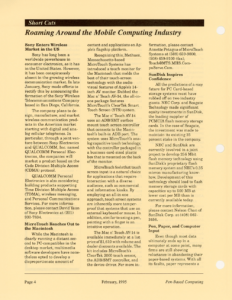
Sony Enters Wireless Market in the US
Sony has long been a worldwide powerhouse in consumer electronics, as it has in the United States. However, it has been conspicuously absent in the growing wireless communication market. In late January, Sony made efforts to rectify this by announcing the formation of the Sony Wireless Telecommunications Company based in San Diego, California.
The company plans to design, manufacture, and market wireless communication products in the American market starting with digital and analog cellular telephones. In particular, through a joint venture between Sony Electronics and QUALCOMM, Inc. named QUALCOMM Personal Electronics, the companies will market a product based on the Code Division Multiple Access (CDMA) protocol.
QUALCOMM Personal Electronics is also considering building products supporting Time Division Multiple Access (TDMA), wireless messaging, and Personal Communications Services. For more information, please contact David Yaun of Sony Electronics at (201) 930-7834.
MicroTouch Reaches Out to the Macintosh
While the Macintosh is clearly running a distant second to PC-compatibles in the desktop market, multimedia software developers have nonetheless opted to develop a disproportionate amount of content and applications on Apple’s flagship platform.
Recognizing this, Methuen, Massachusetts-based MicroTouch Systems has introduced a touch monitor for the Macintosh that melds the best of Apple’s touch-screen technology with the audio visual features of Apple’s 14-inch AV monitor. Dubbed the Mac n’ Touch AV-14, the all-in-one package features MicroTouch’s ClearTek Smart Touch Screen (STS) system.
The Mac n’ Touch AV-14 uses an ADB/SMT surface mount touch screen controller that connects to the Macintosh’s built-in ADB port. The system uses MicroTouch’s analog capacitive touch technology, with the controller packaged in a business card-sized plastic box that is mounted on the back of the monitor.
MicroTouch feels that touch screen input is a natural choice for applications that require interaction with a diverse audience, such as commercial and information kiosks. By employing an all-in-one approach, touch screen systems are inherently more tamperproof that systems that use an external keyboard or mouse. In addition, similar to using a pen, pointing with a finger is an intuitive operation.
The Mac n’ Touch AV-14 is available immediately at a list price of $1,610 with volume and dealer discounts available. The kit includes MicroTouch’s ClearTek 2000 touch sensor, the ADB/SMT controller, and the device driver. For more information, please contact Annette Petagna of MicroTouch Systems at (508) 659-9000, (508) 659-9100 (fax), [email protected].
SunDisk Inspires Confidence
All the predictions of a rosy future for PC Card-based storage systems must have rubbed off on two industry giants. NEC Corp. and Seagate Technology made significant equity investments in SunDisk, the leading supplier of PCMCIA flash memory storage cards. In the case of Seagate, the investment was made to maintain its existing 25 percent stake in the company.
NEC and SunDisk are currently involved in a joint project to develop 256 Mbit flash memory technology using SunDisk’s proprietary flash memory system and NEC’s 0.35 micron manufacturing know-how. Development of this technology should lead to flash memory storage cards with capacities up to 500 MB at lower cost per MB than is currently available today.
For more information, please contact Nelson Chan of SunDisk Corp. at (408) 562-3456.
Pen, Paper, and Computer Input
Even though most data ultimately ends up in a computer at some point, many firms are still showing reluctance in abandoning their paper-based systems. With all its faults, paper represents a tried and true method for recording vital company information.
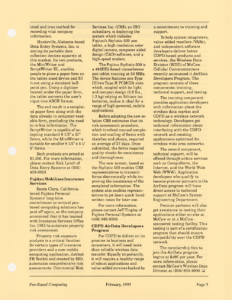
Huntsville, Alabama-based Data Entry Systems Inc. is aiming its portable data collection devices squarely at this market. Its two products, the MiniWriter and ScriptWriter XL, enables people to place a paper form on the tablet-sized device and fill it out using a standard ballpoint pen. Using a digitizer located under the paper form, the tablet converts the user’s input into ASCII format.
The end result is a completed paper form along with the data already in computer readable form, precluding the need to re-key information. The ScriptWriter is capable of accepting standard 8 1/2″ x 11″ forms, while the MiniWriter is suitable for smaller 8 1/2″ x 5 1/2″ forms.
Both products are priced at $1,395. For more information, please contact Rick Lynch of Data Entry Systems at (205) 430-3023.
Fujitsu Mobilizes Insurance Services
Santa Clara, California-based Fujitsu Personal Systems’ long-time commitment to vertical pen-based computing solutions has paid off again, as the company announced that it has teamed with Insurance Services Office Inc. (ISO) to automate property risk assessment.
Property risk exposure analysis is a critical function for certain types of insurance providers and a new mobile computing application, dubbed FR Toolkit and created by ISO, automates comprehensive risk assessments. Commercial Risk Services Inc. (CRS), an ISO subsidiary, is deploying the system which includes Fujitsu’s Stylistic 500 pen tablet, a high resolution color digital camera, computer aided design (CAD) software, and a high-speed modem.
The Fujitsu Stylistic 500 is a 486DX2-based monochrome pen tablet running at 50 MHz. The device features one Type III/two Type II PCMCIA slots which, coupled with its light and compact design (2.6 lbs., 1.2 kg) relying on lithium ion batteries, makes it ideal for a range of high-powered, mobile applications.
Before adopting the new solution CRS estimates that its risk assessment procedure, which involved manual completion and mailing of forms with sketches and photos, required an average of 27 days. Once submitted, the forms required quality checks for consistency and thoroughness.
The new system, based on the Stylistic 500 enables CRS representatives to transmit forms electronically while improving the consistency of the completed information. The system also enables representatives to jot down quick handwritten notes for later use.
For more information, please contact Jeff Tingley of Fujitsu Personal Systems at (408) 982-9500.
CDPD AirData Developers Program
For CDPD to deliver on its promise to business and consumers, it will need more than reliable wireless data transfer. Equally importantly, it will require a healthy range of robust applications and value-added services backed by a commitment to training and support.
To help system integrators, value-added resellers (VARs), and independent software developers deliver better CDPD-based products and services, the Wireless Data Division (WDD) of McCaw Cellular Communications recently announced it AirData Developers Program. The program consists of three components: training, technical support, and testing.
The training component provides application developers with information about the wireless data market and CDPD as a wireless network technology. Developers get technical information about interfacing with the CDPD network and creating applications optimized for wireless wide area networks.
The second component, technical support, will be offered through online services such as CompuServe, the Internet, and the World Wide Web (WWW). Application developers who qualify to become premier partners in the AirData program will have direct access to technical support at McCaw’s System Engineering Department.
Premier partners will also get assistance in testing their applications either on-site at McCaw or at a McCaw-sponsored testing facility. This testing is part of a certification program that should ensure compatibility over the CDPD network.
The membership fees to join the AirData program begins at $495 per year. For more information, please contact McCaw’s Wireless Data Division at (206) 803-4000.
Transcribed from Pen-Based Computing, Volume 5, Number 2 — February 1995. Pages 4, 5.