GO Corporation – PenPoint Introduction Program of Events (Handout)
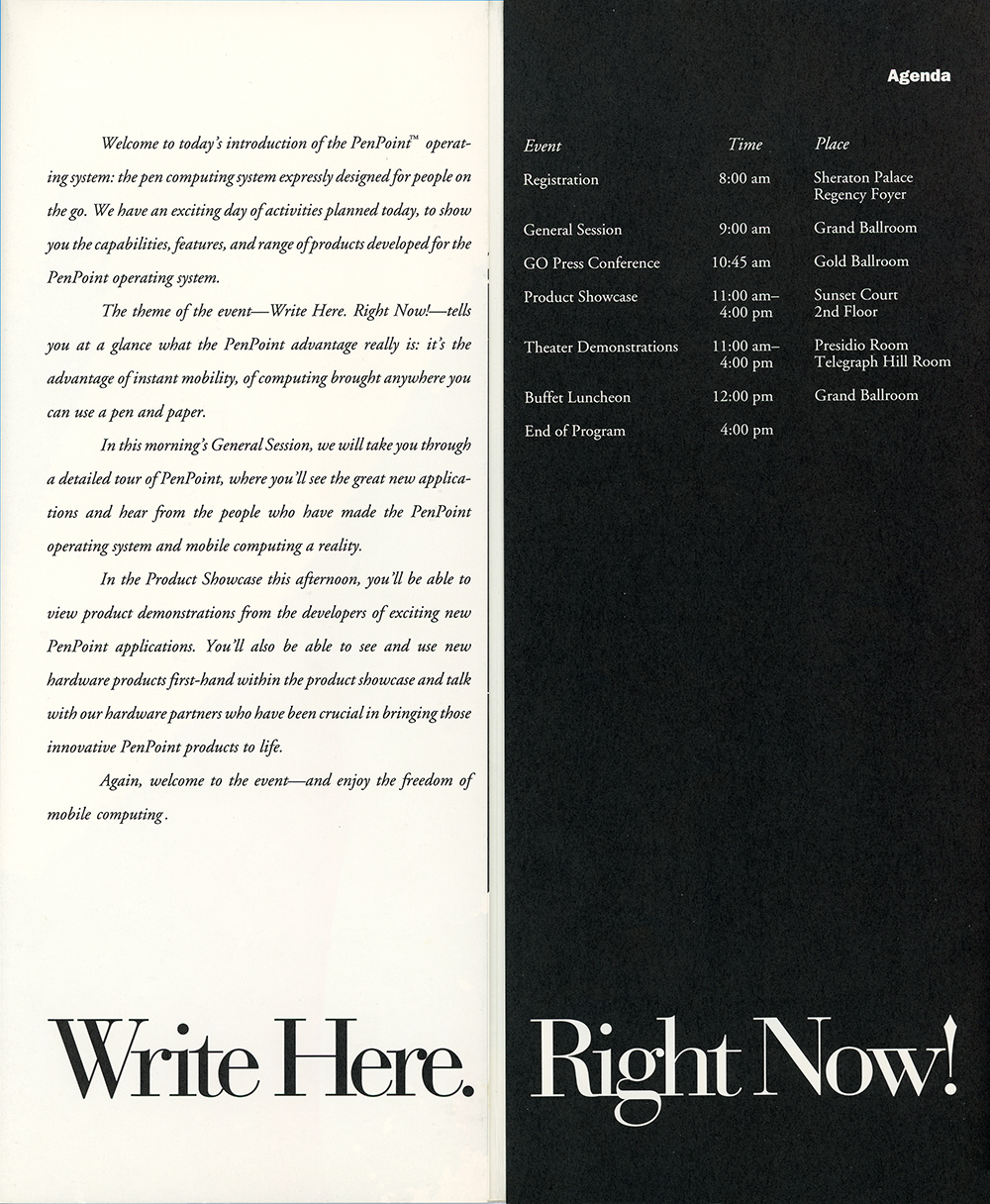
This is the original “Program of Events” for the official introduction of PenPoint at the Sheraton Palace Regency Hotel in San Francisco, California on January 22, 1991.
The program unfolds to 19″ x 23″, describing key sessions on one side and featuring a full-sized PenPoint poster on the other side.
Were you involved with this artifact? If so, we would like to include your story on this page. Let us know how you contributed.
Artifact Details
GO Corporation
United States
English
January 22, 1991
A folded program of events featuring a key to events on one side, and a full-sized PenPoint poster on the other side.
Listed events include:
- PenPoint Introduction and Keynote Speech
- Product Showcase
- Productivity Applications
- Connectivity Solutions
- Custom Solutions Alliance
- PenPoint Tools and Utilities
- Industry-Specific Solutions
- PenPoint Guided Tours
- PenPoint Customer Services
- Ask the Experts
PenPoint Hardware Partners included:
- IBM Corporation
- NCR Corporation
- GRiD Systems Corporation
4.75" x 11.5 (folded), 19" x 23" (unfolded)
1992
Acquired from developer
2018-05-14
Organizations

History
This "Program of Events" handout was distributed at GO Corporation's public introduction of the PenPoint operating system, held at the Sheraton Palace Regency Hotel in San Francisco on January 22, 1991.1 The program's welcome letter introduced PenPoint as "the pen-computing system expressly designed for people on the go" and built the day around the theme "Write Here. Right Now!"1 On the same day, GO announced the February developer release of PenPoint, which it described as the only general-purpose operating system designed for mobile computers operated by a pen instead of a keyboard or mouse.2
The agenda moved from a morning General Session through an afternoon product showcase and theater demonstrations of new PenPoint applications.1 In presenting the system, GO highlighted its central innovations, including the Notebook User Interface, in which a notebook with a table of contents serves as the operating system's organizational structure, and the Embedded Document Architecture, which let users combine different "live" data types within a single document.2 GO positioned the developer release for independent software vendors and value-added resellers, with a commercial version for end users to follow in late 1991.2
The introduction was staged as an industry event. GO announced that 40 software companies had committed to develop for or provide technology for PenPoint — 35 new firms added to the five (Borland International, Lotus Development, WordPerfect, Slate Corp., and PenSoft) named in July 1990.3 NCR Corporation announced its intent to support PenPoint on future pen-based hardware,4 GRiD Systems also announced support, and GO noted that IBM had become the first hardware manufacturer to license the technology the previous year.2 GO additionally licensed Apple's AppleTalk networking software for the new operating system.5
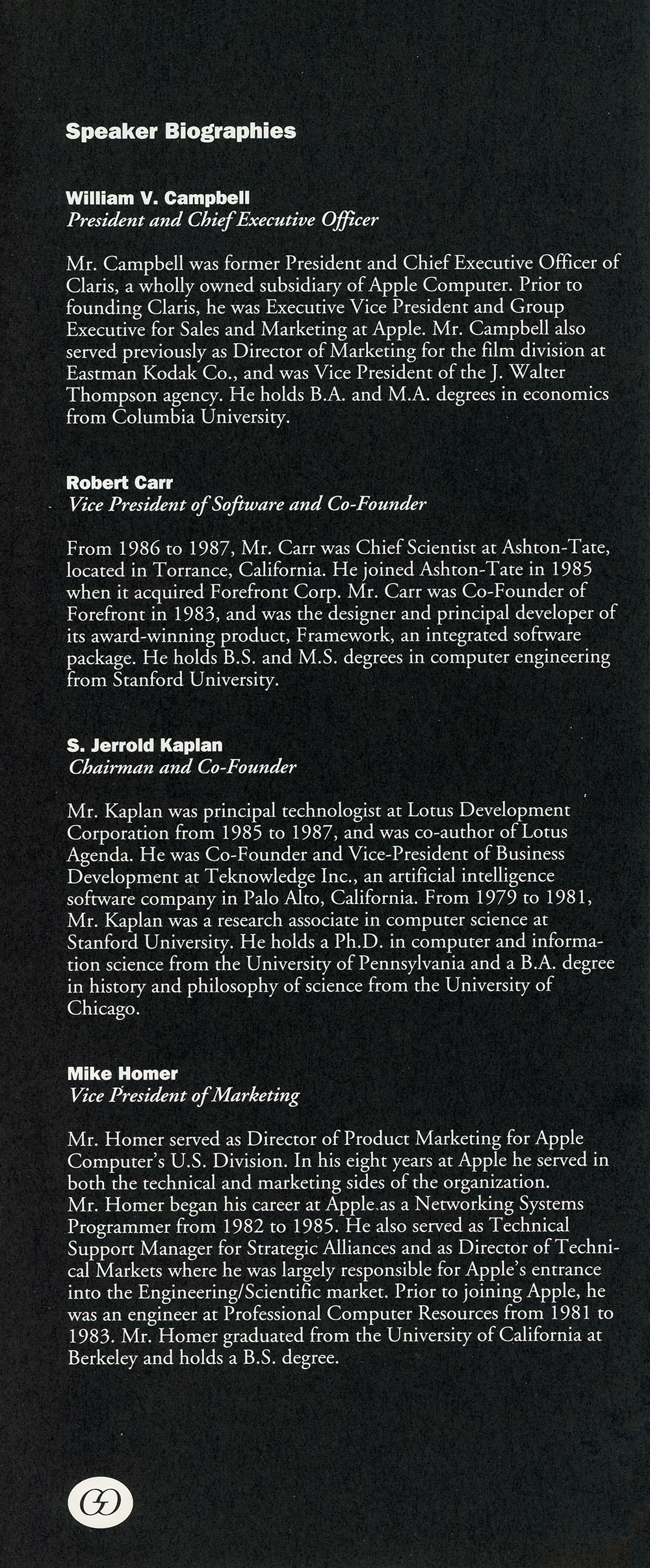
The handout's speaker biographies introduced the company's leadership: S. Jerrold Kaplan, chairman and co-founder; Robert Carr, vice president of software and co-founder; and Mike Homer, vice president of marketing.6 It also listed William V. Campbell as president and chief executive officer, a post he had been named to four days earlier, on January 18, 1991, after leaving Claris, a wholly owned subsidiary of Apple Computer.7 The biographies noted that Kaplan had been principal technologist at Lotus Development Corporation and co-author of Lotus Agenda, and that Carr had been chief scientist at Ashton-Tate and the principal developer of the Framework integrated software package.6
The day's announcements drew immediate coverage: BYTE magazine made PenPoint the exclusive cover story of its February 1991 issue, part of its State of the Art feature on future laptops.8
AI generated using primary sources referenced in the footnotes
Footnotes
- GO Corporation, GO Corporation - PenPoint Introduction Program of Events (Handout) (image scan), January 22, 1991
- GO Corporation, GO Announces PenPoint Operating System for Mobile Pen-Based Computing, January 22, 1991
- GO Corporation, GO Corp. Announces 40 Third-Party Developers and Technology Providers, January 22, 1991
- NCR Corporation, NCR Announces Intent to Support GO PenPoint, January 22, 1991
- GO Corporation, GO Licenses AppleTalk Networking Software for its New Operating System, January 22, 1991
- GO Corporation, GO Corporation - PenPoint Introduction Program of Events (Handout) (image scan), January 22, 1991
- GO Corporation, Bill Campbell Named President and Chief Executive Officer of GO Corp., January 18, 1991
- BYTE Magazine, BYTE Breaks Full Story in February Issue on Revolutionary New Pen-Based Operating System from GO Corp., January 23, 1991
Oral History
Events Leading to the PenPoint Introduction
Jerry Kaplan, writing in his highly-informative and equally entertaining book Startup: A Silicon Valley Adventure describes how the official, January 22, 1991 PenPoint introduction came about.
By late October, a rumor was circulating in the company kitchen that our engineering schedules were going to be delayed again, possibly into 1991. This had become the midlevel technical managers’ standard technique of gauging the reaction to a schedule slip before actually proposing it. GO was rapidly gaining a reputation as a purveyor of “vaporware,” the industry’s term for products that are promised but never delivered.
I had to take some action or we were never going to get a product out. So I called a meeting of the relevant managers: product marketing, quality assurance, documentation, operating systems, applications, technical support, hardware engineering, manufacturing, and public relations. “It’s been three months since the IBM announcement, and all I hear on the phone is ‘When are we going to see a product?’ We can’t hold out on nothing but promises much longer. It’s time to set a product launch date.” I could see everyone freeze.
“Carol, what do you think?” I already knew what she thought. She spent much of her time fielding calls from journalists who teased her with information about our potential competitors. Her voice was strained and tense. “We just got word that Microsoft is going to announce in February that they’re planning some pen extensions to Windows. We can’t let them steal our thunder. We have to announce in January.”
I was hoping to build a consensus, but instead a revolt broke out. The operating system wouldn’t have enough test time. The application developers’ documentation, which had grown like a cancer to several thousand pages, wouldn’t be finished. There was no guarantee of how many demonstration machines we could manufacture by then. Only some of the promised applications would be complete. User testing indicated that the pen computer wasn’t yet ready for sale to end-user customers, only for applications development.
“I’m glad we’re all in agreement,” I said. A nervous laugh rolled around the room. “Look, gang, it’s time to bet the company. IBM is getting antsy again; Microsoft is breathing down our neck; the investors are anxious; and our reputation is fading. We can’t afford to delay any further, period. It’s time to stand and deliver.”
Carol interrupted. “I can get the Meridien Hotel in San Francisco for January 22, but only if we make a fifty-thousand-dollar deposit now. Then we can take a redeye to Boston, where the Boston Computer Society will let us present at their January 23 meeting.” I looked around the room. Everyone’s face was white with fear, wondering if I had the nerve to make this substantial deposit to reserve the hotel.
“OK, Carol, book it. Listen people, figure out what you can get done by that date. This is it—we’re either going to make fools of ourselves or take the high ground in the coming debate.” The room was silent.
S. Jerrold Kaplan
Startup: A Silicon Valley Adventure
Houghton Mifflin Harcourt
The Premier Issue of Pen-Based Computing
The official introduction of the PenPoint operating system on January 22, 1991 served as the impetus for the release of an exciting and energetic new industry newsletter dedicated to this emerging field (also on this date).
Launched by Nicholas Baran, former west coast bureau chief for BYTE Magazine, and Jon Erickson, editor-in-chief of Dr. Dobb's Journal, Pen-Based Computing: The Journal of Stylus Systems started as a quarterly publication, expanding to a robust monthly schedule after being acquired by Volksware, Inc.
As Baran and Erickson wrote in the premier issue:
"Pen-based computing represents a convergence of the most advanced technologies in virtually every discipline of computer engineering, from objected-oriented software development to low-power flat panel displays to wireless networking and fax technology to miniaturized hard disks.
While the challenge of the 80's was to bring the power of the mainframe to the desktop, the challenge of the 90's is to bring the power of the desktop to the notebook. Pen-based computing will revolutionize the way people work on the road and on the job site much the way the personal computer revolutionized the way people work in the office. This is the challenge that we will cover in this publication."
You can read the article about the PenPoint introduction, as it appeared in the journal, here.
The complete premier issue is available here.
John Jerney
Editor and Publisher
Pen-Based Computing
Media
GO Corporation – Introducing PenPoint (1991)
GO Corporation used this video to promote the developer release of the PenPoint OS in 1991. PenPoint was one of the first operating systems designed specifically to run on mobile devices. Featuring: Dr. Norm Vincent (State Farm), Terry Conner (EDS), Phillipe Kahn (Borland), Jack Blount (Novell), David Reed (Lotus), Alan Lefkof (Grid), Vern Raburn (Slate), Dan Bricklin (Slate), and Jim Cannavino (IBM).
PenPoint Demonstration 1991
GO Corporation’s 1991 promotional video about their pen-based operating system, aimed at software developers. Includes an extensive demo by Robert Carr, architect of the operating system, where he shows the notebook metaphor, their use of gestures, the embedded document architecture, and more.
Connections
This artifact's place in the wider network of people, organizations, and artifacts. Drag to pan, scroll to zoom, and tap any node to focus its connections.