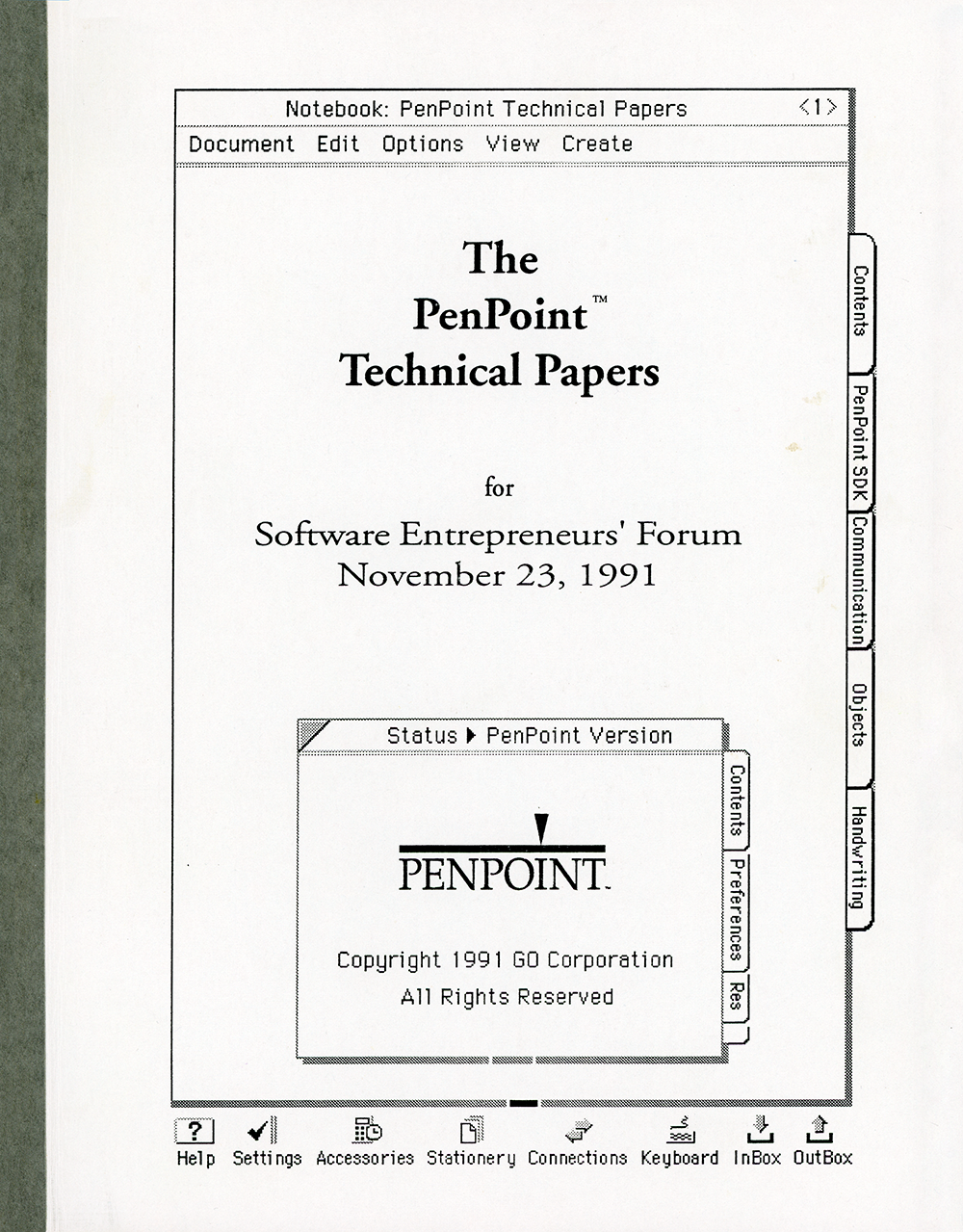
GO Corporation – The PenPoint Technical Papers
The PenPoint Technical Papers describes GO Corporation’s “unique approach to serving the needs of mobile computer users.”
The softcover, Xerox-printed document was targeted at members of the Software Entrepreneurs Forum, a Silicon Valley-based professional organization originally founded in 1983.
Were you involved with this artifact? If so, we would like to include your story on this page. Let us know how you contributed.
Artifact Details
GO Corporation
United States
English
November 23, 1991
A softcover, Xerox-printed document.
Table of Contents
- PenPoint OS
- PenPoint SDK
- Communications
- Object-Oriented OS
- Handwriting
8.5" x 11" (67 pages)
1992
Acquired from developer
2018-05-15
Organizations

Associated Products
The Vision of Mobile Computing
(Note: This introduction appeared as the first page in "The PenPoint Technical Paper.")
From mainframe to mini to workstation to PC, computers have gone from remote, mysterious objects of interest only to highly trained specialists behind glass walls, to personal productivity tools available to any reasonably handy person willing to invest some time and effort. The computer industry grows in waves, rather than through consistent, smooth expansion. Each wave exploits advances in component technologies to deliver new solutions in new formats to new users, making computers more accessible.
We are at the beginning of the next great wave of computing. Advances in hardware, software and communication make possible a new class of machine: the mobile, pen computer. These machines are operated with a pen rather than with a keyboard and a mouse.
Mobile pen computers combine the convenience of a notebook with the power of a computer. This new format - more akin to a paper notebook or clipboard than to today's PCs will once again expand the computer industry by serving new users with new uses.
The pen itself promises simplicity to the new user. It is a single, familiar tool to enter data and issue commands. Good tools fit their function so well that they are transparent to their user. The user focuses only on the result; the tool becomes a natural extension of the individual The tennis racket, the violin, and the sewing needle merge with a skilled practitioner to the point of invisibility. Some tools are more extensions of the mind than of the body; the pen is a tool for manipulating information and ideas rather than physical objects.
Future computers must be better tools. They must become extensions of ourselves, processing information and communicating when and where the need arises. To meet this challenge, computer design must break with the past and derive from the pen, rather than the typewriter. Mobile pen computers can meet the needs business professionals, students, and even consumers, by combining the power of a computer with the convenience of a pen.
The PenPoint Technical Papers contained in this document describe GO's unique approach to serving the needs of mobile computer users. We hope that you find them enlightening.
S. Jerrold Kaplan
Chairman
History
The PenPoint Technical Papers is a softcover, Xerox-printed document that GO Corporation prepared for the Software Entrepreneurs' Forum and dated November 23, 1991.1 Its cover is laid out as a page within PenPoint's own Notebook User Interface — a titled notebook with tabbed sections along the right edge for the PenPoint SDK, Communications, Objects, and Networking, and a strip of PenPoint controls (Help, Settings, Accessories, Stationery, Connections, Keyboard, InBox, OutBox) across the bottom — and it carries a 1991 GO Corporation copyright.1
GO Corporation, a privately held company headquartered in Foster City, California and founded in 1987 to develop pen-based computing technology, had unveiled its strategy for the field on July 18, 1990, announcing a pen-based operating environment available for license to hardware makers and naming IBM as its first licensee.2 On January 22, 1991, GO gave that operating environment a name, announcing PenPoint as a general-purpose operating system designed for mobile computers operated by a pen instead of a keyboard or mouse, with a developer release set for February 1991 and a commercial version to follow.3
PenPoint's design centered on a Notebook User Interface, in which a notebook with a table of contents served as the system's central organizing structure and users interacted with documents rather than with applications and files.3 It introduced an Embedded Document Architecture that let users combine live data of different types by embedding one document inside another, together with handwriting recognition and pen "gestures" such as drawing an X to delete or circling to edit.3 PenPoint was a 32-bit, fully object-oriented, multitasking operating system designed to support the Intel 80386 family.3
Third-party developers were central to PenPoint from the start: at its January 1991 announcement GO reported that 40 companies had committed to develop for or provide technology for the system, up from the five — Borland International, Lotus Development Corp., WordPerfect Corp., Slate Corp., and PenSoft Corp. — it had named in July 1990.4 By October 21, 1991, GO reported that more than 500 individuals and organizations had begun PenPoint development, and it expanded its offerings accordingly, launching a three-phase PenPoint Beta Program leading to a planned PenPoint 1.0 production release in the first quarter of 1992 and an Authorized Education Center program through which third parties could deliver PenPoint training.5 The day after that announcement, PenPoint won PC Magazine's Award for Technical Excellence in the Standards and Operating Systems category.6
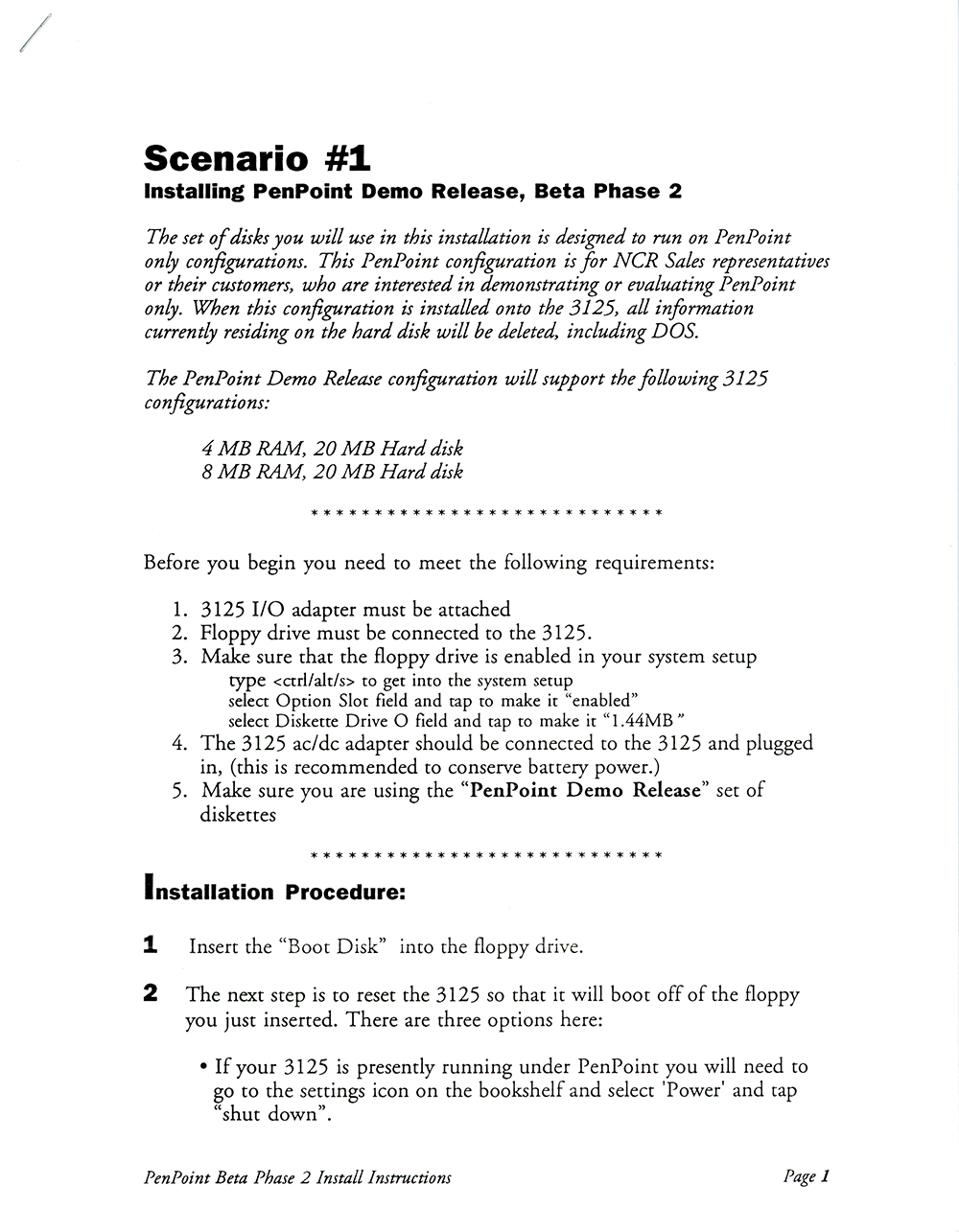
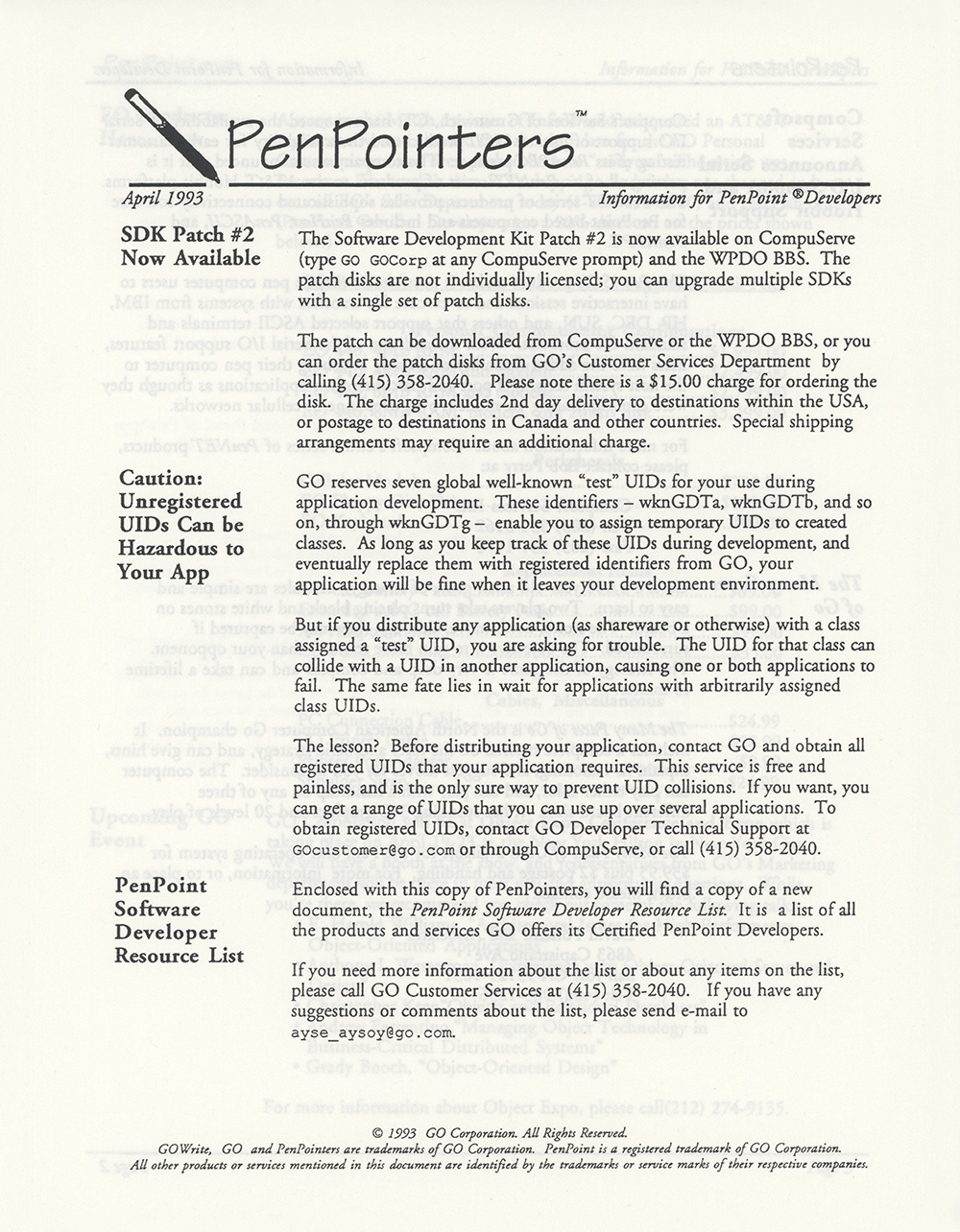
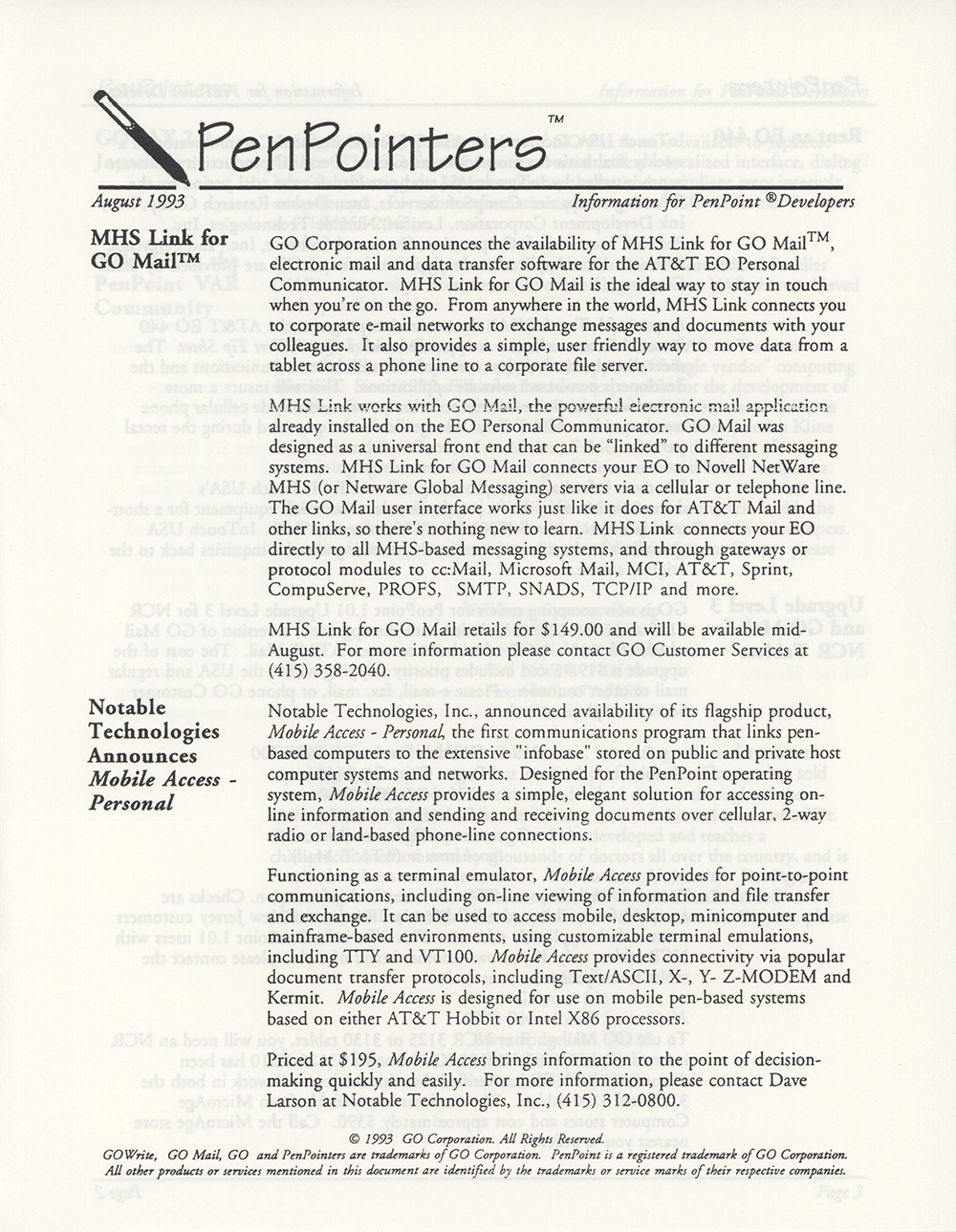
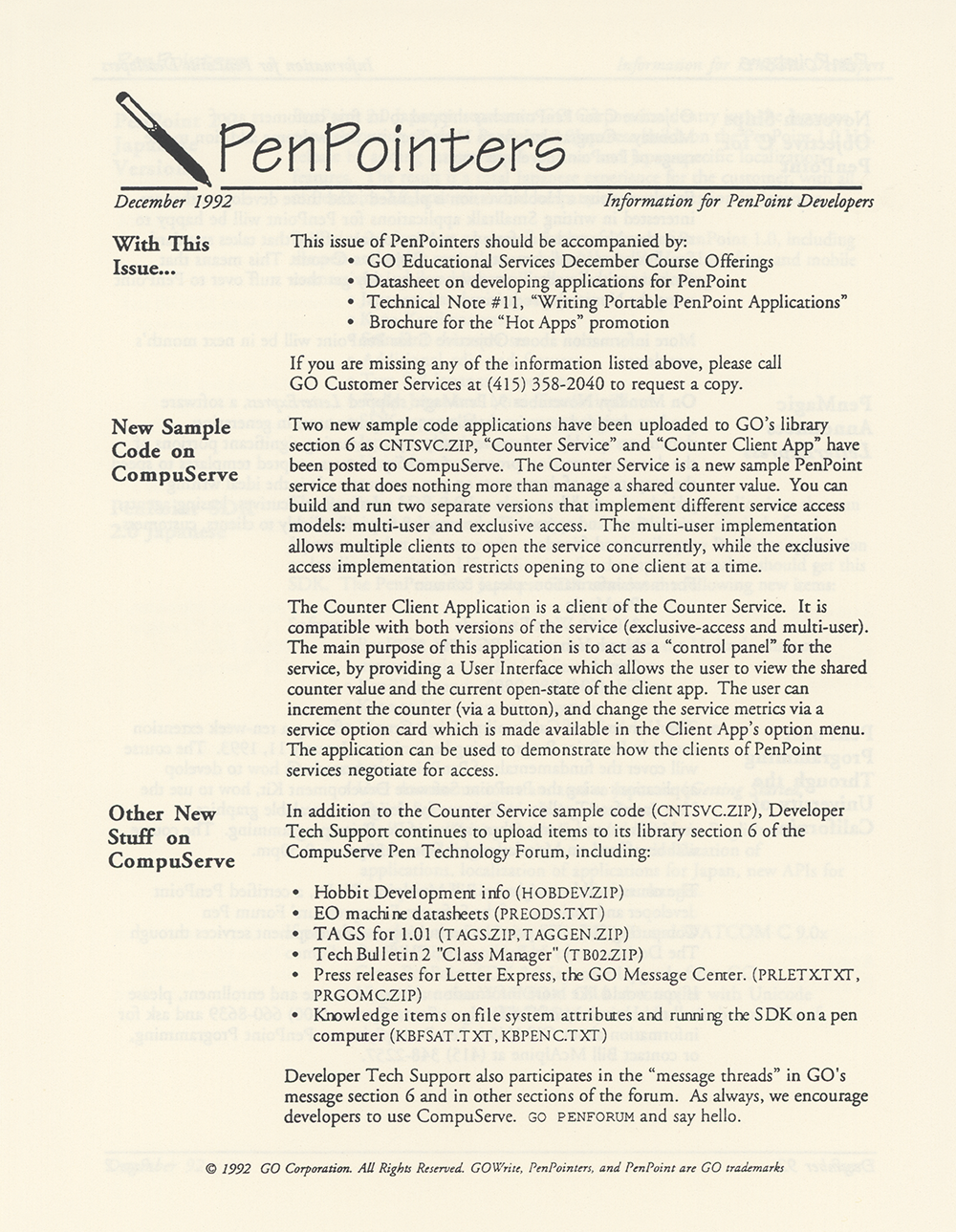
Distributed to the Software Entrepreneurs' Forum about a month after that program expansion, this document dates from the interval between PenPoint's developer release and its commercial launch.1 GO announced the commercial release of PenPoint on April 16, 1992, shipping the PenPoint Software Development Kit alongside a new handwriting engine called GOWrite.7
AI generated using primary sources referenced in the footnotes
Footnotes
- GO Corporation, GO Corporation - The PenPoint Technical Papers (image scan), November 23, 1991
- GO Corporation, GO Corp. Announces Pen-Based Operating Environment Strategy, July 18, 1990
- GO Corporation, GO Announces PenPoint Operating System for Mobile Pen-Based Computing, January 22, 1991
- GO Corporation, GO Corp. Announces 40 Third-Party Developers and Technology Providers, January 22, 1991
- GO Corporation, GO Expands Licensing, Education and Beta Programs to Accelerate Mobile Computer Market Development, October 21, 1991
- PC Magazine, PenPoint Wins PC Magazine Award for Technical Excellence, October 22, 1991
- GO Corporation, GO Corp. Announces Availability of PenPoint, April 16, 1992
Oral History
Media
GO Corporation – Introducing PenPoint (1991)
GO Corporation used this video to promote the developer release of the PenPoint OS in 1991. PenPoint was one of the first operating systems designed specifically to run on mobile devices. Featuring: Dr. Norm Vincent (State Farm), Terry Conner (EDS), Phillipe Kahn (Borland), Jack Blount (Novell), David Reed (Lotus), Alan Lefkof (Grid), Vern Raburn (Slate), Dan Bricklin (Slate), and Jim Cannavino (IBM).
PenPoint Demonstration 1991
GO Corporation’s 1991 promotional video about their pen-based operating system, aimed at software developers. Includes an extensive demo by Robert Carr, architect of the operating system, where he shows the notebook metaphor, their use of gestures, the embedded document architecture, and more.
Connections
This artifact's place in the wider network of people, organizations, and artifacts. Drag to pan, scroll to zoom, and tap any node to focus its connections.