PIE Developers – Volume 2.4 – July, 1994
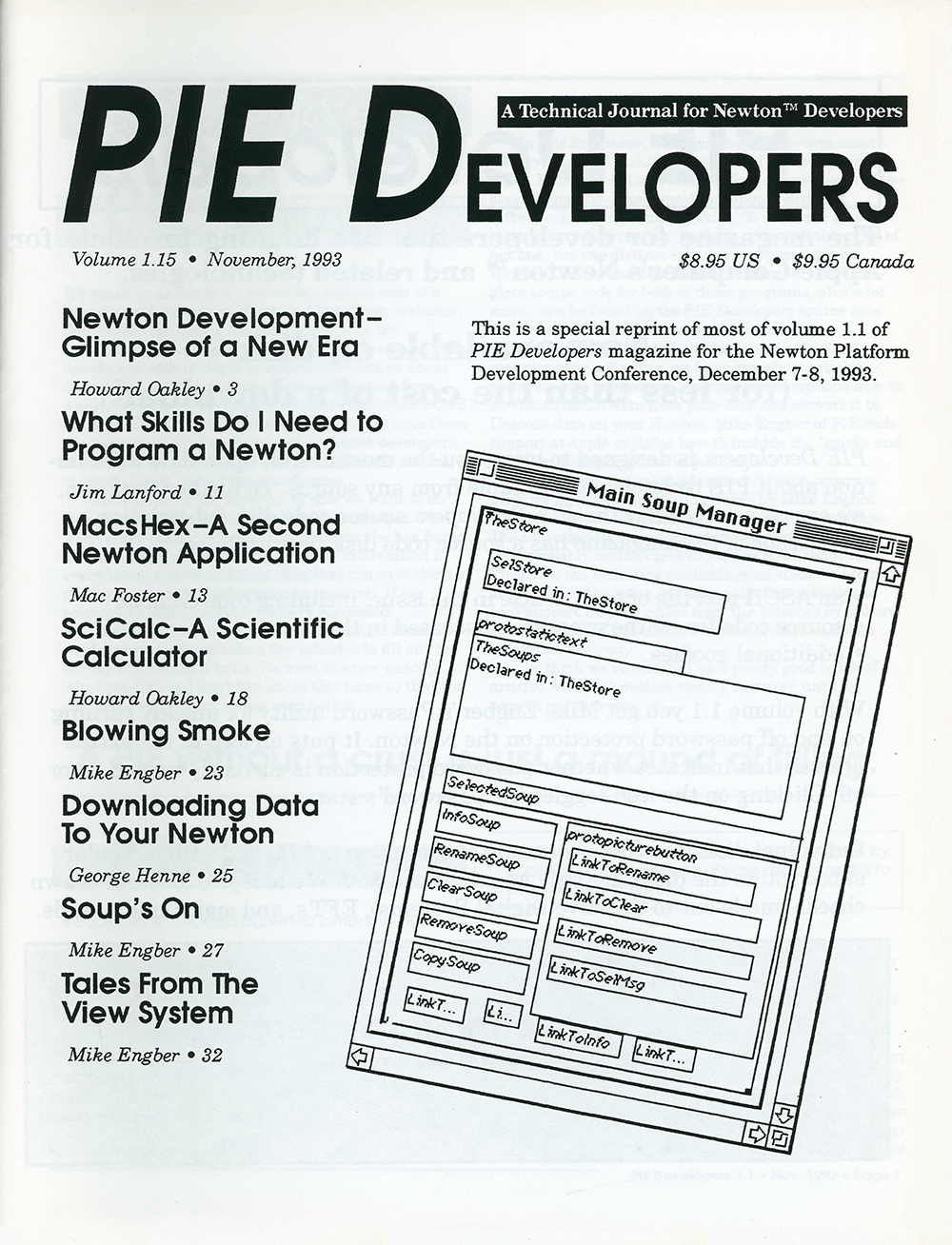
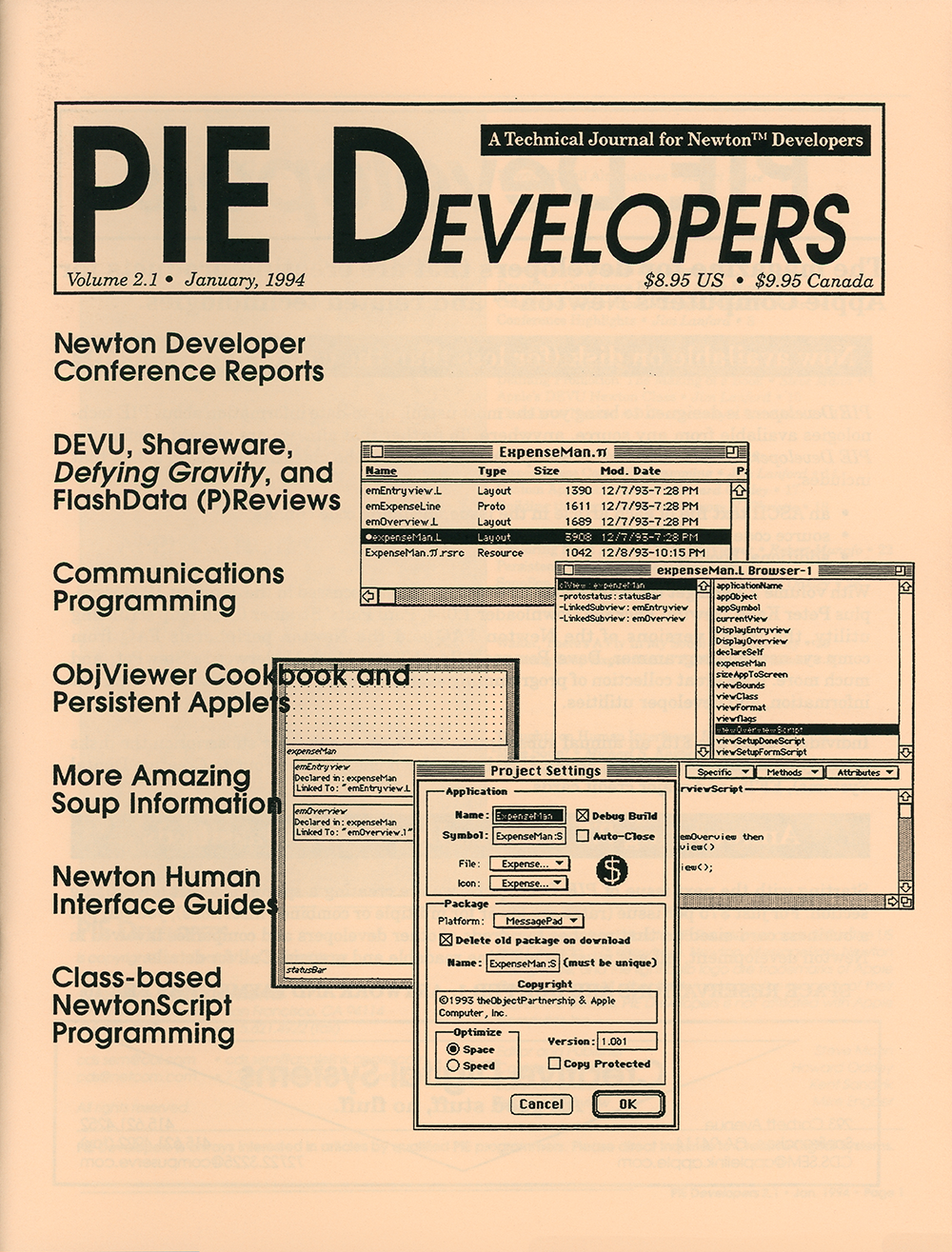
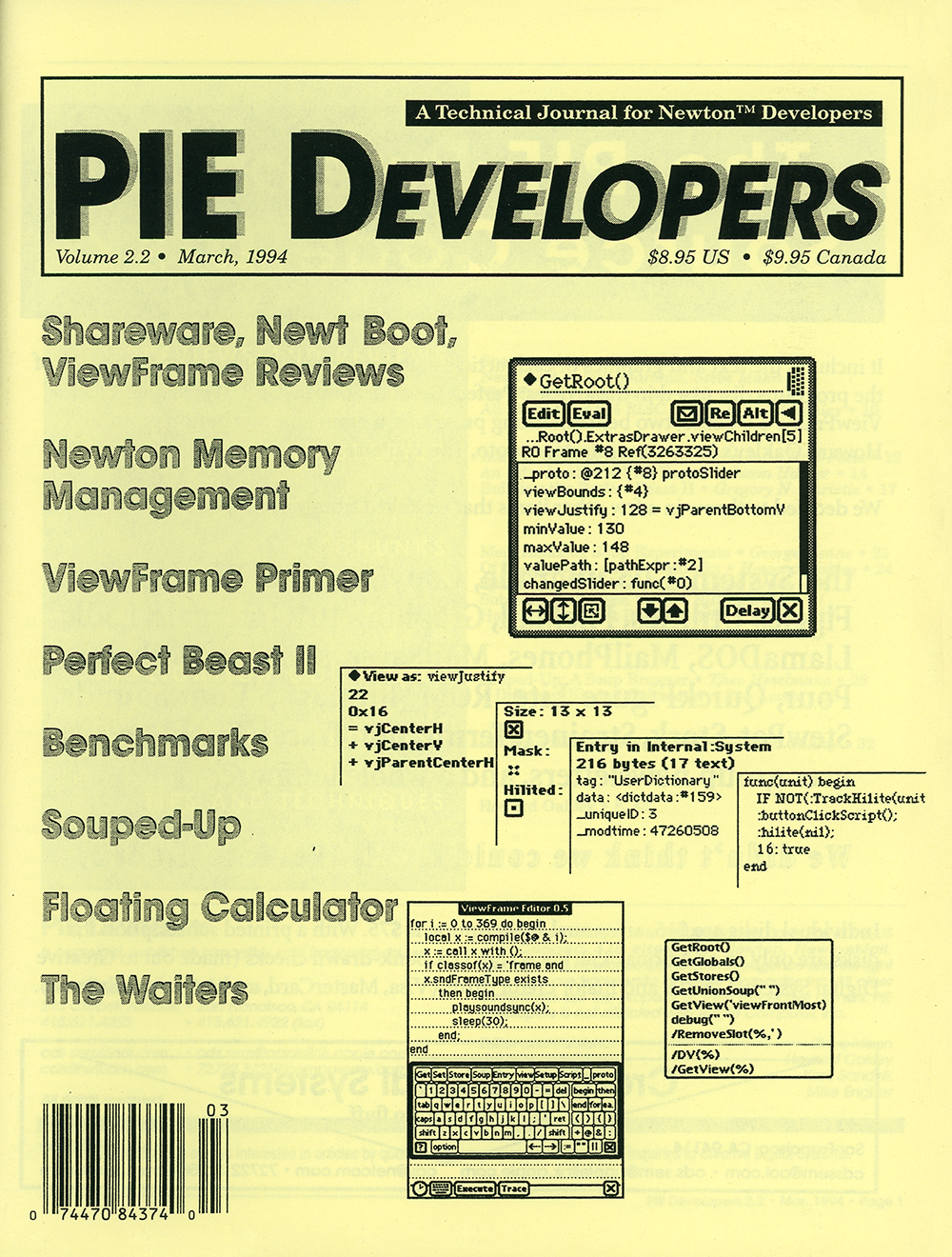
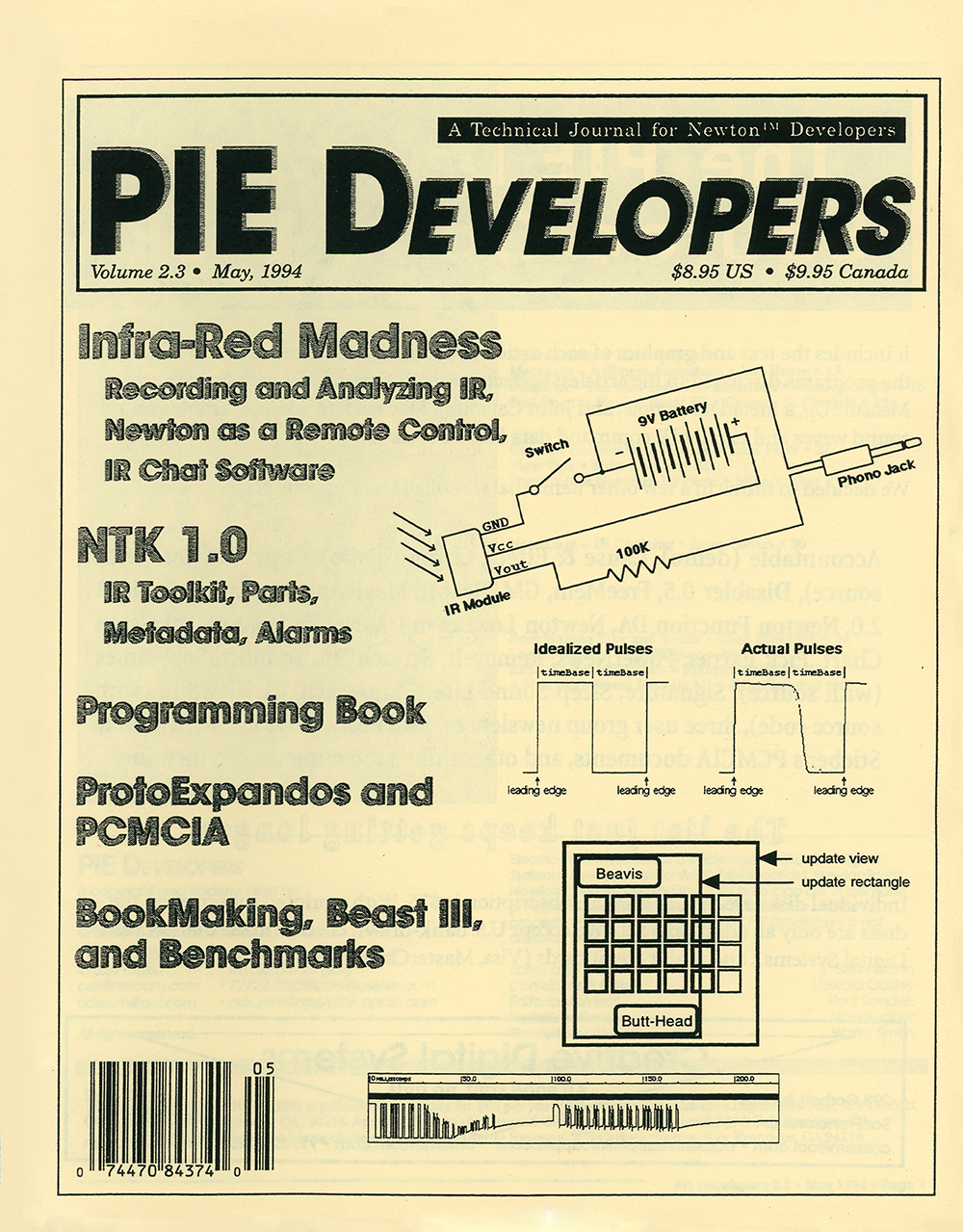
PIE Developers, later PDA Developers, was the premier, independent printed resource for PDA developers in the mid-to-late 1990s. Originally billing itself as “A Technical Journal for Newton Developers,” early issues contained detailed articles, tutorials, and coding examples focusing on the Apple Newton MessagePad platform.
Published by San Francisco-based Creative Digital Systems, the journal was expertly managed and edited by Steve Mann (who also wrote a number of articles in each issue).
Were you involved with this artifact? If so, we would like to include your story on this page. Let us know how you contributed.
Artifact Details
Creative Digital, Inc.
United States
English
July, 1994
$8.95 US, $9.95 Canada
Saddled-stitched printed journal on light-green paper.
In this issue:
- News, Yahoos, and Errata
- Previews and Reviews (Barcoding Solutions, Newt, Dyno NotePad, PDA2PC)
- Fodors Travel Manager
- Newton Coding Guidelines: Avoid the Comment-Free Zone
- Building Native Newton Applications with Newt
- A (NewtonScript) Inheritance Primer
- Building a Better Mousetrap - Improving the Print Dialog
- Keys to the Castle
- NewtRTFM: Case Study of a Runaway Newton Application
- IRTV: A Newton TV Remote Control
- Standing Out
- SELF and the Origins of NewtonScript
- SELF: The Power of Simplicity
8.5" x 11" (54 pages)
PIE Developers 2.4
July, 1994
Acquired from publisher
2018-07-21
Organizations
People

History
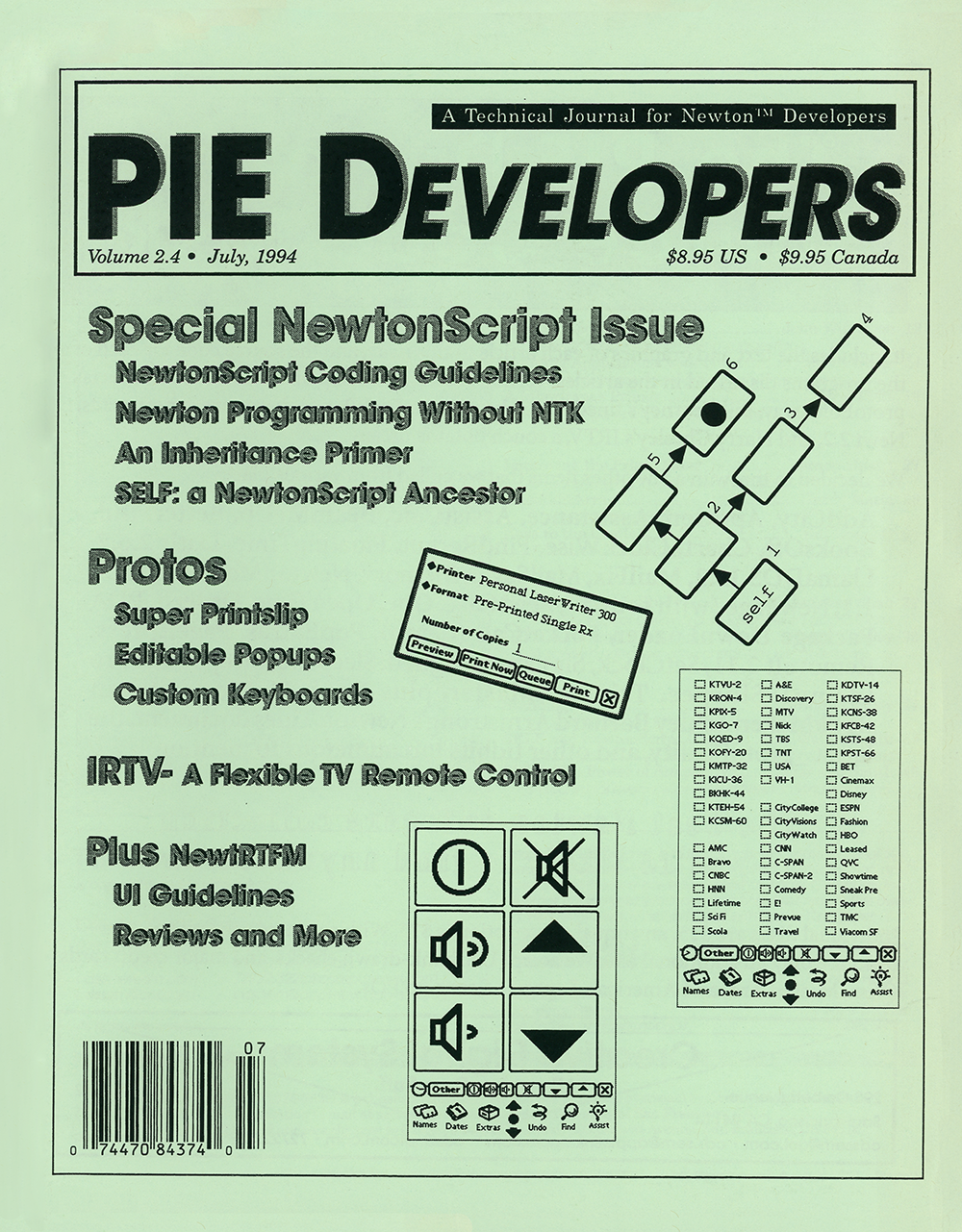
PIE Developers Volume 2.4, dated July 1994, was a technical journal for Apple Newton developers, sold for $8.95 in the United States and $9.95 in Canada.1 The cover billed it as "A Technical Journal for Newton Developers" and presented the issue as a special NewtonScript number, carrying features on NewtonScript coding guidelines, Newton programming without the Newton Toolkit (NTK), an inheritance primer, and a piece on SELF as a NewtonScript ancestor.1
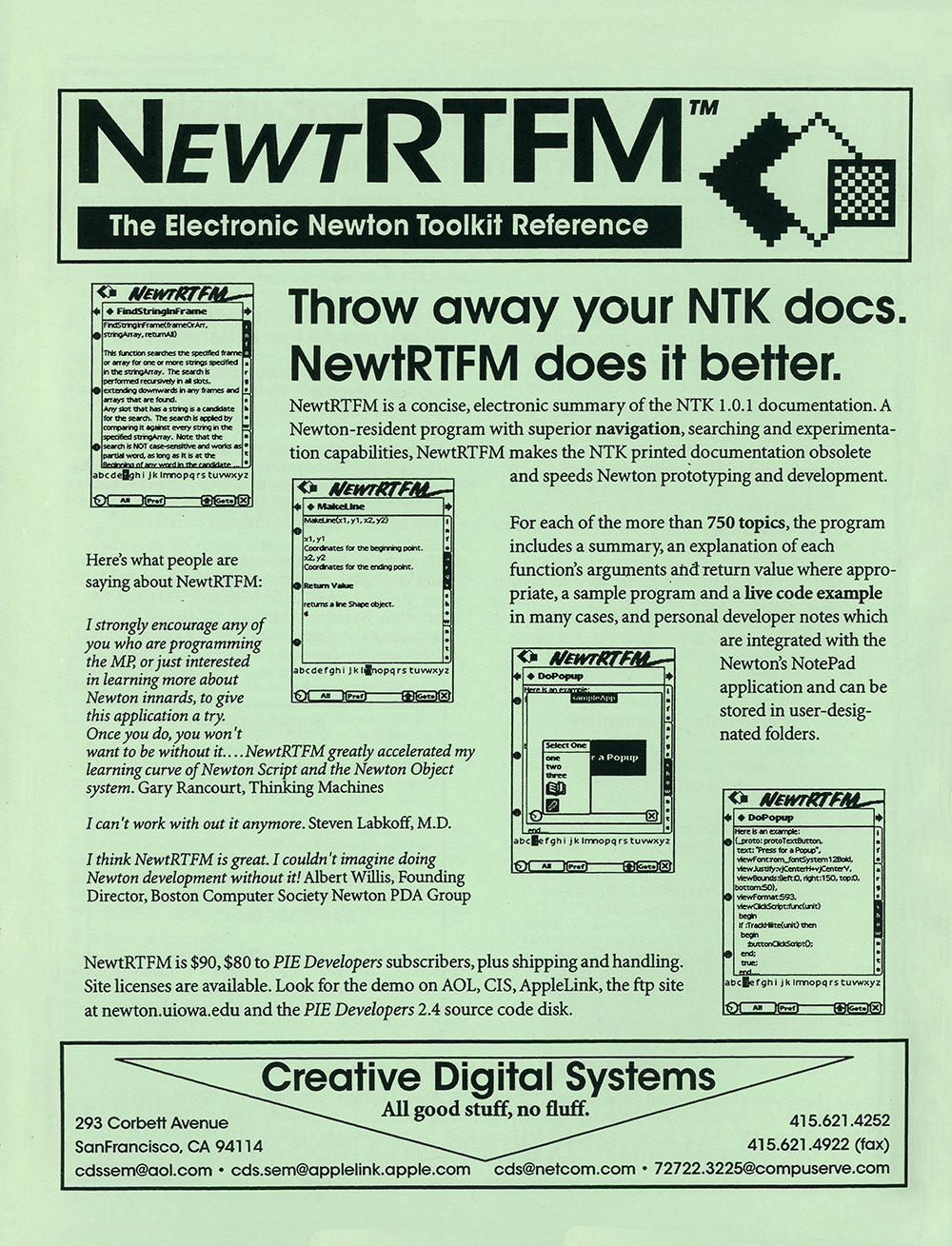
The issue also documented a set of reusable interface protos — Super Printslip, editable popups, and custom keyboards — along with IRTV, a reflective television remote control, and sections covering user-interface guidelines and product reviews.1 Its back cover carried a full-page advertisement for NewtRTFM, "The Electronic Newton Toolkit Reference," a Newton-resident electronic summary of the NTK 1.0.1 documentation that spanned more than 750 topics with function summaries, arguments, return values, and live code examples; it was priced at $90, or $80 to PIE Developers subscribers.1 The journal was published by Creative Digital Systems of 293 Corbett Avenue, San Francisco.1
The following issue, Volume 2.5 (September 1994), kept the PIE Developers logo but changed its cover banner from "A Technical Journal for Newton Developers" to "A Technical Journal for PDA Developers," and raised its price to $10.95 in the United States and $11.95 in Canada.2 Creative Digital carried the publication forward through the decade; by 1997 the company, then operating as Creative Digital Publishing Inc., had folded the former PDA Developers conference into the Handheld Systems Conference, with Steve Mann as its contact.3
AI generated using primary sources referenced in the footnotes
Footnotes
- Creative Digital, Inc., PIE Developers - Volume 2.4 - July, 1994 (image scan), July 1994
- Creative Digital, Inc., PIE Developers - Volume 2.5 - September, 1994 (image scan), September 1994
- Creative Digital Publishing Inc., Creative Digital Posts Handheld Systems Conference Final Agenda, March 17, 1997
Oral History
Connections
This artifact's place in the wider network of people, organizations, and artifacts. Drag to pan, scroll to zoom, and tap any node to focus its connections.